Track Magic Card Prices – The MTG Price Tracker for Your Portfolio
Magic: The Gathering is the oldest trading card game in the world and the very reason Cardmarket exists. But with thousands of sets, reprints, foils and variants, it is easy to lose track. Learn how to keep the price development of your Magic cards under control for the long run with an MTG price tracker.
Magic: The Gathering and the origin of Cardmarket
Magic: The Gathering (MTG) was released in 1993 and is considered the first modern trading card game ever made. It founded the entire genre and remains one of the largest and most valuable collectible card games in the world – surpassed economically only by Pokémon. Over more than three decades, thousands of cards, sets and editions have appeared, and some of the rarest examples are worth five- to six-figure sums today.
What many people don't know: Cardmarket was originally called MagicCardMarket and was founded specifically for trading Magic cards. Only later did Pokémon, Yu-Gi-Oh! and over a dozen other games join. So Magic isn't just any TCG on Cardmarket – it's the game that started it all. The market is correspondingly deep: for practically every card there are listings, historical sales and reliable pricing.
This very depth is both a blessing and a curse. Anyone building a serious Magic collection quickly juggles hundreds of different cards – each in multiple languages, conditions and variants. Cardmarket provides the prices, but it offers no overall view of your collection and no long-term portfolio analysis. This is where a dedicated MTG price tracker comes in.
💡 Good to know: Cardmarket is the largest European marketplace for collectible cards and is regarded as the European price standard – comparable to TCGPlayer in North America. For Magic collectors in Europe, Cardmarket prices are the central reference.
Understanding the Magic market: sets, reprints and variants
The Magic market is more complex than that of many other TCGs. If you want to track Magic card prices, you should know a few market-shaping factors that move the value of a card over time.
Sets, standard rotation and out-of-print
Magic comes out in regular set releases. As soon as a set is no longer reprinted, supply becomes scarcer – a classic driver of rising prices for sought-after cards. Game formats play a role here as market context: cards that are in demand in popular formats often hold their value better. Cards popular in Commander, for instance, tend to stay stable or rise, because the demand comes from a large, permanently active player base.
Reprints as a price risk
The biggest uncertainty factor with Magic is reprints. If the manufacturer prints an expensive card again in a new set or special product, supply jumps suddenly – and the price can drop significantly. For collectors and investors this means: price movements have to be watched, because a reprint can halve the value of a card within a few weeks. That is exactly why price alerts and ongoing monitoring are so valuable for a Magic portfolio.
Promos, special printings and collector vs. player demand
Besides regular cards there are countless promo cards and special printings. The price of a Magic card emerges from the interplay of two types of demand: player demand (cards needed in decks) and collector demand (rare, visually special or nostalgic cards). Some cards are expensive because they are played heavily; others because they are rare and coveted. Both effects can overlap – and both are reflected in the Cardmarket trend price.
Reading the Cardmarket trend price for Magic correctly
Before you can use a Magic price tracker effectively, you should understand how Cardmarket's trend price works – it is the metric best suited to valuing your collection.
The Cardmarket trend price
The trend price is the most important metric. It is based on a weighted average of the items actually sold most recently and filters out outliers. As a result, it reacts with a delay to short-term fluctuations and is the most realistic indicator of the current market value of a Magic card. Especially for cards whose price swings due to reprint rumors or format developments, the trend price is the most reliable point of reference.
With Magic in particular, individual cards are listed across many editions, languages and conditions. Because the trend price draws on actual recent sales and filters out outliers, it stays stable even when a single mispriced listing would otherwise distort the picture. That makes it the right value to base your portfolio on.
📊 Recommendation: For valuing your Magic portfolio you should rely on the trend price. TCGPriceTracker uses the trend price as its reference value throughout. How the trend price is calculated is also explained in our guide Cardmarket Price Tracker.
Want to track Magic prices automatically? With TCGPriceTracker you see the trend price of your entire Magic collection at a glance – updated daily straight from Cardmarket.
Foils & variants: how Borderless, Showcase and Extended move the price
Hardly any other TCG has such a wide variety of card variants as Magic. One and the same card can exist in half a dozen versions – each with its own market value. If you want to track Magic card prices, you have to know these differences, otherwise you'll value your portfolio incorrectly.
Foils: shiny and usually pricier
The foil version of a card has a shiny, holographic surface and is rarer than the regular version. On Cardmarket, foils are listed as separate items with their own price – and that price is almost always above the standard version, sometimes many times higher for coveted cards. A Magic price tracker therefore absolutely must flag foils separately, otherwise your portfolio calculates with the wrong value.
Borderless, Showcase and Extended Art
Modern Magic sets contain numerous special-frame variants:
- Borderless: cards without a classic frame, where the artwork fills the entire card – visually popular and usually traded at a premium.
- Showcase: cards with a specially designed, thematic frame that matches the set. Popular with collectors and often valued higher than the standard version.
- Extended Art: cards with extended artwork that goes beyond the normal image frame. A coveted middle ground between standard and Borderless.
Each of these variants can additionally come as a foil – the combinations multiply. For correct portfolio valuation it is therefore crucial to record the right variant. If you enter a Borderless foil as a standard card, the displayed value can be off by a multiple.
💡 Practical tip: When adding a card, always check whether it's a foil or a special variant. TCGPriceTracker flags foils separately so your portfolio reflects the actual market value – not that of the standard card.
Sealed products vs. singles: long-term investment or quick return?
A well-thought-out Magic portfolio usually consists of a mix of sealed products and single cards (singles). Both categories behave fundamentally differently on the market – and it's exactly this mix that determines risk and return.
Sealed products as a long-term investment
Sealed products – that is, unopened booster displays, bundles and collector boxes – are considered the more stable Magic investment. Once a set is no longer produced, sealed stock can no longer be replenished. Supply shrinks continuously while demand from collectors and players remains. The price development is therefore usually steadier and more predictable than with single cards. The downside: capital is tied up long term, and storage in good condition is a must.
Singles for higher short-term potential
Singles, on the other hand, can fluctuate sharply in the short term – for example when a card suddenly becomes sought after in a format or collapses due to a reprint. The profit potential is higher, but so is the risk. Anyone betting on singles has to watch the market more actively and be able to react faster.
A good MTG price tracker should support both product types and display their performance separately. That way you can tell which part of your portfolio delivers the best returns. You'll find a comprehensive guide on this in our article Trading Card Portfolio Tracker.
Sealed and singles tracked separately. TCGPriceTracker manages booster displays, bundles and single cards and calculates the ROI for each position – based on daily Cardmarket prices.
Why Excel hits its limits with a Magic portfolio
Many Magic collectors start with an Excel spreadsheet. With twenty cards that still works. But a grown Magic portfolio with singles, foils, variants and sealed products quickly outgrows a manual spreadsheet. These are the typical problems:
- No overall view: Cardmarket shows no total for your entire collection. You'd have to look up every card individually and add up all the prices manually – including the correct variant each time.
- No historical data: How has the value of your portfolio developed over the last three months? In Excel you'd have to log these values yourself – day after day.
- No ROI tracking: You paid €120 for a display – is it worth more today? Without a documented purchase price and current market value, that remains pure guesswork.
- No reprint warning: If an expensive card falls in price after a reprint, in Excel you only notice when you happen to check – often too late.
- Foil and variant chaos: Maintaining the correct variant manually is error-prone. A misassigned foil distorts the entire portfolio value.
- Time commitment: Updating manually costs hours per week – time you'd rather invest in collecting and playing.
An external Magic price tracker solves these problems. It pulls the price data automatically, assigns foils and variants correctly, calculates the total value and shows you at a glance where you stand. That way you make data-based decisions instead of going by gut feeling.
Manual tracking vs. TCGPriceTracker compared
Here is a direct comparison between manual tracking in Excel and a dedicated MTG price tracker like TCGPriceTracker:
| Feature | Excel / manual | TCGPriceTracker |
|---|---|---|
| Daily price updates | ✗ look up manually | ✓ automatic |
| Total portfolio value | ✗ calculate yourself | ✓ always current |
| ROI per card & display | ✗ maintain formulas | ✓ calculated automatically |
| Foil & variant flagging | ✗ own columns, error-prone | ✓ foil recorded separately |
| Price alerts / watchlist | ✗ not possible | ✓ email notifications |
| Sealed & singles separated | ✗ separate manually | ✓ both types supported |
| 21 TCGs incl. Magic | ✗ own research needed | ✓ preconfigured |
| Grading status (PSA, BGS) | ✗ own columns | ✓ built in |
| CSV import/export | ✓ native | ✓ supported |
| Time per week | 1–3 hours | 0 minutes |
The comparison clearly shows: beyond a certain collection size, manual tracking in Excel is no longer practical – especially with Magic and its many variants. And the best part: with TCGPriceTracker you can start right away with the free plan and try the tool with no commitment.
TCGPriceTracker: your MTG price tracker for singles & sealed
TCGPriceTracker was built for collectors and investors who want to follow their Cardmarket prices systematically – Magic players included. The tool combines Cardmarket's price data with a powerful portfolio management system. Here are the most important features at a glance:
Daily price updates from Cardmarket
All prices in your Magic portfolio are updated automatically every day from Cardmarket. You always see the current trend price – without a single click. That is the core of a real Magic price tracker: no more looking things up manually.
21 TCGs in one tool – including Magic
Whether it's Magic: The Gathering, Pokémon, Yu-Gi-Oh!, One Piece TCG, Disney Lorcana or another game – TCGPriceTracker supports all TCGs available on Cardmarket. You don't need a separate tool for each game and can manage your Magic portfolio alongside other collections in one dashboard.
Sealed & singles with foil flagging
You can record both sealed products (displays, bundles) and singles. Foils are flagged separately, so your portfolio shows the correct value and not that of the standard version. That way the total really reflects what your collection is worth.
Total portfolio value & ROI analysis
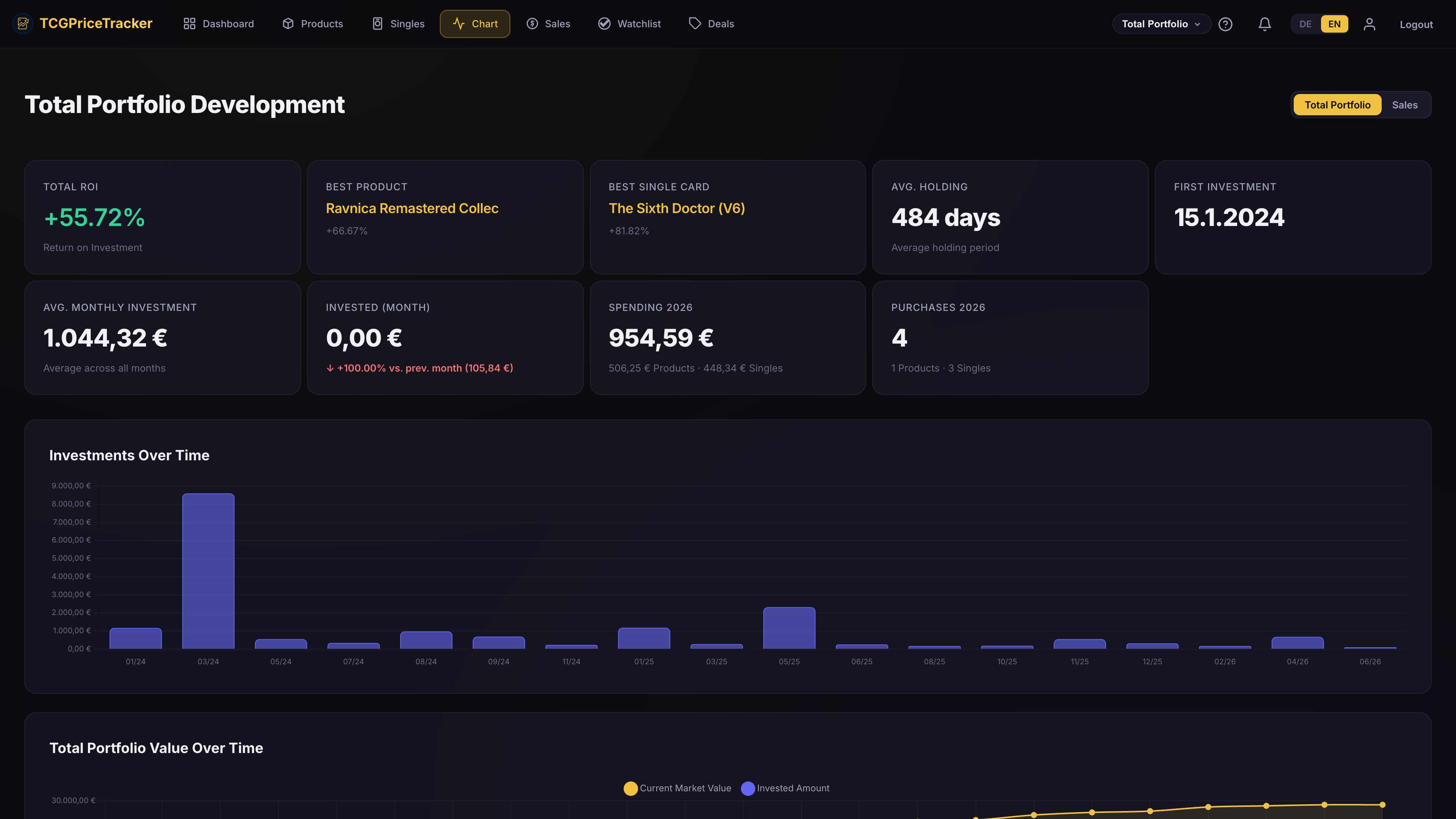
Enter your purchase price and see immediately how your investment is developing. TCGPriceTracker automatically calculates the total value of your collection as well as the ROI (return on investment) for each individual position. That way you can tell at a glance which cards and displays are paying off.
Watchlist with price alerts by email
Are you waiting for the right price – or do you want to be informed about a looming reprint drop? Put the card on your watchlist and define a target price. TCGPriceTracker notifies you by email as soon as the trend price reaches your goal. That way you never miss an opportunity again.
Grading status & CSV import/export
For graded cards you can store the grading status. And if you already have an Excel list or another collection: with the CSV import you transfer your existing Magic collection in just a few minutes. A CSV export is available to you at any time, so your data belongs to you.
Ready to stay on top of it all? Start now for free with up to 20 products, 30 singles and 10 watchlist entries. No risk, no credit card required.
Tracking Magic card prices – 5 pro tips
Using an MTG price tracker is the first step. Here's how to get the most out of it:
1. Rely on the trend price
The Cardmarket trend price reflects the real market value of a card, because it filters out outliers and short-term swings. Use it as your guide when deciding whether to buy or sell.
2. Always record the right variant
With Magic, the variant is everything. Pay close attention to whether you're recording a standard card, a foil, a Borderless or a Showcase version. A misassigned variant distorts your portfolio value – up as well as down.
3. Use price alerts against reprint risks
Set price alerts not just for cards you want to buy, but also for expensive cards in your portfolio. If a card rises sharply, it might be time to take profits. If it falls after a reprint, you want to know early. A good tracker reaches out automatically by email.
4. Document every purchase right away
The most common mistake: buying cards and not recording the purchase price. Three months later you no longer know whether you paid €15 or €25. Enter every purchase immediately – ideally right after checkout on Cardmarket.
5. Check your portfolio dashboard regularly
Take five minutes once a week for your dashboard. Which cards have risen, which have fallen? Are there patterns, for instance around upcoming set releases? Regular monitoring helps you spot trends early and act in time.
🎯 Pro tip: Combine the watchlist with your portfolio data. If a particular set keeps rising, put more cards or sealed products from it on the watchlist and buy more on price dips. TCGPriceTracker makes this strategy easy to put into practice.
Frequently asked questions about the MTG price tracker
What is an MTG price tracker?
An MTG price tracker is an external tool that automatically pulls Cardmarket price data for Magic: The Gathering and lets you follow the value development of your Magic cards and your portfolio at a glance – without having to look up every card individually. Tools like TCGPriceTracker update prices daily and additionally offer ROI calculation, a watchlist with price alerts and foil flagging.
Which Cardmarket price is most meaningful for Magic cards?
For valuing your Magic collection, the trend price is the most meaningful. It is based on a weighted average of recently sold items and filters out outliers, making it the most realistic indicator of a card's current market value.
How do foils and variants affect the price of a Magic card?
Foils and special variants such as Borderless, Showcase or Extended Art are listed on Cardmarket as separate items with their own prices. They usually sit well above the regular version – sometimes many times higher for coveted cards. A good tracker flags foils separately so your portfolio shows the correct value and not that of the standard card.
Is sealed Magic worth it compared to singles as an investment?
Sealed products such as booster displays and bundles often develop more steadily over the long term, especially for sets that go out of print. Singles offer higher short-term potential but fluctuate more – for example due to reprints or format developments. A mix of both reduces risk. The important thing is to track both types separately.
Can I manage other TCGs besides Magic with TCGPriceTracker?
Yes. TCGPriceTracker supports 21 trading card games, including Magic: The Gathering, Pokémon, Yu-Gi-Oh!, One Piece TCG, Disney Lorcana, Digimon, Dragon Ball and many more – all in a single dashboard.
Is TCGPriceTracker free to use for Magic collectors?
Yes! TCGPriceTracker offers a free plan with up to 20 products, 30 singles and 10 watchlist entries. That's plenty to get started. For more extensive Magic collections there is the Pro plan from €5.99 per month or €49.99 per year with unlimited entries.
Can I import my Magic collection into TCGPriceTracker?
Yes, the CSV import lets you transfer existing Magic collections and lists quickly. Export your data from Excel or another tool as a CSV file and upload it directly. This saves you the manual entry and lets you start price tracking right away. A CSV export is also available at any time.
How often are Magic prices updated on TCGPriceTracker?
Prices are updated automatically every day from Cardmarket. You don't have to look anything up manually – your Magic portfolio always shows the current market values based on the latest Cardmarket data. So you're always up to date, with no extra effort.
Ready to track your Magic prices?
Start now for free with TCGPriceTracker and always keep an eye on the value of your Magic collection – with daily price updates straight from Cardmarket, including foil flagging and sealed tracking.
Start for free now →