Trading Card Portfolio Tracker – Your Collection as an Investment
Pokémon, Magic, Yu-Gi-Oh! and 18 more TCGs: learn how to follow the value of your trading cards professionally, calculate your ROI and make well-founded investment decisions – with daily Cardmarket prices.
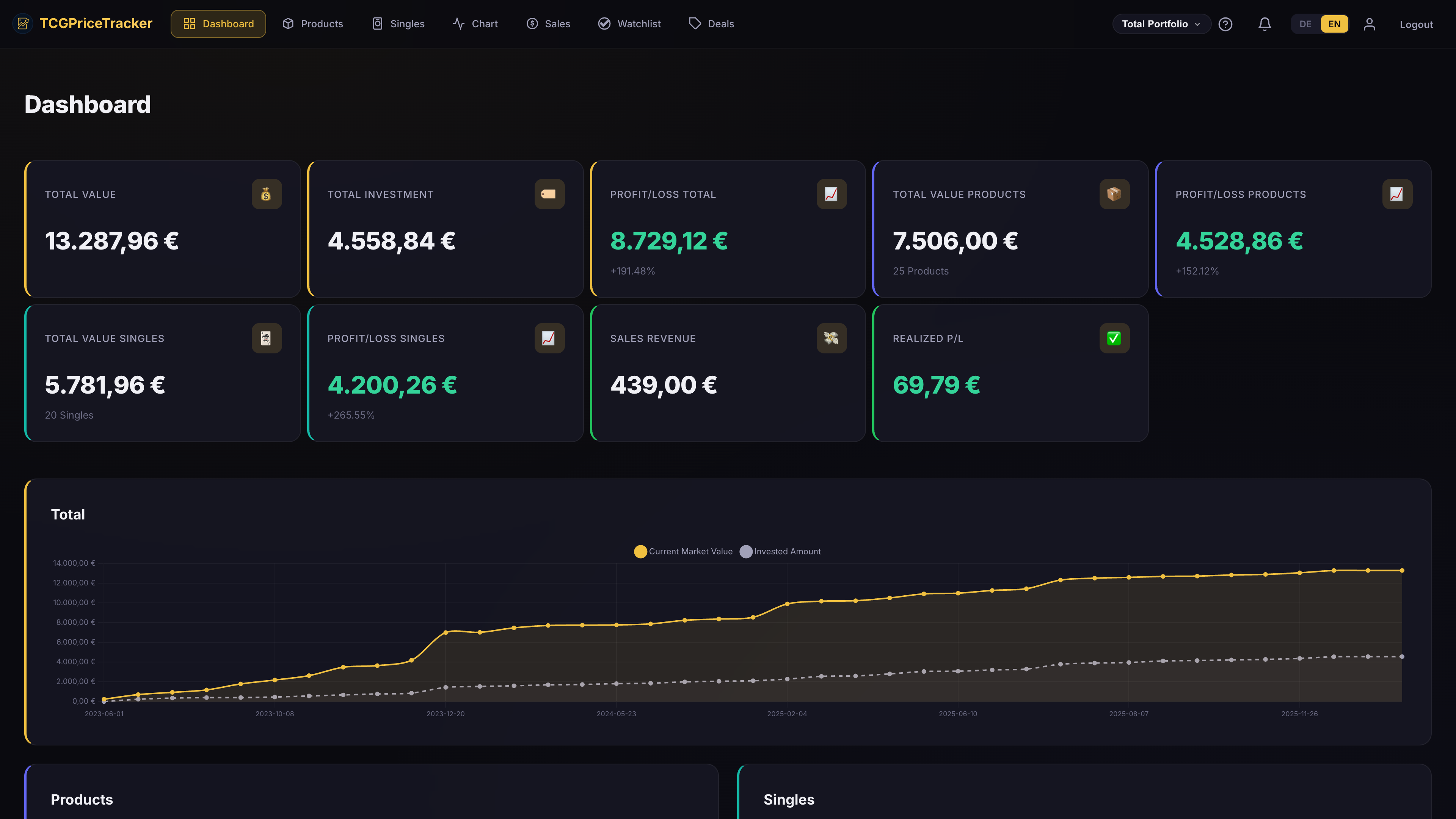
Why you should track your trading card portfolio
Trading cards have long been more than just a hobby – they have become a genuine asset class. Whether you own a sizable Pokémon collection from the 90s, invest deliberately in Magic: The Gathering staples or bet on limited Yu-Gi-Oh! editions: without systematic tracking, you have no idea what your collection is actually worth.
Every collector knows the problem: you buy cards, booster displays, Elite Trainer Boxes and individual singles over months and years. But do you know to the euro how much you've invested in total? And more importantly: how much is your collection worth today? Is it up or down?
This is exactly where a trading card portfolio tracker comes in. Just as stock investors monitor their portfolios, you should keep an overview of your TCG holdings too. The reasons are many:
- Transparency: You always know how much your collection is worth – not estimated, but based on real market data.
- Better decisions: You can see which cards or products are performing well and which are stagnating.
- Right time to sell: You identify the optimal moment to take profits.
- Insurance proof: A documented portfolio helps establish value in the event of a claim.
- Emotional distance: Data instead of gut feeling – you part with underperformers more easily.
Anyone who wants to track Pokémon card prices needs reliable tools. But a good TCG investment tracker goes far beyond a single brand – ideally it covers the entire spectrum of trading card games.
💡 Good to know: According to an eBay study, prices for rare trading cards have in some cases increased tenfold over the past five years. Anyone who doesn't track is literally giving money away – or missing the right time to sell.
TCGs as an investment class: Pokémon, Magic, Yu-Gi-Oh! & co.
Trading card games have evolved from a niche hobby into a serious trading cards as investment class. This applies not only to the "Big Three" – Pokémon, Magic: The Gathering and Yu-Gi-Oh! – but increasingly to newer TCGs that are rapidly gaining popularity.
The established heavyweights
Pokémon TCG is the undisputed market leader in the trading card space. Vintage first-generation cards regularly fetch five- and six-figure sums, and even modern sets like "Obsidian Flames" or "Paldea Evolved" appreciate sharply in value within a few months. Anyone who wants to determine the value of their Pokémon cards will find the most reliable market data on Cardmarket.
Magic: The Gathering is regarded as the oldest and strategically deepest TCG. Reserved List cards such as Black Lotus, the Moxen or Dual Lands have been rising in value for years, since Wizards of the Coast has guaranteed they will never be reprinted. But Standard and Modern staples can offer attractive investment opportunities too.
Yu-Gi-Oh! stands out for its particularly dynamic meta-game. Strong cards can rise or fall massively in value within days of a banlist change – here, fast tracking is especially valuable.
The rising stars
Alongside the classics, there are numerous TCGs with enormous investment potential. One Piece TCG has shown impressive price development since its 2022 launch – limited alternate-art cards and first editions are already highly sought after. Disney Lorcana benefits from the huge Disney fanbase and strong demand. Star Wars Unlimited and Flesh and Blood are likewise gaining significance fast.
On top of that, there are specialized TCGs like Digimon, Dragon Ball Super, Final Fantasy, Cardfight!! Vanguard, Battle Spirits Saga, Weiß Schwarz, Force of Will, Star Wars: Destiny, Riftbound TCG, World of Warcraft, Dragoborne, My Little Pony and The Spoils. Each of these games has its own community and its own price trends.
Maintaining a trading card games portfolio that covers all of these TCGs is practically impossible by hand. This is where the value of a specialized tool like TCGPriceTracker shows – it supports all 21 TCGs with daily price data from Cardmarket.
21 TCGs in one portfolio. Track Pokémon, Magic, Yu-Gi-Oh!, One Piece, Lorcana and 16 more TCGs – with daily Cardmarket prices and automatic ROI calculation.
What a good portfolio tracking tool needs to do
Not every tool is equally suited to tracking trading card value. Many collectors start with Excel spreadsheets or Google Sheets – and quickly hit their limits. A professional tracking tool has to meet certain requirements to deliver real value.
Automatic price updates
The value of your cards changes daily. Manually updating hundreds or thousands of entries is unrealistic. A good tool pulls prices automatically from a reliable source – ideally from Cardmarket, the European reference marketplace.
Multi-TCG support
Most collectors don't limit themselves to a single TCG. If you collect Pokémon and Magic, you don't want a separate tool for each brand. A comprehensive TCG investment tracker covers all relevant games in a single interface.
ROI and profit analysis
Without purchase price data, any value figure is only half the story. The tool has to store the purchase price of each product and automatically calculate the difference to the current market value – at both the individual product and the overall portfolio level.
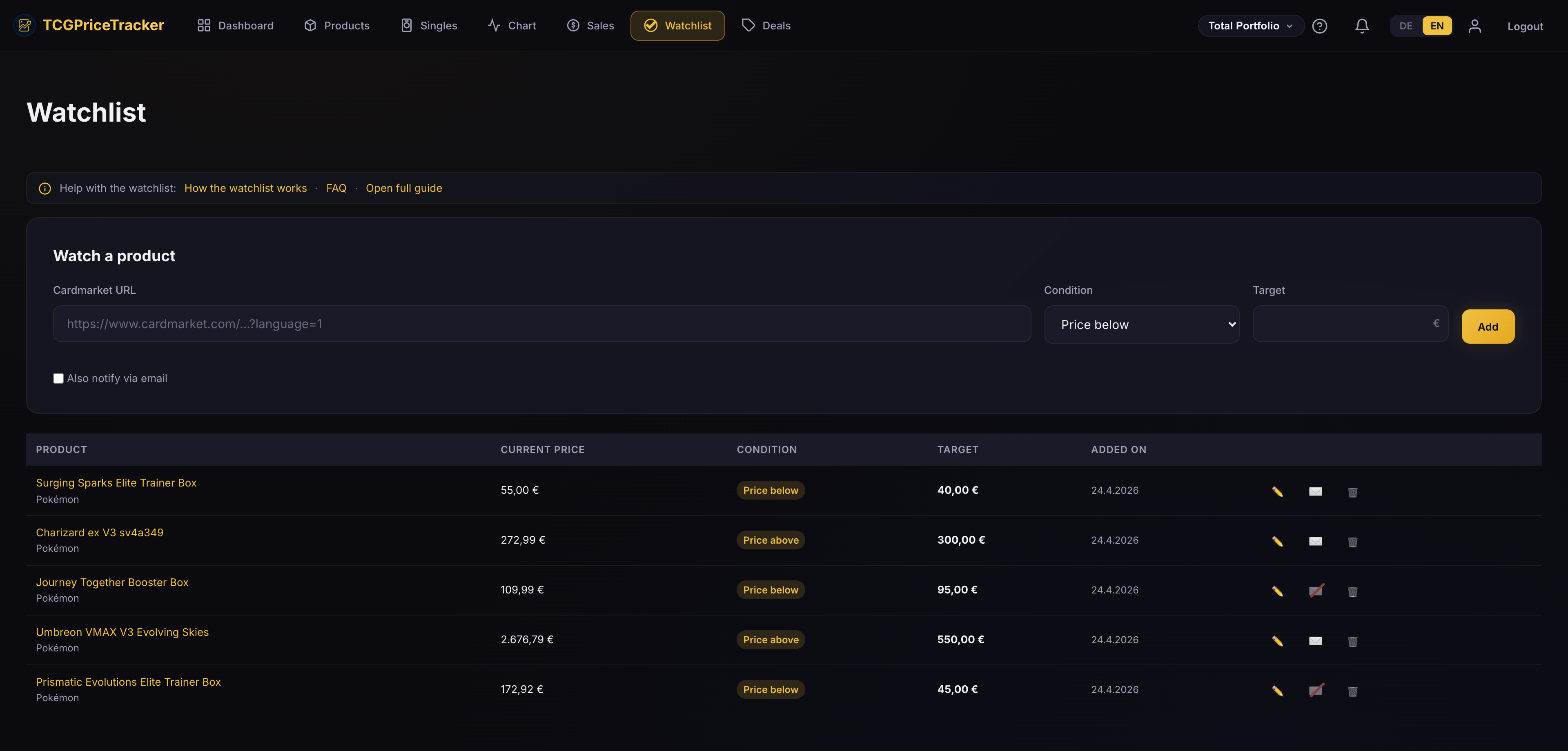
Watchlist with price alerts
You don't buy every card right away. Sometimes you're watching for a price drop or waiting for the right entry point. That's why a watchlist with configurable price alerts is indispensable for serious TCG investors.
Sales tracking and profit calculation
A portfolio is not a static construct. You buy and sell continuously. The tool has to document sales and calculate the realized profits or losses – including a history you can use for tax purposes.
| Feature | Excel / Google Sheets | TCGPriceTracker |
|---|---|---|
| Automatic price updates | ✗ Manual | ✓ Daily (Cardmarket) |
| Multi-TCG support (21 TCGs) | ✗ Maintain yourself | ✓ All 21 TCGs |
| ROI calculation | ✗ Build formulas yourself | ✓ Automatic |
| Watchlist & price alerts | ✗ Not possible | ✓ Included |
| Sales tracking | ✗ Manual | ✓ With profit analysis |
| CSV import/export | ✓ Native | ✓ Included |
| Grading support (PSA, BGS, CGC) | ✗ Cumbersome | ✓ Integrated |
| Sealed & singles separated | ✗ Organize yourself | ✓ Separate categories |
| Mobile access | ✗ Limited | ✓ Web app, usable anywhere |
As the table shows, the difference between manual tracking and a specialized tool is enormous. While Excel works for a handful of cards, it quickly becomes a nightmare as your collection grows. TCGPriceTracker was built precisely for this task – and offers all of these features in a single, clear dashboard.
No more Excel chaos. Your collection deserves a professional tracking tool. Start now for free with up to 20 products and 30 singles.
Calculating ROI: purchase price vs. current market value
Return on Investment (ROI) is the central metric for every TCG investor. It shows you, as a percentage, how profitable your investment actually was. The formula is simple, but powerful:
📐 ROI formula: ROI = ((Current market value − Purchase price) ÷ Purchase price) × 100
Example: You bought a Pokémon booster display "Scarlet & Violet – 151" for €140. The current Cardmarket price is €210. Your ROI is ((210 − 140) ÷ 140) × 100 = 50%. That's a return many stock investors can only dream of.
Of course, when following your collection value you also have to keep the big picture in mind. Individual highlights distort the picture if other positions are in the red. That's why it's important to calculate ROI not just for individual cards, but for your entire portfolio.
What to watch out for with ROI
- Factor in purchase costs: Shipping costs, Cardmarket fees or PayPal fees can eat into your actual return.
- Condition dependency: The condition of a card (Near Mint, Excellent, Good, etc.) significantly affects market value. For graded cards (PSA, BGS, CGC), the exact grade is decisive.
- Mind the time frame: A 20% ROI in one month is better than 20% in three years. The annualized return gives you a fairer picture.
- Account for liquidity: A card is only worth what someone is willing to pay for it. Cardmarket trend prices offer good guidance, but the actual selling price may differ.
TCGPriceTracker handles these calculations automatically. For every product in your portfolio, you can see at a glance the purchase price, the current Cardmarket value, the absolute profit or loss and the percentage ROI. The portfolio overview aggregates all positions and shows you the total value and overall return of your collection.
Sealed products vs. single cards: which is the better investment?
One of the most-debated questions among TCG investors is: should I invest in sealed products or in single cards? Both strategies have their merits – and the optimal answer depends on your risk appetite, your time horizon and your know-how.
Sealed products: the safe bet
Unopened booster displays, Elite Trainer Boxes (ETBs), tins and collection boxes almost always rise in value once they disappear from regular retail (so-called "out of print"). The reason is simple: supply falls as boxes are opened and collected, while demand stays stable or increases.
- Pros: Lower risk, no condition issues, easier to store, broader buyer base.
- Cons: Higher capital outlay per unit, slower appreciation, more storage space needed.
Single cards: the high-risk, high-reward game
If you know the meta, you can achieve significantly higher returns with targeted single-card investments. A Pokémon Illustration Rare that trades for €15 at release and establishes itself as a collector favorite can rise to €80 or more within months.
- Pros: Higher profit potential, lower capital outlay, fine-grained portfolio control.
- Cons: Higher risk (reprints, meta shifts, hype cycles), condition is critical, more market knowledge required.
🎯 Pro tip: Experienced TCG investors combine both strategies. A solid base of sealed products for long-term, stable growth – complemented by targeted singles positions for higher returns. With TCGPriceTracker you can manage sealed products and singles separately and compare the performance of both categories.
Track sealed & singles separately. Keep an overview of both investment strategies – with separate categories, automatic price updates and a total portfolio view.
Practical tips for TCG investors: follow your collection value like a pro
Whether you're a beginner or an experienced collector – these practical tips will help you manage your trading card games portfolio professionally and avoid common mistakes.
1. Always document the purchase price right away
The most common mistake: you buy a card and think, "I'll remember the price." Spoiler: you won't. After 50 purchases at the latest, you won't remember whether the display cost €130 or €145. Enter every purchase into your tracking tool immediately – right after checkout.
2. Diversify across TCGs
Don't put everything on one card – in the truest sense of the word. A healthy mix of different TCGs reduces your risk. If Pokémon goes through a weak phase, One Piece or Magic can offset it. A multi-TCG tracker is what makes this diversification manageable in the first place.
3. Use the watchlist strategically
You don't have to buy every card straight away. Put products that interest you on your watchlist and observe how the price develops. Many cards hit their low point a few weeks after release, once the initial hype fades – that's your entry window.
4. Set price alerts for buy and sell signals
Define target prices for buying and selling. A price alert notifies you when a card on your watchlist falls below your desired price – or when a card in your portfolio reaches a target price and you should take profits.
5. Document your sales
Every sale should be recorded with its purchase price, selling price and sales channel. Over time, this builds you a performance history that shows which strategies work and which don't. TCGPriceTracker offers an integrated sales and profit analysis that prepares this data automatically.
6. Mind the grading effect
Professional grading (PSA, BGS, CGC) can multiply the value of a card – or turn out disappointing. A PSA 10 of a coveted Pokémon holo is often worth five to ten times a Near Mint card. However, grading services cost money and time. TCGPriceTracker supports grading entries so you keep an eye on these investments too.
7. CSV import for existing collections
Already have an Excel list of your collection? No problem. TCGPriceTracker offers a CSV import that lets you transfer your existing collection quickly and easily. That way you don't start from scratch – your portfolio is ready to go in minutes.
TCGPriceTracker: your tool for 21 trading card games
TCGPriceTracker was built specifically for collectors and investors who want to track their trading cards systematically. Unlike generic spreadsheets or simple price apps, TCGPriceTracker offers a complete portfolio management system – tailored to the needs of the TCG community.
The most important features at a glance
- 21 TCGs supported: Pokémon, Yu-Gi-Oh!, Magic: The Gathering, Disney Lorcana, One Piece TCG, Digimon, Flesh and Blood, Dragon Ball Super, Final Fantasy, Weiß Schwarz, Cardfight!! Vanguard, Force of Will, Star Wars: Destiny, Battle Spirits Saga, Star Wars: Unlimited, Riftbound TCG, World of Warcraft, Dragoborne, My Little Pony and The Spoils.
- Daily prices from Cardmarket: All prices are updated automatically – you always get the current market price.
- Portfolio tracking with ROI: Store purchase prices, see the current valuation, profit/loss at a glance.
- Watchlist with price alerts: Watch cards and products and get notified when the price moves.
- Sales & profit analysis: Document your sales and analyze your realized performance.
- Grading support: PSA, BGS, CGC – enter your graded cards with the exact grade.
- CSV import/export: Import existing collections, export data – full flexibility.
Pricing
TCGPriceTracker offers a generous free plan that lets you get started without any risk:
- Free: Up to 20 products, 30 singles and 10 watchlist entries – free forever.
- Pro: Unlimited entries and all premium features for €5.99 per month or €49.99 per year.
Compared to the values you're tracking in your portfolio, that's a minimal investment. Anyone who owns trading cards worth several hundred or thousand euros needs a professional tool – and with its price-performance ratio, TCGPriceTracker is a clear recommendation.
Frequently asked questions about tracking a trading card portfolio
What does tracking a trading card portfolio mean?
Tracking a trading card portfolio means systematically recording the current market value of your entire TCG collection and following it over time. This includes purchase prices, current market prices, profit/loss calculations and value development – much like a stock portfolio. Tools like TCGPriceTracker automate this process with daily price data from Cardmarket.
Which TCGs can I track with TCGPriceTracker?
TCGPriceTracker supports a total of 21 trading card games: Pokémon, Yu-Gi-Oh!, Magic: The Gathering, Disney Lorcana, One Piece TCG, Digimon, Flesh and Blood, Dragon Ball Super, Final Fantasy, Weiß Schwarz, Cardfight!! Vanguard, Force of Will, Star Wars: Destiny, Battle Spirits Saga, Star Wars: Unlimited, Riftbound TCG, World of Warcraft, Dragoborne, My Little Pony and The Spoils. That covers practically the entire relevant TCG market in Europe.
Is TCGPriceTracker free to use?
Yes, TCGPriceTracker offers a permanently free plan with up to 20 products, 30 singles and 10 watchlist entries. For larger collections there is the Pro plan from €5.99 per month or €49.99 per year with unlimited entries and all premium features. You can start for free at any time and upgrade when you need to.
Where does the price data in TCGPriceTracker come from?
All price data is updated automatically every day from Cardmarket – the largest European marketplace for trading cards. Cardmarket trend prices are considered the most reliable reference for market prices in Europe. This means you always have current data as the basis for your investment decisions. Read more in our article about the Cardmarket Price Tracker.
How do I calculate the ROI of my trading cards?
ROI (Return on Investment) is calculated as: ((Current value − Purchase price) ÷ Purchase price) × 100. Example: purchase price €100, current value €150 → ROI = 50%. TCGPriceTracker handles this calculation automatically for every product and your entire portfolio, so you can see at a glance which cards are up or down.
Is it worth investing in sealed products or single cards?
Both strategies have pros and cons. Sealed products (unopened displays, ETBs) often appreciate over the long term and carry lower risk. Single cards offer higher profit potential but require more market knowledge and carry the risk of reprints or meta shifts. Many experienced investors combine both approaches for a balanced portfolio. With TCGPriceTracker you can track and compare both categories separately.
Ready to track your trading card portfolio?
Start now for free with TCGPriceTracker – the portfolio tracker for 21 TCGs with daily Cardmarket prices, ROI analysis and a watchlist.
Start free now →