Track Pokémon Card Prices – Stay in Control
Whether you have a nostalgic Base Set collection tucked away in a cupboard or you actively invest in modern Pokémon cards – without price tracking, you're flying blind. This guide walks you through every method, tool and strategy to reliably follow the value of your Pokémon cards.
Why tracking Pokémon card prices matters
The market for Pokémon trading cards has changed dramatically over the past few years. What was once a children's toy is now a serious collectibles market, with cards worth thousands – sometimes hundreds of thousands of dollars. But even beyond the headlines about six-figure auction results, there's plenty of reason to track your Pokémon card prices.
Many collectors massively underestimate the total value of their collection. A binder full of seemingly ordinary cards from the 2000s can be worth several hundred dollars today – if you know which cards are valuable. On the flip side, social media hype often overvalues cards that drop in price shortly afterwards.
In concrete terms, price tracking helps you with:
- Inventory overview: You always know what your Pokémon collection is worth – not just by gut feeling, but based on real market data.
- Buying and selling decisions: You can tell whether a card is currently cheap or overpriced before you spend any money.
- Loss prevention: If a card's price collapses, you can react in time instead of noticing it by chance months later.
- Insurance: A documented collection with up-to-date market values is essential if you ever need to make a claim.
- Investment planning: You can see your returns and your ROI, and make well-informed decisions about future purchases.
In short: anyone who can track Pokémon card prices gains a decisive information advantage – whether as a collector, a seller or an investor.
Valuing Pokémon cards – the fundamentals
Before you can track the value of your collection, you need to understand how the value of a Pokémon card is created in the first place. Unlike a new car, which loses value the moment you drive it off the lot, trading cards can rise as well as fall over the years. A card's value depends on several factors:
Rarity and set
Not every card is equally rare. Pokémon cards are categorized by rarity tier – from Common and Uncommon all the way up to Ultra Rare, Secret Rare and Illustration Rare. Cards from older sets such as Base Set, Fossil or Team Rocket are generally rarer, because print runs were smaller and few copies have survived in good condition.
Condition and grading
Condition is one of the most important price factors. A Charizard card in Near Mint can be worth a multiple of a Played version. Professional grading through services such as PSA, BGS or CGC objectifies the condition and raises the value further, since graded cards in sealed slabs are protected from further wear. You can learn more in our guide on how to determine the value of Pokémon cards.
Demand and market trends
Ultimately, demand determines the price. A card can be objectively rare, but if nobody wants it, the price stays low. Conversely, cards can suddenly explode in value thanks to viral videos, tournament success or waves of nostalgia. That's exactly why it's so important to keep an eye on prices regularly – the market never sleeps.
💡 Pro tip: Don't rely on isolated eBay auctions or gut feeling. The most reliable price source in Europe is Cardmarket, where actual listings and sales set the market price.
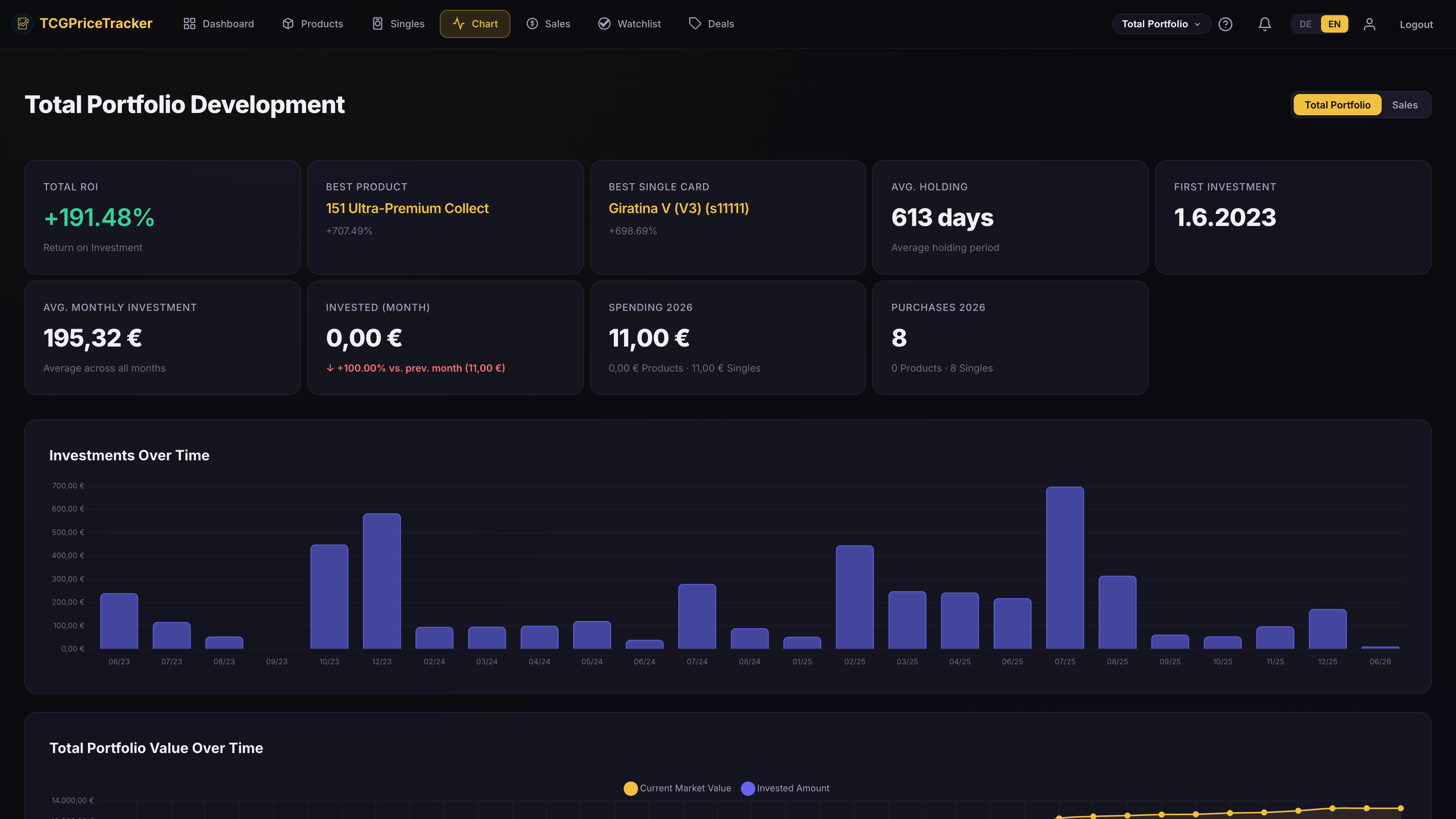
Your Pokémon collection, your overview. With TCGPriceTracker you can see the current value of every card – updated automatically from Cardmarket, every single day.
Understanding Cardmarket – how prices are formed
For the European market, Cardmarket is the central platform for trading cards. Here, thousands of sellers meet thousands of buyers – and that's exactly what makes Cardmarket the best price reference. But the prices shown there aren't always immediately easy to understand.
How the trend price works
The trend price on Cardmarket is a smoothed value derived from past sales. It evens out short-term outliers and shows the general direction of a card's value. That makes the trend price the most reliable basis for valuing your collection, which is why TCGPriceTracker builds entirely on the Cardmarket trend price.
Why Cardmarket prices are the gold standard
Unlike eBay, where auctions can distort the price, Cardmarket prices are based on real fixed-price listings and completed sales. The platform is the most important reference for European collectors – which is exactly why most Cardmarket price tracker tools use it as their data source.
The problem: Cardmarket shows you the price of a single card, but not the total value of your collection. You'd have to look up each card individually, note the price and add it all up in a spreadsheet. With 50 cards that's still manageable – with 500 or more, it becomes a full-time job.
Analyzing Pokémon card price trends the right way
Knowing a price is good. Understanding the Pokémon card price trend is better. Because only once you see how a price has changed over weeks and months can you make well-informed decisions.
Recognizing typical price patterns
Pokémon cards often follow predictable patterns:
- Release hype: New sets often launch at high prices because supply is limited. In the weeks after release, the prices of most cards fall as more and more boosters are opened.
- Rotation and tournament meta: Cards that are strong in competitive play rise in price. When they get banned or rotate out of the format, they often drop rapidly.
- Nostalgia cycles: Older cards see periodic increases in value, especially when anniversaries or remakes are on the horizon.
- Social media spikes: A single YouTube video or a TikTok trend can double prices overnight – and a week later they normalize again.
When to buy, when to sell?
The golden rule: buy when a set has been on the market for more than six weeks and prices have stabilized. Sell when the price shows a clear upward trend and you're happy with the profit. Anyone holding out for the absolute peak often misses the right moment.
To spot these patterns you need historical price data – not just today's value. This is exactly where manual tracking parts ways with automated solutions that store and visualize price history.
📊 Example: An Illustration Rare Charizard ex from the Obsidian Flames set launched at around €45, fell to roughly €25 after eight weeks, and a year later climbed to over €60. Anyone who only knows today's price misses this story – and with it the chance to act at the right moment.
Keep price trends in view. TCGPriceTracker updates all prices automatically every day and shows you ROI, value changes and trends – with no manual lookups.
Manual vs. automatic: tracking methods compared
Broadly speaking, there are two ways to track Pokémon card prices: manually with a spreadsheet, or automatically with a dedicated tool. Both approaches have their place – depending on the size of your collection and how serious you are.
The spreadsheet method
Many collectors start with a Google Sheet or Excel file. Cards get entered, the current price is copied manually from Cardmarket, and a sum formula shows the total value. It works – but it's time-consuming. With 100 cards you'll quickly spend an hour just updating the prices. And you won't get any notification when a price changes dramatically.
Automated price tracking
Price tracker tools take this work off your hands. You enter your cards once and the prices update automatically – ideally every day. On top of that you get features like price alerts, ROI calculation and portfolio analytics that a spreadsheet simply can't deliver.
To make the decision easier, here's a direct comparison:
| Feature | Manual spreadsheet | Automatic price tracker |
|---|---|---|
| Price updates | Manual (time-consuming) | ✓ Automatic, daily |
| Total collection value | Possible with formulas | ✓ Visible instantly |
| ROI & profit analysis | Laborious by hand | ✓ Calculated automatically |
| Price alerts / watchlist | ✗ Not possible | ✓ Notifications on changes |
| Grading support | Needs extra columns | ✓ Built in |
| Managing multiple TCGs | Needs multiple spreadsheets | ✓ All in one platform |
| CSV import/export | ✓ Native | ✓ Supported |
| Cost | ✓ Free | Free to start, Pro from €5.99/month |
| Scalability | ✗ Unwieldy past ~50 cards | ✓ For any collection size |
For collectors with a handful of cards, a spreadsheet is often enough. As soon as your collection grows or you start investing seriously in Pokémon cards, switching to an automated tool pays off – if only for the time it saves. For a comprehensive overview of portfolio tracking, see our article on tracking a trading card portfolio.
Pokémon investment – cards as an asset
Since the Pokémon boom of 2020/2021 at the latest, Pokémon cards as an investment are no longer a niche topic. Individual cards and sealed products have delivered returns rarely seen on the stock market. But as with any investment, the rule holds: without data and a strategy, it's pure gambling.
What makes a good investment card?
Not every Pokémon card is suited to being an asset. Successful investors look for:
- Iconic Pokémon: Charizard, Mewtwo, Pikachu and Gengar will always be in demand. These Pokémon have a timeless fan base.
- Limited print runs: Promo cards, tournament prizes and special editions with limited quantities.
- High condition / grading: A PSA 10 card isn't an ordinary card – it's a verified collector's item.
- Sealed product: Sealed booster boxes and displays from past generations are especially sought after, since they can only ever be opened once.
Portfolio tracking as an investment tool
Professional investors don't just track the current value, but also their purchase price, their return (ROI) and the profit on a hypothetical sale. These are exactly the functions a good price tracker offers: at a glance you can see which cards are up, which are down – and how your entire portfolio is developing.
Anyone serious about Pokémon investing needs more than gut feeling. Automated tracking not only saves time but also prevents emotional mistakes, because you can rely on hard numbers.
Your Pokémon investment under control. Track purchase prices, ROI and total value with TCGPriceTracker. Supports Pokémon and 20 other TCGs – with daily price updates from Cardmarket.
The ideal Pokémon price tracker for your collection
Once you've decided on automated tracking, the question becomes: which Pokémon price tracker is the right one? The requirements are clear: up-to-date daily prices, ease of use, portfolio features and, ideally, support for multiple TCGs in case you don't collect only Pokémon.
What to look for
- Data source: The tracker should pull prices from a trustworthy source. For Europe, Cardmarket is the reference.
- Update frequency: Daily updates are a must. Weekly updates are too slow for serious collectors.
- Portfolio features: Recording purchase prices, calculating ROI, logging sales – that's what sets it apart from a simple price lookup.
- Watchlist & alerts: You should be able to watch cards you want to buy and get notified when prices change.
- Import/export: CSV import saves a huge amount of time on the initial setup, and export keeps your data safe.
TCGPriceTracker at a glance
TCGPriceTracker was built precisely for these requirements. The platform pulls prices automatically from Cardmarket every day and supports 21 TCGs – from Pokémon to Magic: The Gathering, Yu-Gi-Oh! and One Piece TCG. On the free plan you can manage up to 20 products, 30 singles and 10 watchlist entries. If you need more, you can upgrade to Pro (from €5.99/month or €49.99/year) and get unlimited capacity.
The most important features at a glance:
- 📈 Daily price updates straight from Cardmarket
- 💼 Portfolio tracking with purchase price and ROI analysis
- 🔔 Watchlist with price alerts – never miss a deal again
- 💰 Sales & profit analysis – your profit at a glance
- 📦 CSV import/export – bring over existing collections with ease
- 🏆 Grading support – for PSA, BGS, CGC and more
- 🎮 21 TCGs united in one platform
The goal is simple: you should be able to focus on collecting and investing – the technology takes care of the price data.
Related reading: How to sell Pokémon cards · Every Pokémon set in order · Track Disney Lorcana card prices
Frequently asked questions
How can I find out what my Pokémon cards are worth?
The most reliable way to find the value of your Pokémon cards is to check the market prices on Cardmarket, where real sale prices and listings are recorded. Tools like TCGPriceTracker pull these prices automatically and show you the current market value of your entire collection at a glance.
Why do Pokémon card prices change so often?
Pokémon card prices fluctuate with supply and demand, new set releases, tournament format rotation, hype from content creators and seasonal trends. Reprints, ban lists and viral social media posts in particular can move prices dramatically within just a few days.
Is collecting Pokémon cards a good investment?
Pokémon cards can gain value over the long term – especially rare cards, 1st Editions and graded copies in high condition. As with any investment, however, there are risks. The key is to actively follow price trends, know the market and avoid buying purely on emotion.
What does the Cardmarket trend price tell me?
The trend price on Cardmarket is a smoothed value derived from past sales that evens out short-term outliers. For collectors and investors it is a reliable guide to a card's value over time, which is why TCGPriceTracker uses the Cardmarket trend price as its basis for valuing your collection.
How often should I check the prices in my collection?
Active investors should check daily or weekly, especially around new set releases or tournament announcements. Casual collectors can check monthly. With an automatic price tracker like TCGPriceTracker, prices update daily and you receive watchlist alerts whenever something relevant changes.
Can I also track graded Pokémon cards?
Yes, TCGPriceTracker offers grading support. You can record the grading status of your cards and get an even more accurate valuation of your collection, based on the market prices for the relevant grade.
Which TCGs are supported besides Pokémon?
TCGPriceTracker supports 20 different trading card games, including Magic: The Gathering, Yu-Gi-Oh!, One Piece TCG, Disney Lorcana, Digimon and many more. All prices are updated automatically from Cardmarket every day.
Ready to track your Pokémon collection?
Get started with TCGPriceTracker for free and stay on top of the value of your cards – with daily price updates straight from Cardmarket.
Get started free →