How to Value Pokémon Cards – The Complete Guide
What are your Pokémon cards worth? Learn step by step how to assess rarity, condition, edition and grading – with concrete examples, price lists and the best tools for determining value.
Found an old binder full of Pokémon cards in the attic, or wondering whether your collection is worth more than you think? The question "What are my Pokémon cards worth?" occupies millions of collectors worldwide. And the answer can be surprising: while many cards are worth only a few cents, certain examples fetch prices of several thousand – or even several hundred thousand – euros.
In this comprehensive guide we'll show you, step by step, how to work out the value of your Pokémon cards. You'll learn which factors determine the price, how to identify editions and rarities, when grading is worthwhile and where to find the most up-to-date market prices.
Why do Pokémon cards have value in the first place?
Before we dive into the details of valuation, it's worth looking at the basics: why are small pieces of printed cardboard worth money at all – and sometimes a lot of money?
Nostalgia meets supply and demand
Pokémon cards have been on the market since 1996 and have accompanied an entire generation. Many adults who collected as children are now returning to the hobby – with significantly bigger budgets. This nostalgia-driven demand meets a limited supply: cards from the earliest editions were printed in large numbers, but most are now in poor condition or lost.
On top of that comes the collecting and investment angle. Ever since the Pokémon hype of 2020/2021, when influencers like Logan Paul spent millions on individual cards, the wider public has realized that Pokémon cards can be a serious store of value.
The key value factors at a glance
The value of a Pokémon card is determined by the interplay of several factors:
- Rarity – the rarer the card, the higher the potential value
- Condition – Near Mint is worth considerably more than played
- Edition – 1st Edition and Shadowless cards are especially sought after
- Pokémon – iconic Pokémon like Charizard, Pikachu or Mewtwo are in higher demand
- Age – cards from the earliest sets (Base Set, Jungle, Fossil) command premium prices
- Grading – professionally graded cards achieve higher prices
- Artwork – Full Art, Alt Art and Secret Rare cards are particularly popular
💡 Good to know: The Pokémon card market is dynamic. Prices change daily, influenced by new set releases, tournament rules and market trends. What's worth €50 today can cost €30 or €80 a month from now. That's why continuous price tracking is so important.
Identifying the edition: 1st Edition, Shadowless, Holo & more
One of the most important questions when determining a Pokémon card's value is: which edition do I have? A card's edition can change its value by a factor of 10 or more.
1st Edition (First Edition)
Cards from the very first print run of a set carry a small "1" together with the word "Edition" to the left, just below the card image. These cards were printed in much smaller quantities and are today the most sought-after variants. On English Base Set cards, the 1st Edition stamp can lift the price from a few euros to several hundred or even several thousand euros.
Shadowless
A peculiarity of the English Base Set: after the 1st Edition, a second print run was produced in which the shadow box around the card image is missing. These "Shadowless" cards are rarer than the later Unlimited run and sit, price-wise, between 1st Edition and Unlimited.
Unlimited and later print runs
The most common variant, recognizable by the shadow to the right of and below the card image. Unlimited cards are considerably cheaper than 1st Edition, but rare Holos can still hold a respectable value.
Holo vs. Non-Holo vs. Reverse Holo
On Holo cards the card image shines holographically; on Reverse Holos it's the card frame that shines (but not the image). Regular Holos from older sets are generally more valuable than Reverse Holos. In newer sets, however, Reverse Holos of certain rare cards can also command high prices.
⚡ Tip: With German cards, pay particular attention to the "1. Edition" stamp. German 1st Edition Base Set cards are rarer than their English counterparts and sometimes fetch higher prices within the collector scene.
Do you know the current value of your cards? With TCGPriceTracker you record your collection and see daily-updated Cardmarket prices – including profit and loss calculations.
Assessing condition – from Near Mint to Damaged
Alongside rarity, condition is the single most important factor in determining price. A Charizard Base Set Holo in Near Mint can be worth three to five times as much as a played version. When working out a Pokémon card's value, an honest condition assessment is therefore essential.
The condition grades on Cardmarket
In Europe, the Cardmarket condition system has established itself as the standard. It distinguishes several levels:
| Abbreviation | Name | Description | Price impact |
|---|---|---|---|
| MT | Mint | Absolutely perfect, fresh from the pack, no visible flaws | +20-50 % |
| NM | Near Mint | Almost perfect, minimal imperfections only on close inspection | Reference price |
| EX | Excellent | Very good, slight signs of wear on corners or edges | -10-20 % |
| GD | Good | Good, visible wear, light scratches, whitening on edges | -30-40 % |
| LP | Light Played | Lightly played, noticeable whitening, scratches on the holo | -40-50 % |
| PL | Played | Clearly played, heavy wear, possible creases | -60-70 % |
| PO | Poor | Heavily damaged, tears, creases, water stains | -80-90 % |
What to look at closely
When assessing condition, you systematically check the following points:
- Corners – wear, creases, whitening (white patches along the edges)
- Edges – evenly cut? Discoloration? Abrasion?
- Surface – scratches on the holo? Fingerprints? Smudges?
- Centering – is the card image printed centrally? Asymmetry lowers the value
- Back – often overlooked, but whitening and scratches on the back count just as much
📋 Practical tip: Use a strong light source and view the card at a shallow angle. This reveals scratches on the holo surface that aren't visible head-on. For a more professional assessment, a loupe with 10x magnification helps.
Understanding Pokémon card rarity
The rarity symbol in the bottom-right corner of the card is your first reference point when determining a Pokémon card's value. It tells you how frequently the card appears in booster packs.
Classic rarity levels
- ● Circle (Common) – the most frequent cards, found in almost every booster. Value: usually under €0.50
- ◆ Diamond (Uncommon) – medium rarity, 2-3 per booster. Value: usually under €1
- ★ Star (Rare) – rare cards, 1 per booster. Holo Rares from €2-3 upwards
Modern rarity levels
In newer sets (from Sword & Shield and Scarlet & Violet onward) there are numerous additional rarity levels that increase value considerably:
- Ultra Rare (V, VMAX, ex) – Full Art cards with extended artwork, value: €3-30
- Illustration Rare – special artwork spanning the entire card, value: €5-40
- Special Art Rare (SAR) – premium artwork, highly coveted by collectors, value: €10-100+
- Hyper Rare / Gold – golden texture, Secret Rare numbering, value: €15-80
- Secret Rare – card number exceeds the set size (e.g. 201/198), value: variable
With the Scarlet & Violet era, the system was simplified using the new rarity symbols (1-4 stars, crown). Cards with a crown symbol are the rarest and most valuable pulls of a set.
Keep an eye on your rare cards. With the TCGPriceTracker watchlist you're automatically notified when prices rise or fall – ideal for buying and selling decisions.
Pokémon grading explained: PSA, BGS & CGC
Pokémon grading is professional condition assessment by certified companies. The card is sealed into a tamper-proof case (slab) and given a grade from 1 to 10. Grading can increase a card's value considerably – especially with high grades like 9.5 or 10.
The three major grading services
| Service | Origin | Cost (approx.) | Turnaround | Popularity in EU |
|---|---|---|---|---|
| PSA | USA | 25-150 USD + shipping | 2-12 months | Very high |
| BGS (Beckett) | USA | 25-250 USD + shipping | 2-10 months | High |
| CGC | USA | 15-100 USD + shipping | 1-4 months | Growing |
When is grading worthwhile?
Grading isn't a must, but with the right cards it's a worthwhile investment. As a rule of thumb:
- The card is worth at least €50-100 – otherwise the grading costs eat up the added value
- Condition is NM or better – cards below NM usually receive low grades (7 or worse), which can even lower the value
- You're planning to hold long term – the slab protects the card permanently and elevates it as an investment
- Iconic cards – Charizard, Pikachu, Mewtwo & co. benefit disproportionately from grading
🎯 Example: A Charizard Base Set 1st Edition Holo is worth around €3,000-5,000 ungraded in NM. As a PSA 10 (Gem Mint), the price is over €300,000. Even as a PSA 9 it's still €10,000-20,000. For a common card worth €0.50, by contrast, grading makes no sense.
You can also track graded cards with TCGPriceTracker. Simply enter the grading service and the grade to capture the specific value of your slabs in your portfolio.
Price research: using a Pokémon card price list properly
You now know your card's edition, condition and rarity. But how do you find the actual market value? The answer: through systematic price research on the right platforms.
Cardmarket – the European standard
Cardmarket is the largest European trading platform for collectible cards and the most reliable price source for the EU market. Here you can see:
- Trend price – the price level recent sales gravitate towards
- Price history – historical curves over weeks and months
- Items sold – how active the market is for this card
The Cardmarket Price Tracker from TCGPriceTracker pulls exactly this data and updates it automatically every day for your entire portfolio.
eBay – sold items as a reference
On eBay you can find real transaction prices under "Sold items" (activate the filter!). This is especially useful for:
- Graded cards, which are traded less often on Cardmarket
- Rare promo cards and special prints
- International price comparison
⚠️ Important: On eBay, always look only at sold items, never at active listings. Anyone can list a common card for €10,000 – what counts is the price someone actually paid.
Comparing prices systematically
For a well-founded valuation, you ideally combine multiple sources. Compare the Cardmarket trend price with the latest eBay sales and check whether current listings sit significantly above or below them. Large discrepancies point to a market in flux – an opportunity for attentive collectors and investors.
Manual price research is time-consuming. TCGPriceTracker updates all the prices in your collection automatically every day – you instantly see which cards have risen or fallen.
The most valuable Pokémon cards of all time
To get a feel for the price range, here's an overview of the best-known and most valuable Pokémon cards. This Pokémon card price list gives you a point of reference – the actual prices fluctuate depending on condition, grading and market conditions.
| Card | Set / Year | Price (approx., NM/graded) | Why so valuable? |
|---|---|---|---|
| Pikachu Illustrator | Promo 1998 | 5,000,000+ USD | Only ~40 copies exist, the holy grail |
| Charizard 1st Ed. Holo | Base Set 1999 | €5,000-350,000 | Most iconic card, PSA 10 extremely rare |
| Blastoise 1st Ed. Holo | Base Set 1999 | €500-15,000 | Popular starter, rare 1st Edition |
| Venusaur 1st Ed. Holo | Base Set 1999 | €400-8,000 | Completes the starter trio |
| Mewtwo Gold Star | Dragon Frontiers 2006 | €500-5,000 | Extremely rare Gold Star series |
| Rayquaza Gold Star | Deoxys 2005 | €800-6,000 | Most popular Gold Star, few NM copies |
| Umbreon VMAX Alt Art | Evolving Skies 2021 | €100-350 | Most sought-after Alt Art of the modern era |
| Pikachu VMAX Rainbow | Vivid Voltage 2020 | €200-400 | "Chunky Pikachu", huge fan popularity |
Of course, these top prices are the exception. Most collections contain no cards in the four-figure range – but cards worth €5-50 turn up more often than you'd think. Holo cards from the WOTC-era sets (1999-2003), current Alt Art and Special Art Rares, and certain promo cards are especially often underestimated.
🔍 Hidden treasures: It's not only the obvious cards that have value. Some misprints, regional variants or tournament promos are rarer than the best-known cards but go unnoticed by many collectors. Systematically recording your collection helps you discover such surprises.
Automatic tracking with TCGPriceTracker
You now have the knowledge to assess the value of your Pokémon cards. But how do you stay on top of things when prices change daily and your collection keeps growing?
This is where TCGPriceTracker comes in – a specialized web tool built for exactly this purpose.
How portfolio tracking works
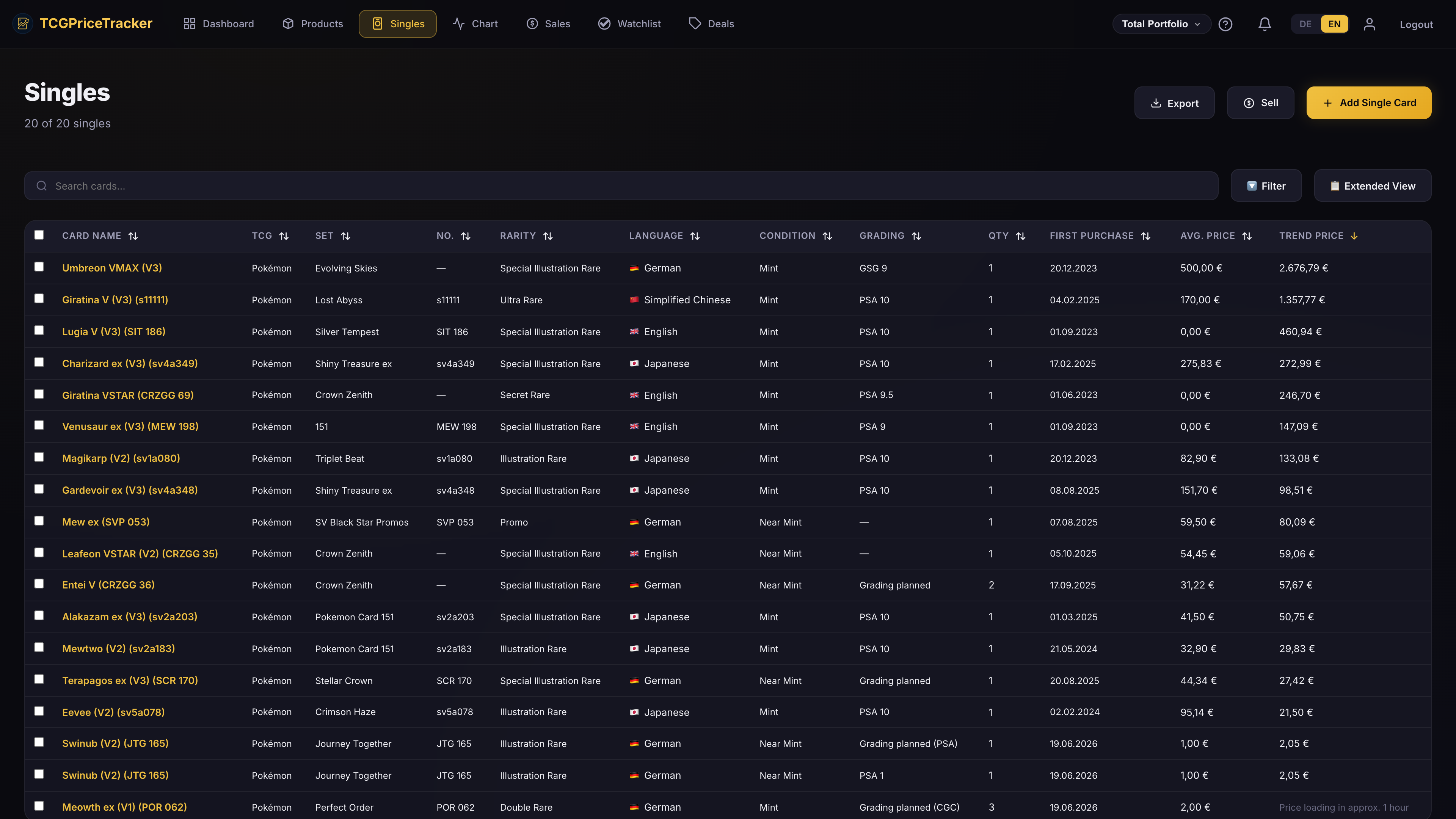
With TCGPriceTracker you record your Pokémon cards digitally and see the current total value of your collection at any time. Prices are updated automatically every day from Cardmarket – you don't have to look anything up manually.
- Record your collection – search for your cards, enter condition and quantity
- Portfolio value – see the total value of your collection at a glance
- ROI analysis – compare purchase price with current value and spot winners and losers
- Watchlist – watch cards you want to buy and set price alerts
- Track sales – record sales and calculate your actual profit
- Grading support – enter grading service and grade for precise valuation
- CSV import/export – import existing lists or export your data
Not just Pokémon
TCGPriceTracker supports 20 different TCGs – including Magic: The Gathering, Yu-Gi-Oh!, One Piece, Lorcana and many more. If you collect several games, you have everything in a single dashboard.
Start for free
On the Free plan you can manage up to 20 products, 30 singles and 10 watchlist entries – perfect for trying the tool out. If you need more capacity, you can upgrade to Pro (from €5.99/month or €49.99/year) and track unlimited cards.
The decisive advantage: instead of looking up every card individually on Cardmarket, you see your entire collection value in real time. That not only saves time but also helps you make well-informed buying and selling decisions. Learn more about tracking Pokémon card prices in our detailed guide.
Related reading: How to sell Pokémon cards · Japanese Pokémon sets · The most valuable Lorcana cards · Document your card collection · TCG glossary · Market report August 2026 · The most valuable Pokémon cards
❓ Frequently asked questions about Pokémon card value
What are my Pokémon cards worth?
The value of your Pokémon cards depends on several factors: rarity, condition, edition, demand and whether the card has been graded. A Base Set Charizard Holo in Near Mint can be worth several hundred euros, while common cards in played condition fetch only a few cents. Use Cardmarket or TCGPriceTracker for current market prices.
How do I tell whether a Pokémon card is valuable?
Look at the rarity symbol in the bottom-right corner of the card: a star means Rare, a diamond means Uncommon and a circle means Common. Holo cards, the 1st Edition stamp, and cards from older sets such as Base Set, Jungle or Fossil tend to be more valuable. Cards with a special artwork variant (Full Art, Alt Art, Secret Rare) also command higher prices.
Is Pokémon card grading worth it?
Grading is worthwhile above all for valuable cards in very good condition (Near Mint or better). As a rule of thumb: if the current market value of the ungraded card is at least three to five times the cost of grading, grading can pay off financially. For cheaper cards under €20, the grading cost of €15–50 per card usually isn't economical.
Where can I check the value of my Pokémon cards?
The most reliable sources for Pokémon card prices in Europe are Cardmarket (current market prices and sold items), eBay (sold listings as a reference) and TCGPriceTracker (automatic daily price updates with portfolio tracking). For US prices, TCGplayer and PriceCharting are good places to start.
What do the condition grades NM, EX, GD mean on Pokémon cards?
The condition grades come from Cardmarket: MT (Mint) is absolutely perfect, NM (Near Mint) almost perfect, EX (Excellent) has slight signs of wear, GD (Good) shows visible wear, LP (Light Played) is clearly played, PL (Played) heavily worn and PO (Poor) has serious damage. Condition affects the price considerably – an NM card can be worth twice as much as the same card in EX.
Which Pokémon cards are the most valuable?
The most expensive Pokémon cards are the Pikachu Illustrator (over 5 million US dollars), the 1st Edition Base Set Charizard Holo (PSA 10: over €300,000), the trophy cards from official Pokémon tournaments and the Pre-Release Raichu. In the more accessible range, 1st Edition Holo cards from the earliest sets, Alt Art cards and Gold Star cards are especially valuable.
How can I value and track my Pokémon card collection?
With TCGPriceTracker you can record your entire Pokémon card collection digitally and have it valued automatically. Prices are updated daily from Cardmarket, so you can see the current total value of your collection at any time. You can also add individual cards to a watchlist and set price alerts so you never miss a buying or selling opportunity.
Ready to know what your collection is worth?
Record your Pokémon cards, track prices automatically and discover what your collection is really worth – for free and in under 2 minutes.
Start for free now →