Yu-Gi-Oh! Card Value: Why the Banlist Matters
In most trading card games, price is set by rarity, condition and age. Yu-Gi-Oh! adds a factor that exists nowhere else in the same form: a rules list that can halve or double a card's value overnight. Without accounting for it, the price movements in this game do not make sense.
What makes Yu-Gi-Oh! different
Three traits separate the Yu-Gi-Oh! market from Pokémon or Magic.
Play value dominates. A very large share of a card's worth rests on whether it is needed in tournament play. Pure collector demand — detached from the game — concentrates on a few iconic pieces of artwork. The consequence: prices react sensitively to anything that changes the game.
Reprints are frequent. Sought-after cards reappear regularly, often in several products a year and in different rarities. A reprint can push down the price of existing printings considerably.
The same card exists many times over. Not only across several sets, but within a single set across several rarity tiers as well. The price gap between two versions of the same card is often larger than the gap between two entirely different cards.
The banlist and its effect on prices
Konami regularly publishes a list setting out how many copies of a card a tournament deck may contain. Four states are possible:
| Status | Copies allowed | Typical price effect |
|---|---|---|
| Unlimited | 3 | The baseline state |
| Semi-Limited | 2 | Demand drops by roughly a third |
| Limited | 1 | A marked decline |
| Forbidden | 0 | Play value falls to zero |
The mechanism is simple and still routinely overlooked. If a deck needs three copies of a card and the card is restricted to one, demand drops to a third at a stroke — with supply unchanged. If it is forbidden outright, play-driven demand disappears entirely.
The effect runs the other way too: when a card is loosened or taken off the list, demand appears overnight that did not exist before. Moves like these are among the sharpest anywhere in the card market.
Important in practice: the market usually reacts to the announcement, not to the date it takes effect. Following the publications gives you a head start of days to weeks. We deliberately do not quote specific statuses here — they change several times a year, and Konami's current publication is always authoritative.
Collector value, incidentally, does not follow the same rule. An iconic card keeps its collector price even when it is no longer playable in tournaments — the play value disappears, the collector value stays. For cards that were expensive purely on tournament strength, little remains.
The rarity thicket
Yu-Gi-Oh! has accumulated an unusually large number of rarity tiers over the years. Alongside the basics — Common, Rare, Super Rare and Ultra Rare — sit numerous special tiers with different finishes, from Secret Rare upwards to particularly scarce tiers that apply to only a handful of cards per set.
You identify the tier from how the card name and artwork are presented: the colour and texture of the lettering, and whether and how the artwork shines. The details differ by tier and by era, which is why no rule of thumb helps here — when in doubt, compare against a reference image of the printing in question.
The costliest beginner's mistake: looking up a card's price without checking the rarity of your own copy. Between the Common and the highest version of the same card there is routinely a multiple. On Cardmarket the rarities are separate product pages — make sure the page whose price you are reading belongs to the card you actually own.
1st Edition, Unlimited and reprints
Beyond rarity, the print run counts. 1st Edition appears on cards from a set's first print run and consistently trades higher than the later Unlimited run. The premium varies widely with age and demand, but on older, sought-after cards it is substantial.
Then there are the reprints. Because Yu-Gi-Oh! reprints frequently, it is worth asking before any larger purchase how often the card has already appeared. A card that resurfaces in a new product every few years holds its price differently from one that has not been printed in a long time.
Reprints work in two ways: they increase supply, and they often bring the card out in a new, more attractive rarity — which then competes with the older printing for the same demand.
OCG or TCG
Yu-Gi-Oh! exists in two separate editions: the OCG for Japan and parts of Asia, and the TCG for Europe, the Americas and other markets. The two differ in card pool, release dates and — importantly — tournament legality: OCG cards are not permitted in TCG tournaments and vice versa.
Both also have their own banlists. A card can be forbidden in the OCG and playable in the TCG. For price watching that means: news about a list change does not automatically concern the market you buy or sell in.
If you import OCG cards, customs and import VAT come into play — what to watch for is covered in Importing Japanese Cards. The article is framed around Pokémon, but the import rules apply regardless of the game.
Reading prices correctly
For assessing your own holdings, the trend price on Cardmarket is the most usable figure: a weighted average of recently sold copies. The lowest price shows only the cheapest current listing, often in worse condition.
Two points that matter particularly in Yu-Gi-Oh!:
Check the product page twice. Hardly any other game has so many versions of the same card. Set, rarity and print run all have to match your copy, or you are reading the price of a different card.
Expect jumps. Price moves here are often not gradual but abrupt, because they are triggered by list changes and product announcements. A history across several weeks shows whether a jump has held or was a short-lived reaction.
Tracking value over time
That is exactly what TCGPriceTracker is built for. You store the Cardmarket link of the version you own for each card — which pins down set, rarity and print run unambiguously — and get the trend price updated daily.
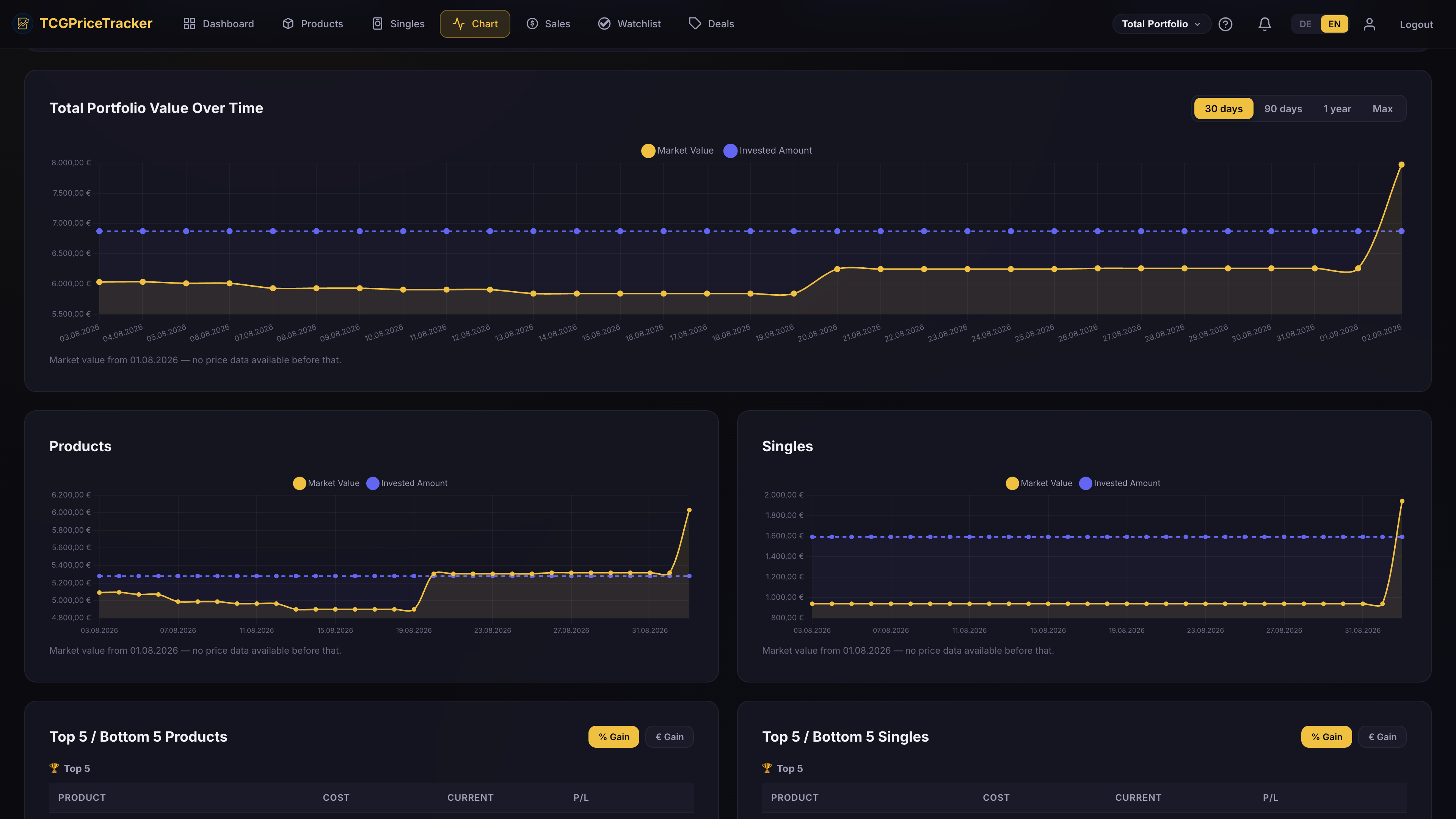
The history is especially useful in Yu-Gi-Oh!, because price moves here are event-driven. A watchlist also lets you follow cards you do not own yet, with a notification once a threshold you set is reached — handy when you are waiting for the market to react to a list change.
Yu-Gi-Oh! is one of twenty supported games; anyone also collecting Pokémon or Magic keeps everything in the same overview. For graded cards you enter your own value, because the trend price reflects the ungraded market product.
Keep your Yu-Gi-Oh! collection in view
Trend prices per card, updated daily, with history and watchlist. Free, no credit card.
Start for free →Frequently asked questions
What is the Yu-Gi-Oh! banlist?
A list published regularly by Konami setting out how many copies of a card a tournament deck may contain: three, two, one or none. It is one of the strongest price-moving forces in the Yu-Gi-Oh! market. Konami's current publication is always authoritative.
Why does the price fall when a card is limited?
Because demand drops while supply stays the same. Someone who previously needed three copies for their deck now needs one. With a ban, play-driven demand disappears entirely — only collector value remains, and not every card has that.
How do I identify my card's rarity?
From how the card name and artwork are presented — the colour and texture of the lettering and the kind and extent of the shine. The traits differ by tier and by era, so when in doubt compare against a reference image of the specific printing.
Is 1st Edition worth more than Unlimited?
As a rule, yes. 1st Edition comes from a set's first print run and consistently trades higher. How large the premium is depends on age and demand — on older, sought-after cards it is substantial.
Can I play OCG cards in tournaments?
No. OCG and TCG are separate editions with their own card pools and their own banlists; OCG cards are not permitted in TCG tournaments. For collectors that does not matter, but for price watching it does: a list change in one market does not automatically affect the other.
Does TCGPriceTracker fully support Yu-Gi-Oh!?
Yes. Single cards and sealed products can be recorded via their Cardmarket link, and the trend price is updated daily. Because the link pins down set, rarity and print run, the version mix-ups that are so common in Yu-Gi-Oh! are ruled out.
What is your Yu-Gi-Oh! collection worth?
Trend prices per card, updated daily, with total value and history. Start free, no credit card.
Start for free →