Importing Japanese Cards: the Real Cost
The price in the Japanese shop is not the price you pay. Every shipment from Japan carries 19% import VAT, and above 150 euros in goods value a further 2.7% customs duty – with shipping counted towards that value. In practice, 20 to 22 per cent lands on top. This article shows the calculation, three worked examples, and why an incorrectly entered purchase price flatters your ROI systematically.
Status of these charges: checked on 29 July 2026 for imports into Germany. Duty rates, value thresholds and carrier fees can change – if in doubt, check with customs or the carrier concerned.
The short version
| Item | Value |
|---|---|
| Import VAT | 19% – applies from the first cent since 1 July 2021 |
| Customs duty on trading cards | 2.7% – only from 150 euros in goods value |
| Tariff number | 9504 40 00 (playing cards) |
| What counts towards goods value? | Purchase price plus shipping |
| Order of calculation | Duty on the goods value, then 19% on goods value plus duty |
| De-minimis | Where import VAT would be under 1 euro it is not levied – this affects only very small shipments |
| Carrier fee | Comes on top, and varies by provider |
| Effective surcharge | 19% below the threshold, around 22% above it |
Which charges apply
For the EU, Japan is a third country. Two charges therefore apply, and they work differently.
Import VAT at 19% is the counterpart to domestic VAT. Until mid-2021 there was an exemption threshold of 22 euros below which small shipments stayed free. That threshold was abolished on 1 July 2021 – since then import VAT applies in principle from the first cent. If you remember cheap single cards arriving without a surcharge: that ended five years ago.
Customs duty is the second charge and the smaller one. For tariff purposes, trading cards count as playing cards under heading 9504 40 00, with a duty rate of 2.7%. Unlike import VAT, it only applies from a goods value of 150 euros.
There is a third item that is not a charge but behaves like one: the carrier's handling fee for customs clearance. The amount differs by provider and shipment – for postal items it sits in the single-digit euro range, while express carriers may scale it with the duties owed. You only see this at delivery, but you should budget for it.
The calculation
The order matters, because import VAT is charged on top of the duty:
| Step | Calculation |
|---|---|
| 1. Determine goods value | Purchase price + shipping |
| 2. Check duty | Goods value below 150 euros → no duty. From 150 euros → 2.7% of the goods value |
| 3. Taxable base | Goods value + duty |
| 4. Import VAT | 19% of the taxable base |
| 5. Total cost | Goods value + duty + import VAT + carrier fee |
Because the tax sits on top of the duty, the effective surcharge above the 150-euro threshold is not 19 + 2.7 = 21.7%, but around 22.2%. Not a dramatic difference, but it explains why the bill always comes out slightly higher than a rough estimate.
The 150-euro threshold and shipping
The most expensive misconception when importing: assuming the 150 euros refer to the card price. They refer to the goods value including shipping. For international shipping from Japan, 15 to 30 euros is normal – so the threshold arrives considerably earlier than the basket suggests.
How unpleasant that gets is shown by a jump of a few euros. An order of 140 euros in cards with 9 euros shipping sits at 149 euros in goods value: no duty, 28.31 euros import VAT, 177.31 euros in total. The same order with 15 euros shipping sits at 155 euros: 4.19 euros duty, 30.25 euros import VAT, 189.44 euros in total.
Six euros more in goods value therefore cost 12.13 euros more – because crossing the threshold makes duty payable on the whole goods value, not only on the part above it. If you are close to the line, look twice at the shipping option.
💡 Good to know: The effect resembles the exemption limit for private disposals – there too, exceeding it flips the entire amount rather than just the excess. More on that in Selling trading cards in Germany: tax records.
Three worked examples
| Order | Goods value | Duty | Import VAT | Total |
|---|---|---|---|---|
| Single card €40 + €12 shipping | €52.00 | — | €9.88 | €61.88 |
| Several cards €130 + €25 shipping | €155.00 | €4.19 | €30.25 | €189.44 |
| Display €300 + €40 shipping | €340.00 | €9.18 | €66.34 | €415.52 |
In all three cases the carrier's fee comes on top. So the 40-euro card really costs you around 62 euros, and the 300-euro display around 416. That is not a rounding error you can do in your head – it is a fifth.
Why your ROI is otherwise wrong
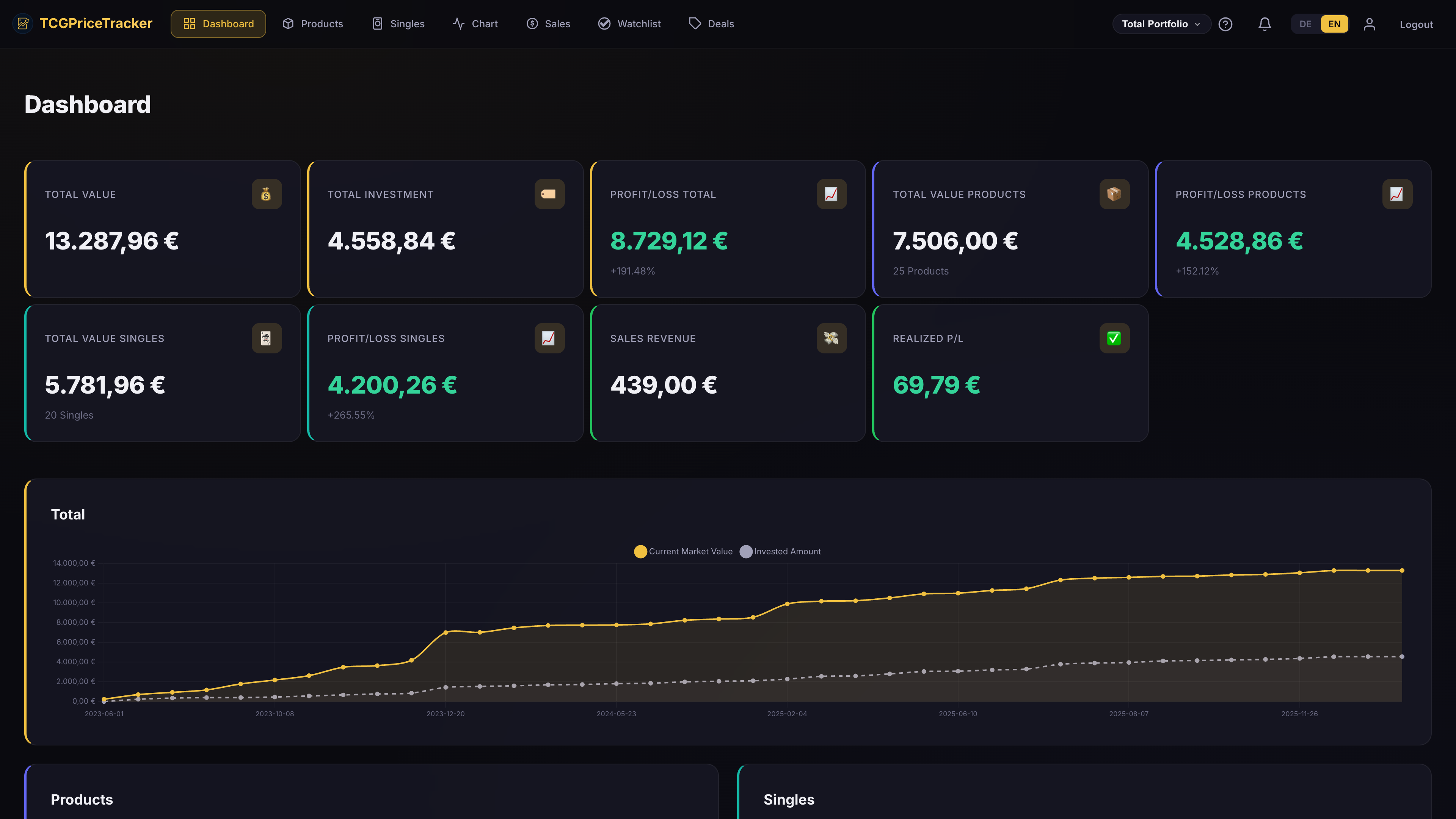
This is where a customs question turns into a tracking problem. Enter the card from the first example at 40 euros instead of the actual 61.88 euros, and you get shown a return that never existed.
Suppose the card later sits at a trend price of 70 euros. On a basis of 40 euros your portfolio shows +75%. On the real 61.88 euros it shows +13.1%. Both figures refer to the same card and the same market value – the difference lies entirely in the cost basis you recorded.
For one card that is merely annoying. For a collection made up in good part of Japanese imports, it shifts the total invested noticeably – and with it every statement about whether collecting has paid off so far.
Entering the purchase price correctly
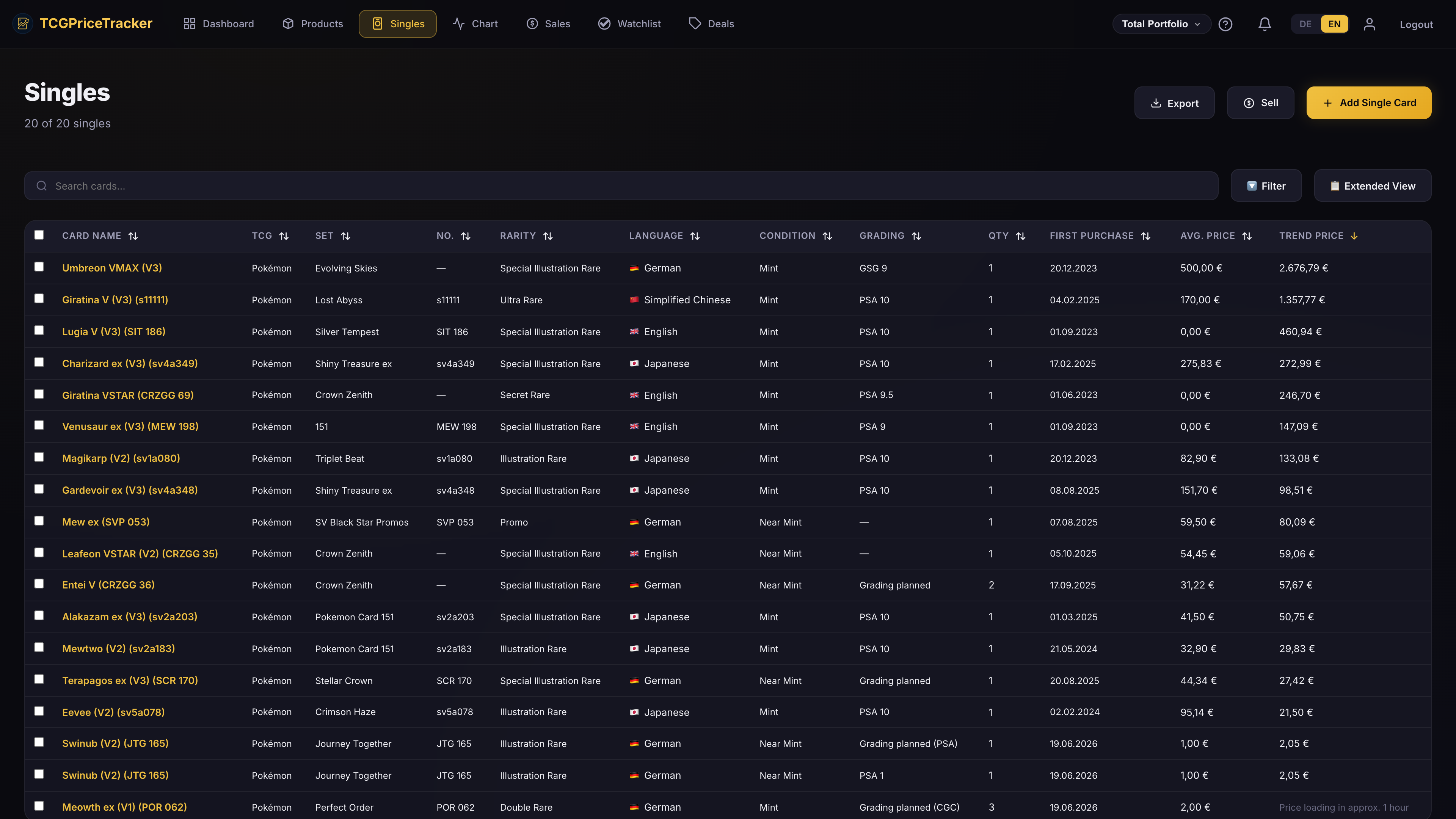
The rule is simple: enter what the card actually cost you – not the shop price. So purchase price plus a share of shipping plus a share of the charges.
For a combined order, spread the additional costs pro rata by value. Example: if an order with 155 euros in goods value ends up costing 189.44 euros, that is a factor of about 1.22. A card that cost 30 euros in the shop therefore goes in at around 36.60 euros. That is precise enough – the cent does not matter here, the order of magnitude does.
Two things that get mixed up easily. First: the displayed value does not change as a result. It comes from the trend price of the Cardmarket product page you linked and has nothing to do with your import costs. You are correcting the investment side, not the valuation.
Second: Japanese sets have their own Cardmarket product pages. The entry price and trend price you see are therefore the ones for the Japanese print, not for the Western release – and you need do nothing beyond pasting the right link. Which Japanese sets exist is covered in the overview of every Japanese Pokémon set. The same charge mechanism applies to graded cards returning from the USA – why it can now disappear is covered in PSA now grades in Germany.
Purchase price, quantity and value per card – in euros. Start free with 20 products, 30 single cards and 10 watchlist entries.
Frequently asked questions
From what amount do I pay import VAT?
In principle from the first cent. The former exemption threshold of 22 euros was abolished on 1 July 2021. Only where the import VAT would come to less than one euro is it not levied – which affects shipments in the single-digit euro range.
From when does customs duty apply as well?
From a goods value of 150 euros. Trading cards fall under tariff number 9504 40 00 with a duty rate of 2.7%. Below 150 euros, only import VAT applies.
Does shipping count towards the goods value?
Yes. The goods value is the purchase price plus shipping. At 20 to 30 euros for shipping from Japan, that moves the 150-euro threshold considerably – an order with 130 euros in cards can already be liable to duty.
How large is the surcharge overall?
Below 150 euros in goods value it is 19%. Above it, around 22.2%, because import VAT also applies to the duty amount. On top of that comes the carrier's fee for customs clearance.
Which price do I enter in the tracker?
The actual cost – purchase price plus a share of shipping plus a share of the charges. For a combined order, spread the additional costs pro rata by value. Enter only the shop price and your ROI will show a return that never existed.
Do Japanese cards get their own price?
Yes, because Japanese sets have their own Cardmarket product pages. Since entry price and trend price come from the page you linked, you see the price for the Japanese print rather than the Western release.
Record imports at their real cost
Purchase price per position, values in euros from Cardmarket trend prices, ROI across the whole collection. Start free, no credit card.
Start for free now →