PSA Now Grades in Germany: What Changes
For European collectors, PSA has always meant the same thing: ship the card across the Atlantic, pay customs, wait months. Since August 2026, PSA grades in Frankfurt am Main – at the first full-scale facility on the European mainland. The catch: only authorised dealers and partners can submit so far. This article sets out what is confirmed, what is still open, and what actually changes for you.
Status of these figures: checked on 13 August 2026. PSA Europe is still ramping up – access, pricing and turnaround can change at short notice. PSA's own statements are authoritative.
The short version
| Question | Answer |
|---|---|
| Where? | Frankfurt am Main – PSA's first full-scale grading facility on the European mainland |
| Since when? | Submissions since July 2026, on-site grading since August 2026 |
| Who can submit? | So far only authorised PSA dealers and partners from continental Europe and Ireland |
| And private collectors? | Full access is announced for later this year – until then the route runs through an intermediary |
| Which cards? | Sports cards and TCG, including Pokémon and Yu-Gi-Oh! |
| What does it cost? | No official European price list has been published |
| Why does it matter? | No transatlantic trip – so customs and import VAT on the return leg disappear |
| How big is it? | Around 100 staff in Frankfurt, phase one of a 200 million dollar investment |
Where things stand in August 2026
What PSA opened in Frankfurt is not an intake office but a full grading facility. The difference matters: cards are actually examined, graded and encapsulated there, rather than collected and forwarded.
The sequence so far: in July 2026, intake began for submissions from authorised PSA dealers and partners across continental Europe and Ireland. In August 2026, on-site grading started for those early-access partners. A full launch for everyone is announced for later this year, explicitly conditional on operations running smoothly.
The scale shows this is not a trial balloon. PSA has hired around 100 people in Frankfurt – graders, research specialists, security and floor management, plus administration, marketing, finance and IT. Experienced graders from other PSA sites relocated to Europe so that grading applies the same standard from day one. The facility is the first phase of an announced 200 million dollar investment in global capacity.
Frankfurt was chosen for its transport links, as a central hub with connections across Europe. PSA Europe is led by Matthias Peuckert, previously at Amazon EU and DocMorris.
The biggest win: customs disappears
The saving nobody talks about is also the most reliable one. Anyone shipping to California paid not only for transport but also import charges on the way back: the graded card returns from a third country and is charged again on entry.
How much that costs is worked through in Importing Japanese cards – that article is about orders from Japan, but the mechanism on a return from the USA is identical: 19% import VAT, customs duty above 150 euros in goods value, plus the carrier's handling fee.
With grading inside the EU, that entire block falls away. No customs declaration, no import VAT, no carrier handling fee, and no risk of a valuable card sitting at a customs office.
💡 Good to know: What disappears is the journey, not the grading fee. Nothing published so far suggests the fee itself gets cheaper – PSA has not released a European price list.
Who can submit today
This is the decisive limitation. Frankfurt currently accepts submissions from authorised PSA dealers and partners, not from private individuals. If you want to send a card there yourself as a collector, you cannot.
That leaves two routes. Either keep shipping to the USA with everything that entails – on top of which comes the current backlog situation, covered in the PSA backlog. Or go through an intermediary that is allowed to submit as a partner and bundles collections.
That is exactly why intermediaries matter more right now, not less: until the full launch they are the only route to a grade obtained in Europe. Once PSA opens up to everyone, that reverses.
Disclosure: S.L.A.P is a partner of TCGPriceTracker and one of the routes through which private collectors can currently place PSA submissions in Europe. Once you register, your account shows a 5% discount code. We receive a commission on submissions made with that code – it has no bearing on the assessment in this article.
What to look at when comparing intermediaries: the price per card including return shipping, the stated processing time, and whether cards are submitted in bundles. The concrete costs, and the question of the card value at which it pays off at all, are covered in Is grading worth it?.
What else changes
Shorter routes. The round trip across the Atlantic disappears. Industry observers put the logistics alone at several weeks – time a European grade saves regardless of how long the examination itself takes.
Less transport risk. Every extra leg is another opportunity for loss or damage. A route inside the EU is shorter, cheaper to insure and easier to track.
Lower shipping cost. Insured international shipping is a noticeable item on valuable cards. Within Europe it is considerably smaller.
More capacity in the system. Frankfurt grades in addition to the existing sites. For the global backlog that is relief – how much remains to be seen.
What is still open
Honesty belongs here: a good deal of what currently circulates about PSA Europe is unconfirmed.
There is no official European price list. The scene assumes pricing will track US rates – that is not confirmed. Nor are figures about minimum volumes for partners, or an exact date for the public launch. Numbers of that kind come from a single source not attributable to PSA.
Turnaround times in Frankfurt are not reliable yet either. A facility that has been grading for a few weeks simply has no meaningful statistics. If you are planning today, work with PSA's known turnaround times rather than hopeful estimates.
Recording graded cards properly
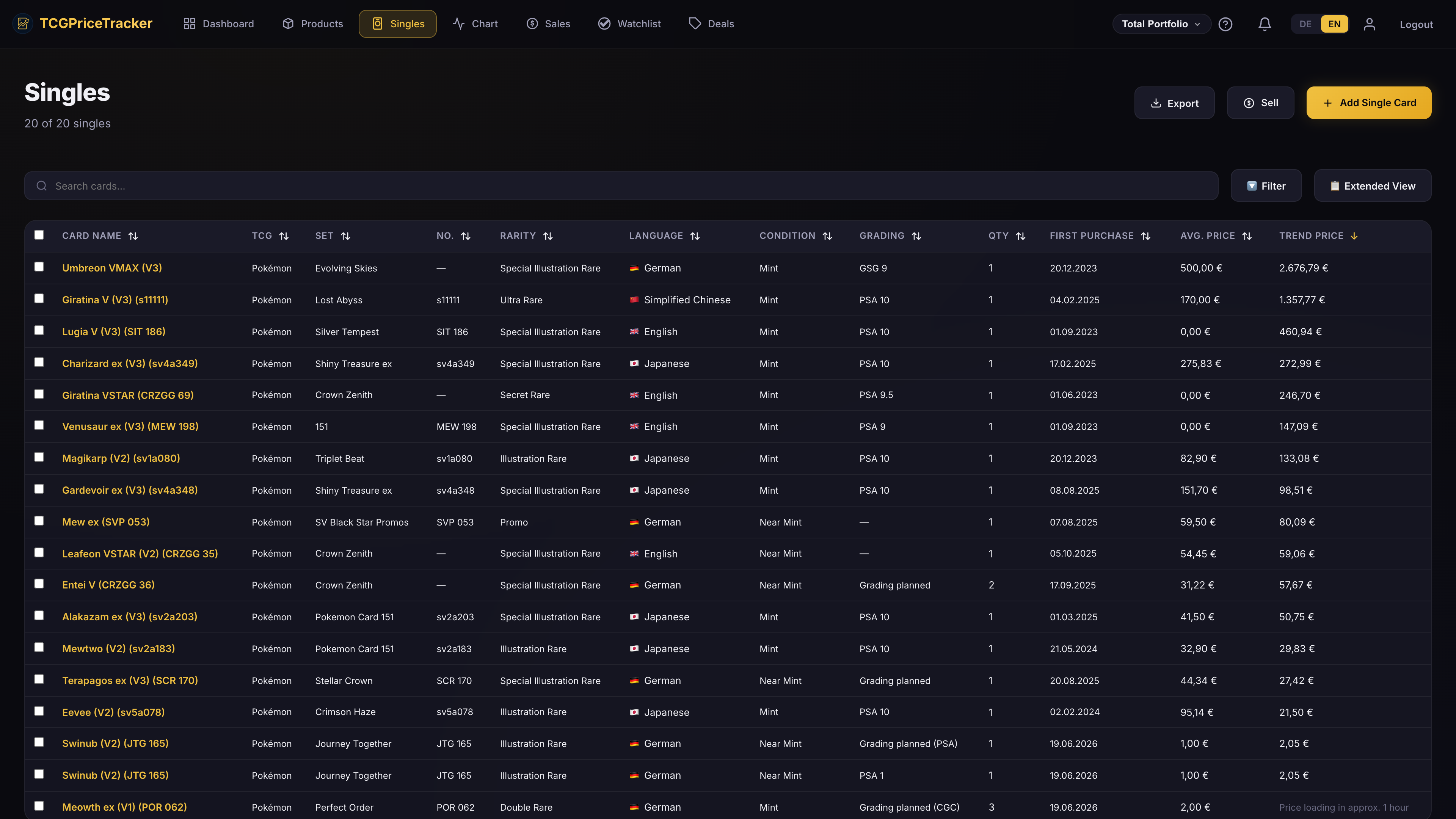
If you submit, do not lose sight of the card in your portfolio. In TCGPriceTracker you record grader and grade per position, along with the usual purchase date, purchase price and quantity.
One point matters for valuation: the value shown comes from the trend price of the Cardmarket product page you linked, and therefore represents the ungraded card. It cannot represent a PSA 10. For graded cards you therefore enter your own value per position – every position has a manual value field for exactly that, and it takes precedence over the trend price.
And the costs belong on the investment side: the grading fee, shipping and – as long as you are still shipping to the USA – the import charges all raise your cost basis. Leave the original purchase price standing on its own and you overstate your return.
Grading, purchase price and value per card in one place. Start free with 20 products, 30 single cards and 10 watchlist entries.
Related reading: Is grading worth it? · The PSA backlog · Importing Japanese cards
Frequently asked questions
Can I submit to Frankfurt as a private collector?
Not at the moment. Frankfurt accepts submissions from authorised PSA dealers and partners in continental Europe and Ireland. Full access for everyone is announced for later this year. Until then the route runs either through an intermediary or still to the USA.
Does this make grading cheaper?
The journey gets cheaper, because customs and import VAT on the return disappear and shipping inside Europe costs less. Whether the grading fee itself falls is open – PSA has not published a European price list.
Which cards does Frankfurt accept?
At launch, sports cards and trading card games including Pokémon and Yu-Gi-Oh!. PSA has not announced whether or when further categories will follow.
How long does grading in Frankfurt take?
There are no reliable figures yet – the facility has only been grading since August. If you are planning, work with PSA's known turnaround times. The one certainty is that the transatlantic transport time disappears.
Does this change anything about PSA's global backlog?
Frankfurt adds capacity, and the 200 million dollar investment is aimed at exactly that. How far it reduces the existing backlog cannot be said yet. We have summarised the current state in a separate article.
How do I keep a graded card in my portfolio?
Grader and grade are recorded per position. Because the trend price represents the ungraded card, you enter your own value for graded copies; that value takes precedence. Grading and shipping costs belong with the purchase price, otherwise your return is wrong.
Keep your collection in view – graded or not
Grading, purchase price, value and development per position, all in euros. Start free, no credit card.
Start for free now →