Is Grading Worth It? The European Calculation
"Grading pays off from about 50 euros in card value" – you read that rule everywhere, and since 2026 it is worthless. The reason: there is now a factor of five between the services. Through a European intermediary, CGC costs around 23 euros and PSA Regular around 114. So there is no single threshold any more, but one per service. This article shows how to work yours out for your own card.
Status of these figures: checked on 13 August 2026. Grading prices and turnaround times change often – particularly so in 2026. The respective provider's own statements are authoritative.
The short version
| Question | Answer |
|---|---|
| Is there a fixed threshold? | No – it depends on the service, and the gap is large |
| What does CGC cost from Europe? | Around 23 euros per card via an intermediary |
| What does PSA Regular cost? | Around 114 euros per card via an intermediary |
| Why is PSA so much dearer? | The cheap Value tiers have been paused since June 2026 |
| What drives the upside? | The card itself – the premium for top grades differs with every card |
| When is it never worth it? | When you do not expect a 9 or a 10 |
| What is the right question? | Not "from how many euros" but "how large is the premium on this particular card" |
What grading actually does
In grading, a service assesses a card's condition against fixed criteria – centring, corners, edges and surface – assigns a grade and seals the card in a tamper-evident holder.
Three things come out of it. First clarity: instead of a self-assessment like "Near Mint", which is arguable, there is a fixed number. Second protection: the card is permanently secured against creases, scratches and moisture. Third – and only sometimes – a higher price.
The third point is what the calculation is about, and it is the least certain. The premium does not come from grading as such, but from the combination of a high grade and a card people want. A perfectly preserved card nobody is looking for does not become valuable through a 10.
The services compared
| Service | Scale | Strength |
|---|---|---|
| PSA | 1–10, whole grades | Highest market acceptance; a PSA 10 achieves the best prices on many cards |
| CGC | 1–10, with half steps | Considerably cheaper, growing acceptance, now grading in Munich |
| BGS (Beckett) | 1–10 with half steps, plus four subgrades | The only scale with a tiered top end: Gem Mint 9.5, Gold Label and Black Label |
| SGC | 1–10 | Good balance of speed and price |
BGS has one peculiarity worth knowing: above 9.5 there is not one tier but three. Gem Mint 9.5 requires all four subgrades at 9 or better, with three at 9.5 or higher. Gold Label requires all subgrades at 9.5 or better, with three at 10. And Black Label demands a straight 10 in all four categories – meaning 50/50 centring, with no exceptions.
That matters for the calculation further down: at PSA the 10 is the end of the scale, whereas at BGS what happens above 9.5 still decides which league the card ends up in. A Black Label is exceptionally rare and commands premiums to match – but the odds of getting one are low enough that you should not build your calculation around it.
The difference in market acceptance is real and cannot be argued away: for resale, a PSA grade brings more on many cards than the same grade from another service. Anyone who instead wants to protect and document their own collection is not bound by that – and can take the cheaper route.
What it costs from Europe
Until 2026 the answer for European collectors was always the same: ship to the USA, budget for customs and waiting time. That has changed. CGC now grades full-time in Munich, and PSA has opened a facility in Frankfurt – though so far only authorised dealers and partners may submit there. For private collectors, the route currently runs through an intermediary that bundles submissions.
Disclosure: S.L.A.P is a partner of TCGPriceTracker. Once you register, your account shows a 5% discount code; we receive a commission on submissions made with it. That has no bearing on the assessment in this article – the alternatives named here carry no partnership, and where another route is cheaper, we say so.
| Route | Price per card | Processing |
|---|---|---|
| CGC via S.L.A.P | €22.99 incl. return shipping | around 75 days |
| PSA Regular via S.L.A.P | €113.99 incl. return shipping | per PSA turnaround |
| PSA Regular direct to the USA | $79.99 plus shipping, insurance and import charges | 40–60 days plus transport |
| CGC Economy direct | $20 plus shipping and charges | 90 working days |
Comparing the two European routes is the heart of this article: €22.99 against €113.99 – a factor of five for the same service on the same card. That is not a detail; it decides whether grading pays off at all.
One detail to carry into the calculation: with S.L.A.P the return shipping is included, the outbound leg is not. So you additionally pay whatever insured shipping to the intermediary costs you – a one-off amount per parcel, not per card.
Which has a practical consequence: several cards in one parcel noticeably lower the cost per card. Send a single card and you carry the outbound cost alone; with five cards it spreads across five. That is precisely why collectors accumulate submissions instead of sending them one at a time.
The reason for the PSA figure lies not with the intermediary but with PSA itself: the four cheap Value tiers have been paused since 2 June 2026, after a backlog that at one point reached 14 million cards. The background is in the PSA backlog.
Shipping directly to the USA adds more to the fee: transport both ways, insurance, and the import charges on the return. How much that adds is worked through in Importing Japanese cards – the mechanism on a return from the USA is identical.
Working out your own threshold
Blanket thresholds are convenient and usually wrong, because they leave out the decisive figure: the premium on your particular card. On a sought-after vintage card it is a multiple; on a current mass-produced card it is close to nothing.
The calculation has three steps:
| Step | What you do |
|---|---|
| 1. Establish the ungraded value | The trend price for your card in near mint |
| 2. Look up the graded value | Completed sales of the same card in PSA 10 or CGC 10 – not asking prices on active listings |
| 3. Set the difference against the cost | Graded value − ungraded value − grading cost = your gain |
A worked example with openly stated assumptions. A card sits ungraded at €80, and comparable copies in a top grade sell for €160 – double.
Via CGC at €22.99: €160 − €80 − €22.99 = €57.01 in gain, less the outbound shipping. Clearly worth it.
Via PSA Regular at €113.99: €160 − €80 − €113.99 = −€33.99, a loss. On this card it does not pay off, even though a PSA grade counts for more in the market.
One distinction almost always missing from calculations like this: what you paid for the card deliberately does not appear here – at least not if you already own it. For the question "should I have this card graded?", all that counts is whether the premium exceeds the grading cost. Whether you bought it three years ago for €20 or overpaid at €150 changes nothing – the money is spent either way, and grading does not undo a bad purchase.
It is different if you buy a card in order to grade it. Then you calculate against the purchase price rather than the ungraded value: expected graded value − purchase price − grading cost − outbound shipping. That is the considerably riskier version, because two uncertainties combine – whether you bought cheaply enough, and whether the grade lands.
For your portfolio both still apply: the purchase price remains the position's cost basis, and the grading cost comes on top. "Is it worth it?" and "what has this card cost me in total?" are two different questions, and only the second one belongs in the tool.
For the same calculation to work at PSA, the graded value would need to sit at €193.99 – or the card would have to be considerably more valuable. As a rough orientation: with a premium of double, CGC pays off from around €25 to €30 in card value, PSA only from around €115 to €130. Build in a safety margin for a grade below your hopes, add the outbound shipping, and both figures move up.
The risk: when the grade disappoints
The calculation above assumes a top grade. If that does not arrive, it flips – and worse than merely "no gain".
A low grade can reduce a card's value. The reason is psychologically understandable: "Near Mint" is a self-assessment that leaves a buyer room. A confirmed 8 is an established flaw, documented and permanently sealed in with the card.
From which follows the most important rule in this article: only submit if you realistically expect a 9 or a 10. Look the card over in good light beforehand – centring, whitening at corners and edges, scratches on the surface. Be strict with yourself; the graders will be.
💡 Good to know: The cost comparison also shifts the risk calculation. At €22.99 a disappointing grade is annoying. At €113.99 it is expensive – so the cheaper service is more forgiving of a misjudgement.
Graded cards in your portfolio
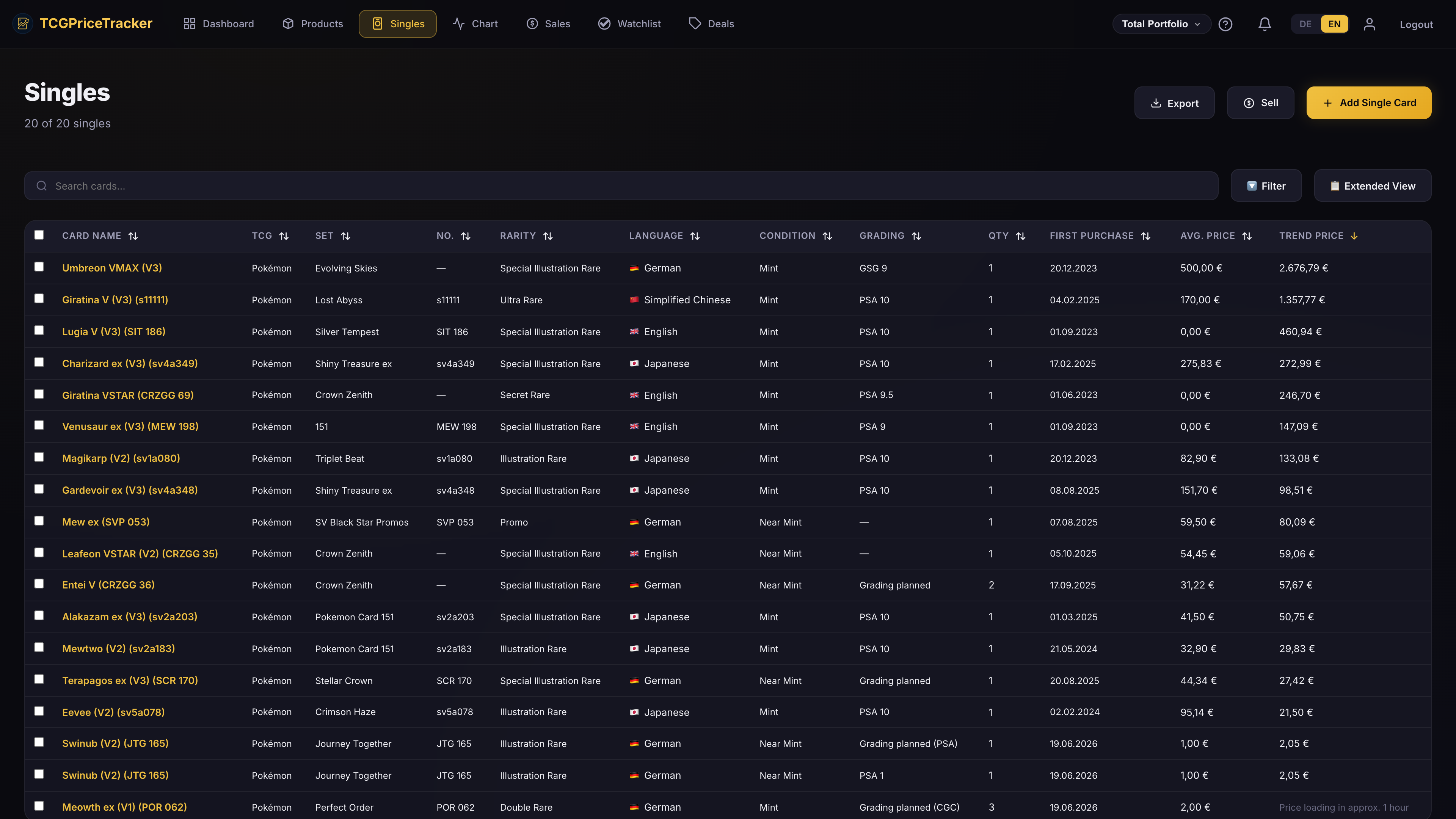
After grading, one number in your portfolio is no longer right: the value. The trend price shown comes from the Cardmarket product page you linked and represents the ungraded card. It cannot represent a PSA 10 – that is not a gap in the tool, it is a property of the market price.
In TCGPriceTracker you therefore record grader and grade per position and enter your own value for graded cards. Every position has a manual value field for exactly that, and it takes precedence over the trend price.
Just as important is the other side: grading costs belong to your cost basis. Leave €80 standing as the purchase price without adding the €22.99 fee and you see a return that does not exist. Enter purchase price plus fee plus shipping – then the ROI is right.
Grading, cost basis and value per card in one place. Start free with 20 products, 30 single cards and 10 watchlist entries.
Related reading: PSA now grades in Germany · The PSA backlog · Document your card collection
Frequently asked questions
From what card value is grading worth it?
There is no fixed line, because costs differ by a factor of five between services. With a premium of double, CGC pays off from around €25 to €30 in card value, PSA Regular only from around €115 to €130. What decides it is the premium on your specific card, which you look up through completed sales.
Why has PSA suddenly become so expensive?
PSA paused all four cheap Value tiers on 2 June 2026, after a backlog that at one point reached 14 million cards. The cheapest orderable tier since then is Regular. The pause is meant to hold until the backlog falls to 5 million cards.
Can grading lower a card's value?
Yes. A grade of 8 or below is a confirmed and permanently documented flaw, while "Near Mint" as a self-assessment leaves room. So only submit cards where you realistically expect a 9 or a 10.
PSA or CGC?
For resale, PSA has higher market acceptance and achieves better prices on many cards. For protecting and documenting your own collection, CGC at a fifth of the cost is the more sensible choice. Weigh the premium against the extra cost – at middling card values CGC almost always wins.
Can I submit directly to Frankfurt?
Not as a private collector at present. PSA has been grading there since August 2026 but accepts submissions only from authorised dealers and partners for now. Full access is announced for later this year.
How do I record a graded card in the tracker?
Grader and grade are stored per position. Because the trend price represents the ungraded card, you enter your own value for graded copies, and that value takes precedence. Add the grading fee and shipping to the purchase price, otherwise the ROI shows too high a return.
Do the maths first, not afterwards
Purchase price, grading and value per position – in euros, based on Cardmarket trend prices. Start free, no credit card.
Start for free now →