Document Your Card Collection: Proving Holdings and Value
A trading card collection is worth five figures faster than most people realise – and almost nobody has it documented. If a burglary, a water leak or a conversation with your accountant leaves you with nothing but a phone gallery, you are in a weak position. This guide covers what a solid inventory has to contain, how an inventory list, a valuation report and a sales record differ, and how to keep it all current without drowning in spreadsheets.
Why documentation has to happen before the claim
The uncomfortable part first: in a claim, the burden of proof is on you. Telling a household insurer after a burglary that the drawer held four figures' worth of cards takes more than a memory. Without a list, you are left with whatever you can reconstruct – and in practice that is far less than what was actually there.
The same applies to the unspectacular case. You sell over several years, and at some point someone asks what the items originally cost. If you never recorded what you bought, when and for how much, the acquisition cost is gone.
Both problems have the same fix: an inventory list with purchase data, maintained as you go. Not reconstructed in an emergency, but kept alongside.
Worth knowing: whether your policy covers a collection at all, and up to what amount, is a question for your contract – many household policies cover collections only up to a low limit, or not at all. Clarify that with your insurer first. Good documentation does not replace suitable cover; it only helps you quantify a loss that is covered.
What belongs in every inventory list
A list that just says “Charizard, about €300” helps nobody. It only becomes usable with the details that identify a card unambiguously – because the same card can be worth ten times or one tenth depending on the variant.
| Detail | Why it matters |
|---|---|
| Card name and number | Without the set number, reprints cannot be told apart from first editions |
| Set | The same card often appears in several sets at completely different prices |
| Language | German, English and Japanese printings are traded separately |
| Condition | Between Mint and Played sit multiples, not percentages, on sought-after cards |
| Grading | A PSA 10 is a different commodity from the same card ungraded |
| Quantity | Obvious – and still the most common gap in self-made lists |
| Purchase date and price | The only record of acquisition cost; impossible to reconstruct later |
| Current market value | Must belong to a stated date, otherwise the figure is meaningless |
That last point is where home-made spreadsheets fall apart. A market value without a date says nothing, and looking it up by hand for hundreds of positions is not something anyone keeps up.
Record the collection once, values follow automatically. Language, condition and variant come straight from the Cardmarket link; price data is pulled automatically and updated daily.
Sealed products: what changes in the documentation
For sealed products, the card logic does not apply. A display has no condition in the “Near Mint” sense and no grading – what decides its value is something else: whether it is untouched. And because a single display can easily be worth as much as several hundred single cards, it is usually the part of a collection where a gap in the documentation hurts most.
| Detail | Why it matters for sealed |
|---|---|
| Product type | Display, Elite Trainer Box, booster bundle, tin, blister – price differences between formats of the same set are substantial |
| Set | As with cards, the single biggest price factor |
| Language | German and English displays of the same set trade separately and often far apart |
| Sealed yes/no | The one point that decides everything with sealed product – opened, it is a different item |
| Condition of the packaging | Dents, tears in the wrap or storage marks reduce the value without the product being opened |
| Receipt and provenance | At high values, the only thing that counters the suspicion of a resealed box |
| Quantity, purchase date, price | As with single cards – impossible to reconstruct later |
The last two points are routinely underestimated. With sealed product, resealing is a real issue, and the older and more expensive an item, the closer people look. Anyone who still has the order confirmation, the seller and the purchase date can show the chain – anyone who bought the display “at some convention years ago” cannot.
In practice that means: photograph sealed products while they are still sealed. One shot of the unopened wrap, one of the side with the set name and one of the bottom with the batch print, plus the purchase date – two minutes per display, and worth more in a claim than any description written afterwards. Those photos belong with your records, not in the inventory list; the list just points to them.
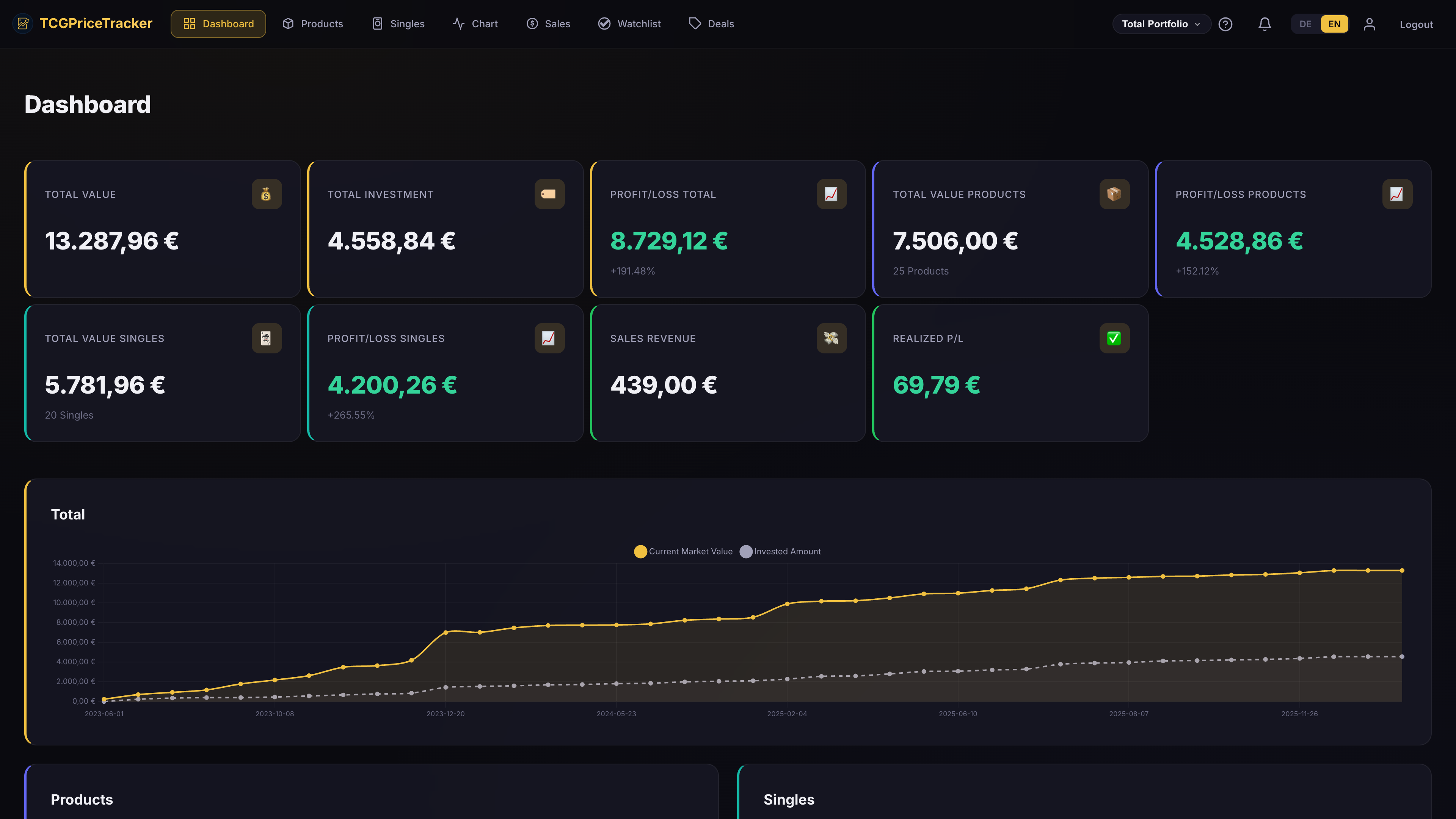
In the tracker, products are kept as their own category and totalled separately from single cards in the valuation report. So you can see at a glance how much of your total value sits in sealed product – often the decisive figure in a conversation with an insurer.
Inventory, valuation report, sales record
Three documents, three purposes. They are often confused, although they answer different questions.
| Document | Answers | Typical occasion |
|---|---|---|
| Inventory list | What do I own, in which variant, how many? | Ongoing overview, the basis for everything else |
| Valuation report | What were those holdings worth on a given date? | Talking to an insurer or accountant, personal asset overview |
| Sales record | What did I sell, when and at what price? | Evidence for a single transaction |
The key difference: the inventory is an ongoing state, the valuation report a snapshot. As soon as prices move – and they move daily – a valuation report only holds for its stated date. That is why the date belongs visibly on the document.
What a valuation report contains
A usable valuation report is more than a total. It has to be traceable: whoever reads it should be able to see where the number comes from. The valuation report in TCGPriceTracker therefore lists, per position, the name, set, language, number, condition and quantity, plus the average purchase price, the value per unit and the total value of that position.
Below that sit subtotals split by products and single cards, along with the grand total, the amount invested and the change against purchase. The header carries the account, the creation date and – crucially – the price date. The footer names the price source, and manually set values are marked separately so they are not mistaken for retrieved market prices.
What such a document is not: it is a structured statement of your own data, not an expert appraisal and not an official valuation. Whether an insurer, a bank or a tax authority accepts it is entirely their decision – nobody can promise that in advance. For high individual values, insurers regularly ask for an independent appraisal. The valuation report is good preparation for that, because it lists the holdings completely and by exact variant.
Recording sales
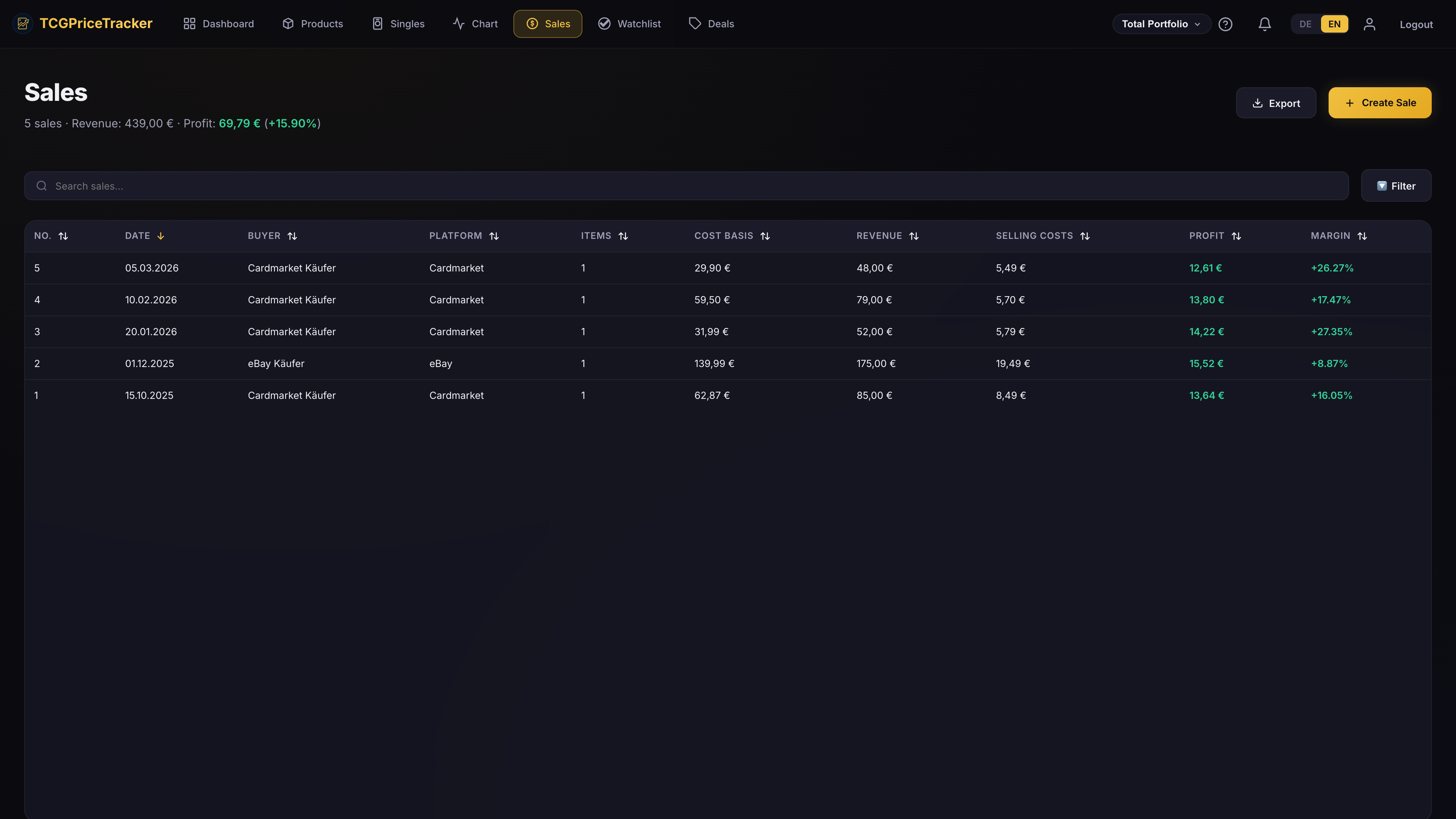
Selling creates the second half of the documentation. What matters is not the sale price on its own but what remains: revenue minus purchase cost, fees, shipping and tax. That is exactly the calculation a sales record contains – with the date, quantity sold, sale price per unit and the average purchase price of the position leaving your holdings, followed by total revenue, total purchase cost, the deductions and the realised result.
One boundary worth knowing here too: the document evidences your transaction for your own records. It is not an invoice in the VAT sense – anyone selling commercially needs proper invoices with all the legally required details.
Separating holdings: multiple portfolios
As soon as you collect privately and buy deliberately for resale, a single list becomes useless. An insurer cares about the private collection; an analysis of your trading activity cares about the rest. Mixed together, neither can be stated cleanly.
That is what portfolios are for: separate areas inside one account, with entries movable between them and a combined view across all of them. A valuation report can be limited to a single portfolio – so you get a document covering exactly the part in question, rather than everything you own.
Setting the split up from the start saves sorting it out later. Sensible cuts are private versus trading stock, graded versus ungraded, or one portfolio per game.
Keeping it current without effort
Documentation rarely fails at the setup stage; it fails at maintenance. These four habits are enough:
- Record at purchase, not later. The date and price are known at the exact moment you will later be unable to reconstruct them.
- Keep the purchase receipts. The order confirmation or invoice is the actual evidence; the list is the overview on top of it.
- Pull and file a valuation report once a quarter. That gives you a history of dated snapshots rather than only today's state.
- Enter sales immediately. Otherwise the remaining holdings are wrong and the next valuation report comes out too high.
The rest runs on its own: price data is pulled from Cardmarket and updated daily; by default your collection is valued by entry price in your card's language and condition, with the trend price alongside. A CSV export of your holdings is included in every account, the free one as well – exported files can be edited and imported again. The valuation report as a PDF is part of the yearly plan; the sales record is available to every paying account.
Related reading: Work out what a Pokémon card is worth · How to sell Pokémon cards · Trading card portfolio tracker
Frequently asked questions
How do I document my trading cards for insurance?
With a complete inventory list that identifies every position unambiguously: name, set, number, language, condition, any grading, quantity, plus purchase date and price. Add a value statement with a clear date and a named price source. Whether and up to what amount your policy covers collections is something to clarify with your insurer beforehand – that is in the contract, not in the document.
Will an insurer accept a valuation report like this?
That is entirely the insurer's decision and cannot be promised in advance. A valuation report is a structured statement of your own data with a traceable price source and a stated date – not an appraisal. For high individual values, insurers frequently ask for an independent appraisal in addition.
What is the difference between an inventory list and a valuation report?
The inventory list answers what you own and is an ongoing state. The valuation report answers what those holdings were worth on a particular day, making it a snapshot. Because market prices move daily, a valuation report only ever holds for its stated date – which is why that date belongs visibly on the document.
Do I need these documents for my accountant as well?
What is relevant for tax and how it should be treated is for your accountant to judge – this article deliberately does not advise on that. What you can provide regardless is clean paperwork: acquisition data with dates and prices, sales with revenue and costs, and the underlying receipts. The more complete the data, the fewer questions come back.
Is a spreadsheet enough?
For the static data, yes – a spreadsheet can hold name, set, condition and purchase price just as well. Where it fails is market values: you would have to look them up by hand for every position and refresh them regularly, otherwise you end up with a number and no date attached. That is precisely the part a tracker takes over.
How often should I create a valuation report?
Once a quarter is a good rhythm, plus whenever the holdings change significantly – after a larger purchase, a sale, or when cards come back from grading. Filed over time, those documents build a history of dated snapshots.
Can I document a private collection and trading stock separately?
Yes, using separate portfolios inside one account. Entries can be moved between them and there is a combined view across all of them. A valuation report can be limited to a single portfolio, so the document only covers the part in question.
Is a sales record the same as an invoice?
No. The sales record documents your transaction for your own files: date, quantity, sale price, purchase price, fees, shipping, tax and the realised result. It is not an invoice in the VAT sense – anyone selling commercially needs proper invoices with all the legally required details.
Does all of this apply to sealed products too?
Partly. You need set, language, quantity, purchase date and price just the same. Condition and grading drop out – instead you add the product type, the state of the packaging and above all whether the item is still sealed. Because resealing is an issue with older, expensive product, the receipt and provenance matter more here than with single cards. Photograph sealed products while they still are.
Document your collection before you need to
Record holdings by exact variant, let market values follow automatically, and pull a valuation report or sales record when you need one. Free to start, no credit card.
Start for free →