Sell Pokémon cards – where, when and for the best price
You have a collection sitting in a cupboard, maybe left over from your childhood or built up on purpose – and you are wondering what it is worth and how to turn it into cash. This guide shows you where to sell Pokémon cards, how to set the right price and which window you should not miss.
Why you ended up here
Maybe you found an old collection while tidying up. Maybe you have been deliberately building a portfolio for years and now want to realize your gains. Or you have duplicates from opened displays that you do not need. In every case, the same question comes up: How do I sell my Pokémon cards properly – and get the most out of them?
The honest answer: a sale is not decided the moment you list the card, but long before. Anyone who carelessly throws a card onto a classifieds site often gives away 30 to 50 percent of the possible proceeds – because the price was set wrong, the condition was misjudged or the timing was poor. This guide walks you through all three levers: where you sell, at what price and when.
One important note up front: we cover the entire selling process here across all platforms. At the end, we will show you how a tracking tool like TCGPriceTracker helps you determine the value before selling and record your real profit afterwards. The selling itself always happens externally – the tool is a tracker, not a marketplace.
💡 Good to know: The first step toward a good sale is never the listing, but the valuation. Anyone who knows their cards – set, condition, market value – negotiates from a position of strength and avoids costly bad decisions.
Where you can sell Pokémon cards
There is no single best place to sell. Which platform suits you depends on the value of the cards, your patience and whether you are willing to deal with shipping and fees. Here are the five most important options with their pros and cons.
Cardmarket
Cardmarket is the largest European marketplace for trading cards and the first choice for most sellers. The reach is enormous: buyers across Europe come here specifically looking for particular cards and sets. Prices are based on a transparent market, and the Cardmarket trend price serves as a fair reference.
- Advantages: Huge, ready-to-buy audience; fair, market-driven prices; moderate selling commission of around 5 percent; standardized condition and language details build trust.
- Disadvantages: You have to list, package and ship cards correctly; for a few cheap cards, the effort is hardly worth it; account maintenance and ratings take some discipline.
Cardmarket is particularly suited to mid- to high-value single cards as well as sealed products. Anyone who sells regularly builds a reputation here with good ratings that makes future sales easier.
eBay
eBay scores above all with its auction format and the sheer number of visitors. For rare cards, unusual pieces or graded slabs (PSA, CGC, BGS), an auction can drive the price up when several bidders compete.
- Advantages: Very high reach even beyond the TCG community; auctions can achieve top prices for sought-after pieces; buyer protection builds trust for expensive cards.
- Disadvantages: Comparatively high selling fees plus payment processing; more fraudulent buyers and complaints than on specialized platforms; fixed-price listings often compete with cheaper Cardmarket offers.
Local card shops
Selling to a local card shop is the fastest and easiest option: you bring your cards in, get an offer and go home with cash. No shipping, no platform fees, no waiting.
- Advantages: Instant payout; no shipping and no packaging; ideal for offloading large quantities or entire collections at once.
- Disadvantages: The shop has to make its own margin, so the buy-in prices are usually well below market value (often 50 to 70 percent of the trend price); rarely the best choice for individual top cards.
Classifieds
Classifieds platforms enable fee-free, local selling – often with in-person handover. This saves shipping costs and is straightforward if you live in a city with an active collector scene.
- Advantages: No selling fees; cash payment on pickup; no shipping risks with in-person handover.
- Disadvantages: Lower reach than Cardmarket or eBay; lots of hagglers and dubious inquiries; prices often get pushed down; shipping to strangers carries a fraud risk.
Conventions and card fairs
At TCG conventions, collector fairs and tournaments, you meet buyers directly who know exactly what they want. The sale is personal, fast and without shipping.
- Advantages: Direct contact with real collectors; instant cash payment; a great opportunity to trade and network; no shipping.
- Disadvantages: Only available occasionally (dates, travel); limited audience on site; table fees if you run your own sales table; price levels depend heavily on the event.
📊 Recommendation: Sell high-value single cards and sealed products via Cardmarket; rare or graded pieces via eBay auction; large quantities or quick liquidations to the local shop; local bargains via classifieds and fairs. Whatever the channel, the rule is the same: you know the value best via the Cardmarket trend price.
Before you sell: know the value. With TCGPriceTracker you see the Cardmarket trend price of your entire collection at a glance – updated daily straight from Cardmarket.
Setting the right selling price
The most common reason for poor sales is a mispriced card – too high (the card sits unsold) or too low (you give away money). To find the right price, you need three building blocks: the Cardmarket trend price, an honest condition assessment and – where relevant – an understanding of grading.
The Cardmarket trend price
The trend price is the price figure that matters for your sale:
- Trend price: A weighted average of the items most recently actually sold. It filters out outliers and reflects the most realistic market value. For pricing your sale, it is your most important reference point.
Rule of thumb: anchor your price to the trend price and adjust according to condition and your desired selling speed. If you want to sell safely and quickly, go slightly below the trend price. If you are patient, you can list at the trend price or just above it.
The impact of condition (NM, EX, GD)
A card's condition is decisive for its price. Cardmarket works with standardized grades – the most important are:
- NM (Near Mint): Almost flawless, only minimal signs of wear. Fetches the full trend price or more.
- EX (Excellent): Light marks such as minor edge wear. Typically 10 to 25 percent below NM.
- GD (Good): Visible signs of wear, creases or whitening. Well below NM, often only a fraction of the trend price.
Assess the condition honestly. A card sold as NM with visible flaws leads to complaints and bad ratings that cost more in the long run than the few extra euros you make. Photograph valuable cards in good light and describe flaws transparently.
Grading: PSA, CGC and BGS
For high-value cards in top condition, professional grading can multiply the value. Services like PSA, CGC and BGS grade cards on a scale (usually 1 to 10) and seal them in a protective case (slab). A PSA 10 of the same card can fetch many times the value of the ungraded version.
But: grading costs money and time. It only pays off when the expected added value clearly exceeds the costs – that is, for valuable cards that are highly likely to receive a top grade. For cheap or slightly damaged cards, grading eats up the profit. Check the trend price of the graded version beforehand to assess whether it is economically worthwhile.
💡 Good to know: In TCGPriceTracker you can record the grading status of your cards and flag foil or reverse holo variants. This way you keep track of which pieces are graded and which you still want to submit – before you decide on a sale.
When to sell? Market timing and risks
The same card can be worth double or half depending on the timing. Anyone who watches the market does not sell at random, but in favorable windows. These factors determine the timing.
Making the most of hype phases
Pokémon prices react strongly to attention. A viral social media moment, a prominent mention, a new card in competitive play or collector hype around a particular set can send prices soaring within days. Such spikes are ideal selling windows – provided you spot them in time.
Out of print and set rotation
When a set is no longer printed (out of print), supply becomes scarce and prices often rise over the long term. Sealed products of popular, discontinued sets are among the most reliable stores of value. Anyone who bought early can earn good returns here with patience.
The risk of reprints
The flip side: if the manufacturer announces a reprint of a sought-after card or set, supply can suddenly rise and push prices down. Anyone holding an expensive card whose reprint is on the horizon should seriously consider selling before the new edition is released.
The overall market situation
The market as a whole fluctuates too. After major set releases, a lot of fresh material is in circulation, which can put short-term pressure on single-card prices. In quieter phases, prices normalize again. A look at the price trend over several weeks helps distinguish short-term dips from genuine trends.
🎯 Pro tip: Put cards you want to sell on your watchlist with a price alert in TCGPriceTracker. As soon as the trend price reaches your target level, you get an email – so you do not miss the selling window while you are focused on something else.
Don't miss the right moment. With price alerts by email, TCGPriceTracker automatically notifies you as soon as a card reaches your selling target – based on up-to-date daily Cardmarket trend prices.
Step by step: From valuation to sale
Here is how to proceed in a structured way instead of carelessly listing individual cards. These four steps get the most out of your collection.
Step 1: Value your collection
First get an overview. Record which cards and sealed products you own, in what condition and – if known – at what purchase price. Look up the Cardmarket trend price for every relevant position. For large collections, a tracking tool that calculates the total value automatically is worthwhile, rather than laboriously adding things up in a spreadsheet. You can find a detailed guide in How to determine the value of Pokémon cards.
Step 2: Choose a platform
Decide per card or bundle where you sell. Rule of thumb: high-value singles and sealed products on Cardmarket, rare or graded pieces via eBay auction, large quantities quickly to the local shop, local deals via classifieds or fairs. Always factor in the fees – 5 percent on Cardmarket looks different from the higher eBay rates plus shipping.
Step 3: Create the listing
Describe the condition and variant (foil, reverse holo, edition) correctly. Take sharp photos in good light, especially for valuable cards. Set the price based on the trend price and your desired selling speed. Honesty about condition pays off: it avoids complaints and protects your rating.
Step 4: Factor in shipping and fees
Package securely: a penny sleeve, a toploader or team bag and a sturdy, waterproof envelope are a must. For higher-value cards, insured shipping with tracking is worthwhile. Subtract the platform fee, payment processing and shipping costs from your selling price to know your real net proceeds. Then log the sale to document your actual profit per card.
Common mistakes when selling
These mistakes regularly cost sellers money or nerves. Anyone who knows them avoids them easily.
- Setting the price by gut feeling: Without a look at the trend price, you either sell too cheaply or get stuck with the card. Always check the current Cardmarket data.
- Describing the condition too optimistically: An embellished description leads to complaints, returns and bad ratings. Better to assess conservatively.
- Not knowing the purchase price: Without a documented purchase price, you never know whether a sale really makes a profit or is a loss-making deal.
- Forgetting fees and shipping: What looks like a profit often shrinks considerably after deducting commission, payment processing and postage.
- Packaging poorly: A creased card or one damaged by moisture in the buyer's hands means a reversal and hassle – especially for expensive pieces.
- Selling at the wrong time: Selling in the middle of a price dip or shortly after a reprint announcement leaves money on the table. Watching the timing pays off.
- Missing hype spikes: Anyone who does not track price movements only realizes after they fade that the ideal selling window was open. Price alerts help.
Platform comparison at a glance
Which platform suits your sale? This direct comparison sums up reach, fees, speed and the typical use case.
| Platform | Reach | Fees | Speed | Best for |
|---|---|---|---|---|
| Cardmarket | ✓ very high (EU) | approx. 5% commission | medium | valuable singles & sealed |
| eBay | ✓ very high | higher + payment processing | medium (auction) | rare & graded cards |
| Local card shop | ✗ low | ✓ none | ✓ instant | large quantities, quick liquidation |
| Classifieds | medium (local) | ✓ none | variable | local sales without shipping |
| Conventions / fairs | medium (on site) | possible table fee | ✓ instant | in-person sales & trading |
The comparison shows: for maximum proceeds on individual valuable cards, there is rarely a way around Cardmarket or eBay. For speed and simplicity, the local shop and fair win. In every case, what matters is that you know the market value before you sell – otherwise you negotiate blind.
First track, then sell smart
TCGPriceTracker is not a marketplace – selling always happens externally on Cardmarket, eBay and the like. But the tool covers exactly the steps before and after the sale where most mistakes happen: determining the value, finding the right moment and documenting the profit cleanly.
Determine the value before selling
All prices in your portfolio are updated automatically every day from Cardmarket – based on the Cardmarket trend price. You see at a glance what your entire collection is worth, without having to look up each card individually. This way you go into every sale with a realistic price in mind.
Catch the right moment
With the watchlist and price alerts by email, you are notified as soon as a card reaches your desired selling level. Instead of checking the market manually every day, you let the tool keep watch for you and only react when it is worth it.
Document the profit after selling
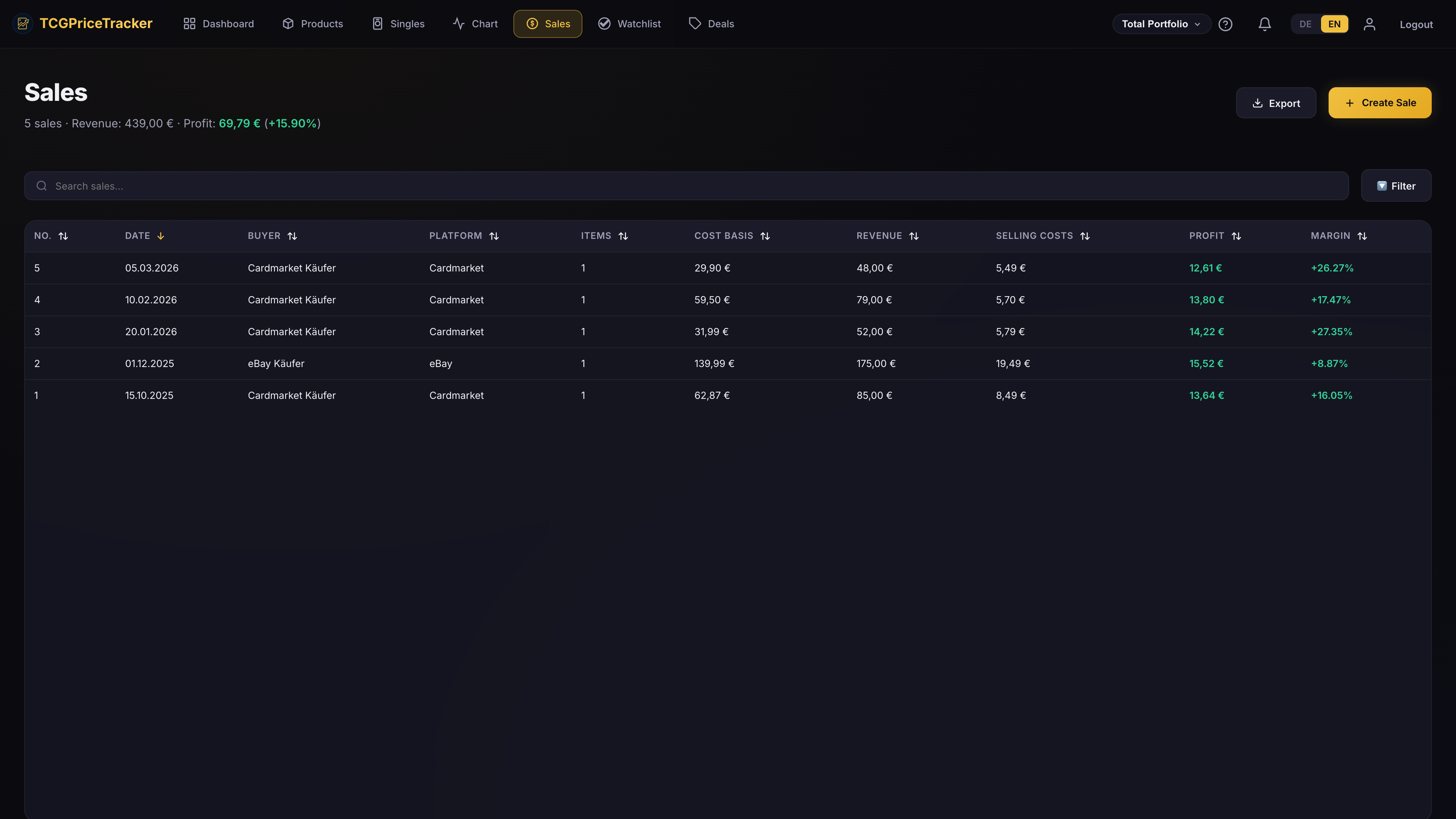
Enter the purchase price and TCGPriceTracker automatically calculates the ROI and profit per item as well as for your entire collection. When you have sold a card externally, you log the sale in the tool and see your actual profit margin with a clear sales and profit analysis. This way you know exactly which pieces paid off.
More features for sellers
Over 21 TCGs in one tool, CSV import and export for existing lists, grading status tracking and the flagging of foil and reverse holo variants round off the package. The free plan allows up to 20 products, 30 singles and 10 watchlist entries – ideal for getting started. Anyone who needs more uses the Pro plan for €5.99 per month or €49.99 per year.
How to keep an entire collection systematically in view is explained in detail in our guide Track your trading card portfolio. What is left after commission and shipping is covered in Cardmarket fees, and the records a sale produces in Selling trading cards: tax records.
First determine the value, then sell smart. Start for free with up to 20 products, 30 singles and 10 watchlist entries – and document your profit after every sale. No credit card required.
Frequently asked questions about selling Pokémon cards
Where is the best place to sell my Pokémon cards?
For valuable single cards and sealed products, Cardmarket usually gets you the best prices with moderate fees and a wide reach. eBay works well for rare or graded cards thanks to its auction format. Local card shops and classifieds offer quick, fee-free sales, but often at lower prices. Conventions and card fairs are worthwhile for selling in person without shipping.
How do I set the right selling price for Pokémon cards?
Use the Cardmarket trend price as your guide, as it reflects the most realistic market value and filters out outliers. Also factor in the condition (NM, EX, GD) and whether the card is graded (PSA, CGC, BGS), since both strongly affect the price you can achieve.
When is the best time to sell Pokémon cards?
The best time is often during a hype phase, for example when a set goes out of print, a card becomes relevant in competitive play or a social media trend emerges. Be cautious of announced reprints, which can push prices down. Anyone who tracks the trend price over time spots favorable selling windows earlier.
What fees apply when selling Pokémon cards?
Cardmarket charges a selling commission of around 5 percent. Depending on the category, eBay charges similar to higher selling fees plus payment processing. Classifieds and direct sales to a local card shop are usually fee-free, but the selling prices are often lower. Shipping costs and packaging are added on top for online sales.
Is it worth getting Pokémon cards graded before selling?
Grading by PSA, CGC or BGS pays off mainly for high-value cards in top condition, since a high grade can significantly increase the value. For cheap or slightly damaged cards, the grading costs often exceed the added value. Check the trend price of graded versions beforehand to assess whether it is economically worthwhile.
How do I ship sold Pokémon cards safely?
Put single cards in a penny sleeve and a toploader or a team bag and send them in a sturdy, waterproof envelope. For higher-value cards, insured shipping with tracking is recommended. Document the condition before shipping with photos to prevent complaints.
Can I sell my Pokémon cards directly with TCGPriceTracker?
No, TCGPriceTracker is a tracking tool and not a marketplace. The actual sale takes place externally on platforms such as Cardmarket or eBay. However, TCGPriceTracker helps you determine the fair value before selling, find the right moment and document your actual profit after the sale.
How do I document my profit when selling Pokémon cards?
Record the purchase price and selling price per item to calculate your real profit margin. In TCGPriceTracker you can log sales and get a profit analysis across your entire collection. This way you can see which cards paid off and how much return your portfolio achieved overall.
Ready to sell your Pokémon cards smartly?
First determine the value, find the right moment and document your profit – start now for free with TCGPriceTracker and track your collection with daily price updates straight from Cardmarket.
Start for free now →