Selling Trading Cards in Germany: Tax Records
Two numbers decide almost everything: one year and 1,000 euros. If you have owned a card for more than a year, § 23 of the German Income Tax Act no longer treats the sale as a private disposal. Below that, what counts is your total gain from all private disposals in the calendar year – and 1,000 euros is an exemption limit, not an allowance. Neither can be shown without a documented purchase date and purchase price. That is what this article is about.
The short version
| Question | Answer in one sentence |
|---|---|
| How long must I hold? | More than one year between acquisition and disposal – as set out in § 23 (1) sentence 1 no. 2 of the Income Tax Act |
| How high is the threshold? | Gains remain tax-free if the total gain in the calendar year is below 1,000 euros (§ 23 (3) sentence 5) |
| Limit or allowance? | An exemption limit – once it is reached, the entire gain is taxable, not just the part above it |
| Since when 1,000 euros? | Since 1 January 2024; before that it was 600 euros |
| Does each sale count separately? | No, all private disposals in a calendar year are added together |
| What does the platform report? | From 30 sales or 2,000 euros in income per year, the reporting duty under the Platform Tax Transparency Act applies |
| What do I need as evidence? | Purchase date, purchase price, sale date, proceeds and costs incurred – per position |
The one-year holding period
For tax purposes, trading cards are "other assets". For those, § 23 (1) sentence 1 no. 2 of the Income Tax Act covers disposals where the period between acquisition and disposal is not more than one year. Read the other way round: if more than a year lies between the two, this provision no longer applies.
The year is counted to the day, not by calendar years. What matters are acquisition and disposal – in practice, the dates on your records. Buy in March 2025 and sell in February 2026, and you are inside the year. Wait until April 2026, and you are past it.
And this is where the real problem starts: the rule only helps those who can evidence it. A screenshot of your current collection value does nothing. What is needed is the acquisition date per individual card – and in a collection grown over years, that is exactly the figure that is almost always missing.
💡 Good to know: The period relates to the individual asset, not to the collection as a whole. If you sell cards bought in 2019 alongside cards bought last month, one order contains two completely different situations.
1,000 euros: a limit, not an allowance
§ 23 (3) sentence 5 of the Income Tax Act states that gains remain tax-free where the total gain from private disposals in the calendar year was less than 1,000 euros. That figure was raised from 600 to 1,000 euros by the Growth Opportunities Act, effective 1 January 2024.
The decisive point, and the one most people miss: this is an exemption limit, not an allowance. With an allowance, the first 1,000 euros would always stay free. With an exemption limit, the benefit falls away entirely once the limit is reached – then the whole gain is taxable, not merely the part above it.
On top of that, all private disposals in a calendar year are added together. Three sales with a gain of 400 euros each come to 1,200 euros – a fully taxable amount, even though every single sale was far below the limit. Nor is it only cards: other private disposals in the same year count as well.
In practice that means: anyone selling something in December should know where they stand for the year. A total reconstructed painfully in the following year comes too late for that decision.
What platforms report to the tax office
Since January 2023, Germany has applied the Platform Tax Transparency Act (PStTG), which implements the EU directive known as DAC7. Online platforms have since been obliged to pass transaction data about their sellers to the tax authorities.
A report is made where a private individual carries out 30 or more sales in a calendar year or receives income of 2,000 euros or more. Reaching either threshold is enough. Anyone staying below both is not reported by the platform.
Those thresholds arrive faster than they sound. Break up a collection into single cards and you have 30 sales over one weekend – even if the total only comes to a few hundred euros.
Important context: A report is not a tax demand. It only means the tax administration receives the data. Whether anything follows from it, and how much, depends on the individual case – and that question belongs with a tax adviser or the tax office, not in a blog article. The practical point for you is different: if data is being transmitted, you want to know and be able to evidence your own numbers.
Which records you need
Regardless of how a case is ultimately assessed, the underlying data is always the same. Per position sold:
| Item | What it is for |
|---|---|
| Acquisition date | Evidences the holding period and therefore the one-year rule |
| Acquisition cost | The starting point of any calculation of gain |
| Description of the card | Set, number, language, condition – so the position is unambiguous |
| Quantity | Indispensable where you hold several copies of the same card |
| Disposal date | The second point in the holding-period calculation |
| Proceeds | What was actually received |
| Costs of the sale | Platform fees, shipping, packaging – they reduce the result |
The acquisition date is the sore point. Sale proceeds can be pulled from platform history if need be; purchase dates from 2019 usually cannot. Anyone who wants to rely on the holding period has to document at the time of purchase, not at the time of sale. Retrospectively it is mostly too late.
Purchase date and purchase price sit on every position. Start free with 20 products, 30 single cards and 10 watchlist entries – no credit card.
How to keep them as you go
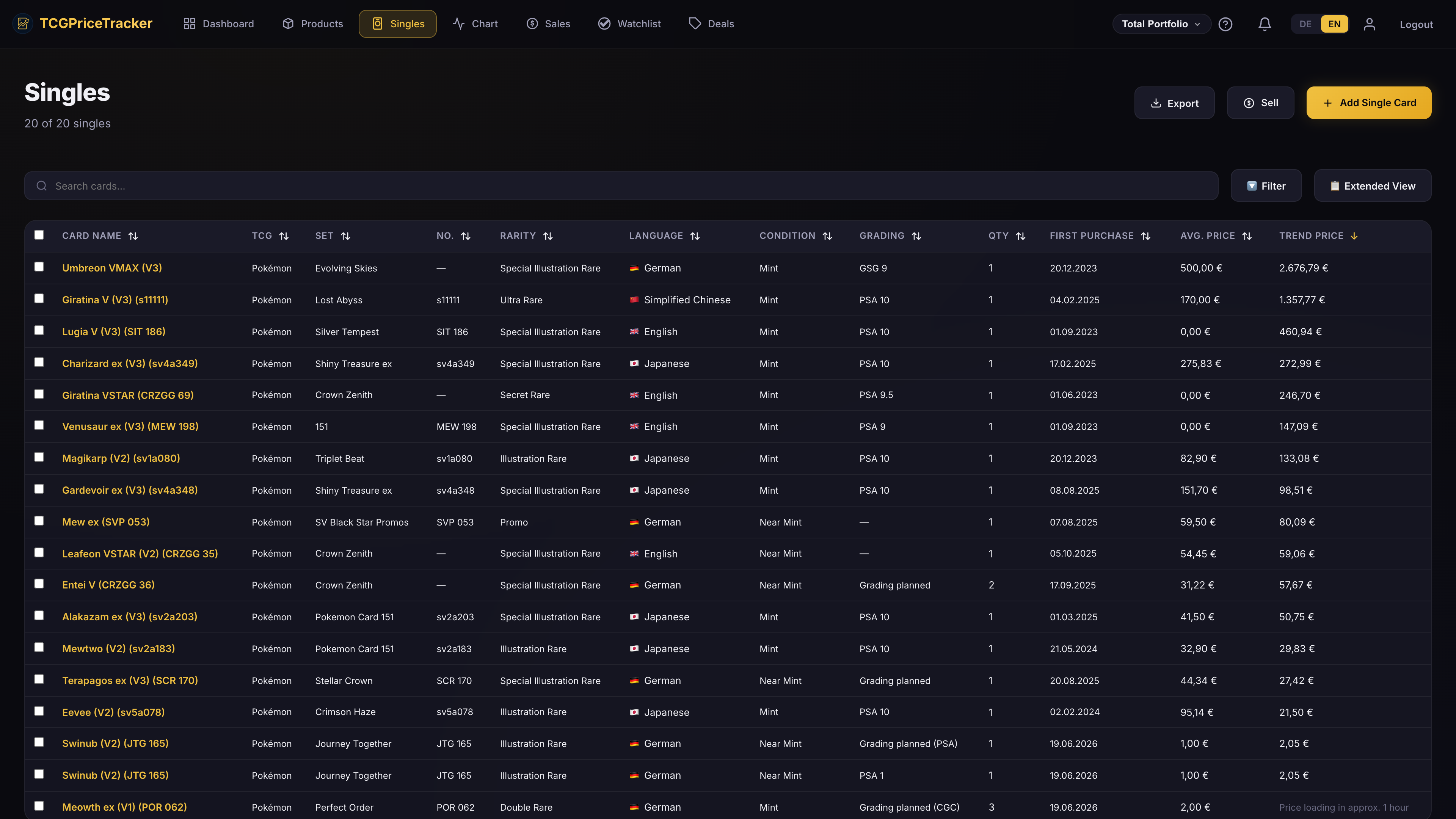
In TCGPriceTracker you enter purchase date, purchase price and quantity for every position. That is deliberately not required for day-to-day use – but for the holding-period question it is the decisive figure, and it cannot be reconstructed later.
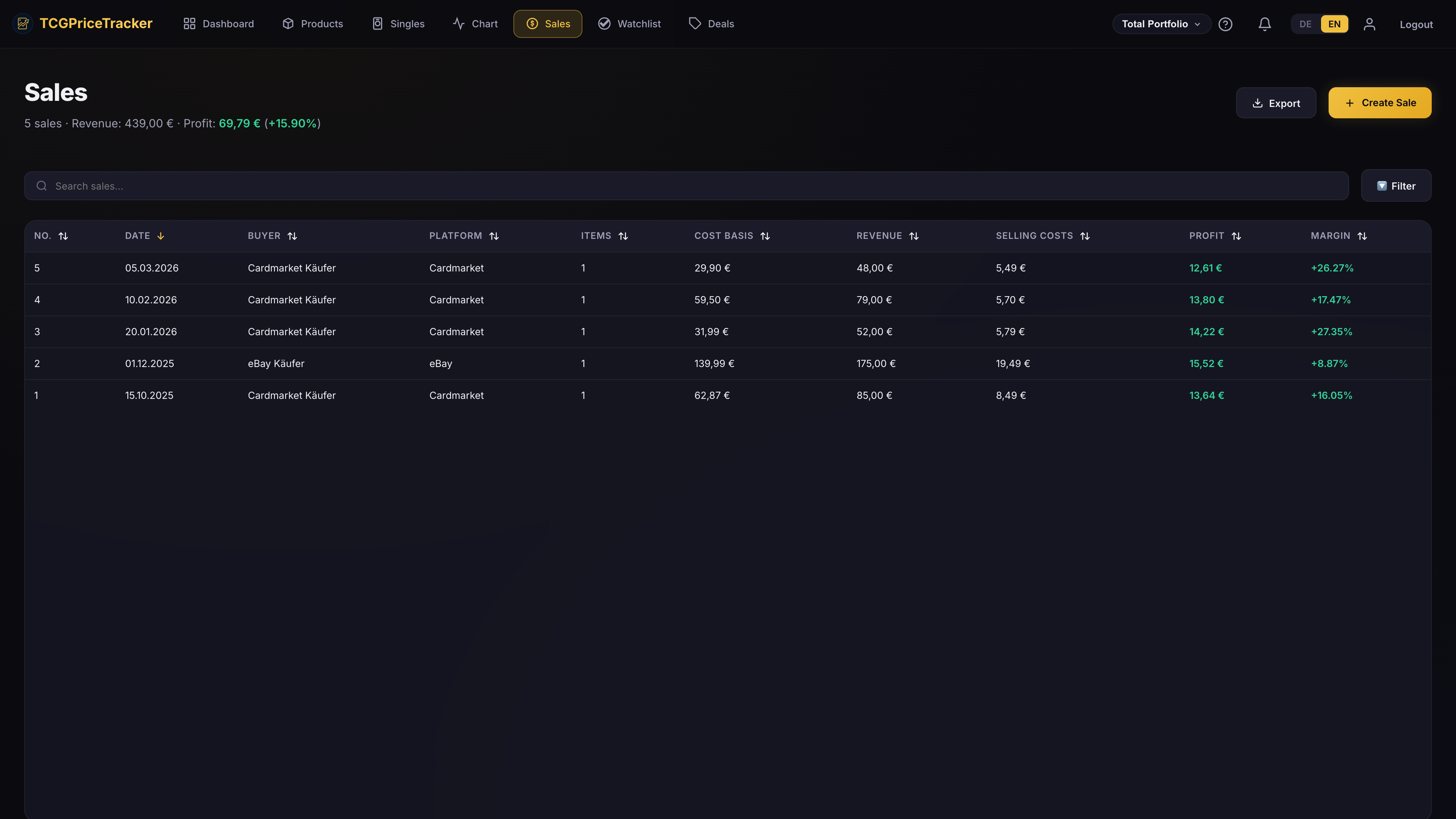
When you sell, you record the transaction as a sale, with proceeds, costs, fees and shipping. The tool calculates the realised result per sale from that. This history is what produces the yearly picture you need in order to answer the threshold question at all.
There are two ways to hand it on. The CSV export of your holdings is included in every account, the free one as well. The PDF sales record documents a single transaction with proceeds, costs, fees, shipping and realised result, and is available in every paid account. How to turn that into a clean handover is covered in detail in Document your card collection.
One point of honesty: the tool is a documentation aid, not tax software. It calculates no tax, fills in no tax return and says nothing about how your case should be assessed. It makes sure the numbers are there when somebody asks for them.
Four mistakes that can get expensive
Documenting only the sale. The proceeds sit in the platform history, the purchase date nowhere. Without an acquisition date, the holding period cannot be evidenced – the rule comes to nothing even though it was met in substance.
Reading the limit as an allowance. "I stay under 1,000, so the first 1,000 are free" is not how it works. Once the limit is reached, the entire gain is affected.
Looking at sales individually. Four sales with a gain of 300 euros each come to 1,200 euros. What counts is the total gain for the calendar year, not the single transaction.
Forgetting costs. Platform fees, shipping and packaging belong in the calculation of the result. Record only the gross proceeds and you overstate your result – and lose the records that would support the deduction. What actually comes off when selling via Cardmarket is covered in Cardmarket fees.
Related reading: Document your card collection · How to sell Pokémon cards · Cardmarket fees
Frequently asked questions
How long do I have to own a card?
§ 23 (1) sentence 1 no. 2 of the Income Tax Act covers disposals of other assets where not more than one year lies between acquisition and disposal. If more than a year lies between them, the provision does not apply. The period is counted to the day and applies per card, not to the collection as a whole. How that plays out in your case is a question for your tax adviser.
What does exemption limit rather than allowance mean?
With an allowance, part of the gain would always stay untaxed. With an exemption limit, the benefit disappears entirely once the limit is reached. § 23 (3) sentence 5 leaves gains tax-free where the total gain in the calendar year was less than 1,000 euros – reach that figure, and the entire gain is taxable.
Are my sales reported automatically?
Platforms report under the Platform Tax Transparency Act where 30 or more sales were made in the calendar year, or 2,000 euros or more received. Either threshold is enough on its own. The report itself does not trigger a tax liability – it only means the data is transmitted.
I no longer have my old purchase prices. What now?
That is the most common situation with collections grown over time, and not a question that can be answered generally – how to deal with missing acquisition data belongs in a conversation with your tax adviser. What makes practical sense is to document properly from now on: for everything you buy going forward, you will have date and price without gaps.
Do fees and shipping count?
Acquisition costs and the costs connected with the disposal are what matter for determining the result. So record platform fees, shipping and packaging per sale rather than just the gross proceeds. The sales record in the tool covers exactly those items.
Does TCGPriceTracker calculate my tax?
No, and that is deliberate. The tool documents purchase date, purchase price, sale date, proceeds and costs per position and makes them available as CSV or a PDF sales record. The tax assessment stays with your tax adviser or the tax office.
Record the purchase date now, don't hunt for it later
Purchase price, purchase date and quantity per position – plus sales with proceeds, fees and realised result. Start free, no credit card.
Start for free now →