Cardmarket Fees: What You Actually Keep
The sales commission on single cards is 5% of the sale price – that is the part everyone knows. The part that actually makes small sales unprofitable is a different one: mis-costed shipping. On a 5-euro card, postage set 70 cents too low costs you almost three times the commission. This article walks through the full calculation, from sale price to what is left in your pocket.
Status of these figures: checked on 29 July 2026. Fee models change – the binding, current overview is on Cardmarket's "Prices and Fees" page. This article explains the calculation; check the exact rates there if in doubt.
The short version
| Item | What it covers |
|---|---|
| Sales commission | 5% of the sale price for single cards – borne by the seller alone; the rate can differ for sealed products |
| Registration and listings | Free – you pay nothing for listing itself |
| Payment processing | Costs can arise depending on the payment route used |
| Currency conversion | Applies where settlement is in a currency other than your account's |
| Shipping | You set it yourself – this is where the biggest losses happen |
| Packaging | Toploader, sleeve, envelope: appears on no statement, but costs money |
| Rule of thumb | On small sales, shipping decides the margin, not the commission |
The sales commission
Single cards sold carry 5% of the sale price. The maths is unspectacular: 1 euro on a 20-euro sale, 12.50 euros on a 250-euro sale. Sealed products carry a slightly different rate – anyone regularly selling displays and boxes should check the current figure in the fee overview.
One point worth being clear about: this commission is borne by the seller alone. As a buyer you pay no commission – your cost is the item price plus whatever shipping the seller sets. So if you are wondering whether buying through the platform costs more than elsewhere: there is no surcharge on the buyer side.
What costs nothing: registration, listing offers and maintaining your stock. There is no listing fee and no base fee for private sellers. You only pay once something has sold.
That makes the model markedly different from auction platforms, where merely offering an item can cost money. For collectors who part with a few cards now and then, it is the more comfortable route.
What else can come off
Beyond the commission there are items that apply depending on the situation and cannot be summed up in a single percentage.
Payment processing depends on the route chosen. Using the platform's trustee service has a different cost structure from a direct transfer.
Currency conversion affects anyone serving buyers outside the euro area, or whose account is held in another currency. The conversion margin works quietly: it does not appear as its own line at the top, it hides in the amount that arrives.
Finally there is an optional seller subscription for high-volume sellers with additional features. It does not pay off for occasional sales; for commercial volumes it can.
💡 Good to know: Precisely because these items apply differently, a single percentage misleads. The only meaningful comparison is: what came in, and what actually reached you? That difference is what you should record per sale.
The path to net proceeds
| Step | Calculation |
|---|---|
| 1. Income | Sale price of the cards + shipping received |
| 2. Deduct commission | 5% of the cards' sale price |
| 3. Deduct actual postage | What you really paid the post office |
| 4. Deduct packaging | Envelope, toploader, sleeve, tracking where used |
| 5. Net proceeds | What is left with you |
| 6. Result | Net proceeds minus the card's purchase price |
Step 6 is the one most people skip. A sale with 40 euros in net proceeds is not a 40-euro profit – it is 40 euros minus whatever the card cost you. Without a documented purchase price, that simply cannot be stated.
Shipping: the underestimated item
This is where the real leverage sits. Take a card at €5.00 where you charge €1.50 for shipping, while postage and packaging actually cost you €2.20.
The commission is 25 cents. The shipping shortfall is 70 cents – almost three times as much. You received €6.50; off it came €0.25 commission and €2.20 in real shipping costs. That leaves €4.05, which against a card price of €5 is about 19% less.
Across thirty small sales the shipping shortfall adds up to €21, while the commissions together come to €7.50. Anyone who feels the effort is not worth it usually does not have a platform problem, but a postage-costing problem.
Two practical consequences. First: work out postage and packaging honestly once, then set your shipping options accordingly. Second: bundle small amounts instead of sending them individually – the same parcel with five cards instead of one spreads the fixed costs over five times the value.
Three worked examples
| Sale | Commission | Actual shipping | Net | Share of card price |
|---|---|---|---|---|
| 1 card €5, €1.50 shipping charged | €0.25 | €2.20 | €4.05 | 81% |
| 5 cards €60, €2.50 shipping charged | €3.00 | €3.20 | €56.30 | 94% |
| 1 card €250, €6 shipping charged | €12.50 | €6.50 | €237.00 | 95% |
The pattern is unambiguous: the smaller the sale, the more the fixed costs eat the margin. At €250 you keep 95%, at €5 only 81% – and that despite an identical commission percentage in both cases.
Proceeds, fees, shipping and result per sale. Start free with 20 products, 30 single cards and 10 watchlist entries.
Recording sales properly
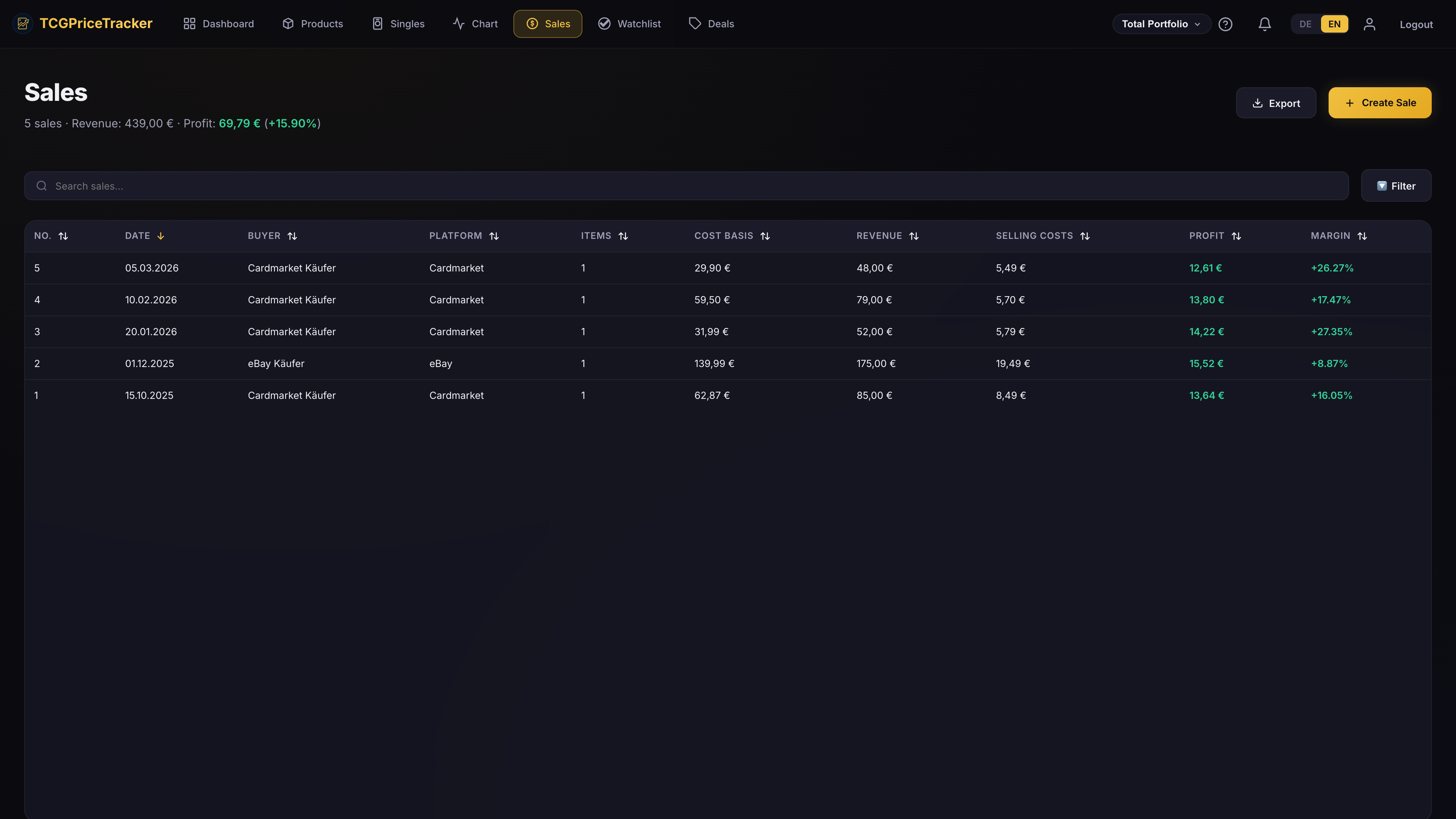
In TCGPriceTracker you create a sale with proceeds, cost, fees, shipping and tax, and the realised result follows from it. That answers the question from step 6 automatically instead of leaving it to mental arithmetic.
The benefit only shows across several sales. Record twenty transactions with real figures and you can see in black and white the card value at which single-item shipping starts to be worth it for you – an insight no rule of thumb from the internet can supply, because it depends on your postage and your packaging.
For handing it on there is the PDF sales record, which documents one transaction with all its items; it is included in every paid account. Why that is worth more than a simple overview is covered in Selling trading cards in Germany: tax records.
Frequently asked questions
How high is the sales commission?
5% of the sale price for single cards. Sealed products carry a slightly different rate. The binding, current overview is on Cardmarket's fee page – fee models can change.
Does listing offers cost anything?
No. Registration, buying and listing offers are free. The commission only arises once something has actually sold.
Why are cheap cards barely worth selling?
Because postage and packaging are fixed costs. On a 5-euro card the commission is 25 cents, while shipping costed 70 cents too low costs almost three times that. Of €6.50 received, €4.05 remains – 19% below the card price.
What can I do about it?
Work out postage and packaging honestly once and set your shipping options from that instead of guessing. And bundle small amounts: one parcel with five cards spreads the same fixed costs over five times the value.
Are there fees on sales abroad?
On top of the commission, a currency conversion can apply where settlement is not in your account's currency. That margin does not appear as its own line on the sale; it shows up in the amount that reaches you.
Does TCGPriceTracker calculate the fees automatically?
No, you enter the amounts when creating a sale – proceeds, cost, fees, shipping and tax. The tool calculates the realised result from them and keeps it, so that across several sales you can see the card value at which the effort starts paying off for you.
See what you actually keep
Sales with proceeds, fees, shipping and realised result – plus purchase price and value per position. Start free, no credit card.
Start for free now →