TCG Glossary: Trading Card Terms Explained
"NM/M, Reverse Holo, no whitening, PSA 9 in the slab, rest is bulk." Newcomers understand roughly half of a listing like that — and pay for the other half. This glossary explains over 70 terms from condition, rarity, prices, grading and community slang, each in a single sentence.
Most of these terms originate in English-language communities and are used unchanged across Europe, which is why the same abbreviations appear in listings regardless of the seller's country.
Condition
The common condition scale in European trading has seven steps. It is the single biggest price factor there is — on older cards, the gap between the best and worst step is easily tenfold.
| Code | Term | Meaning |
|---|---|---|
| M | Mint | Flawless, as if fresh from the booster, without any sign of handling |
| NM | Near Mint | Almost flawless, at most minimal marks visible on close inspection |
| EX | Excellent | Light marks on edges or surface, unobtrusive at a distance |
| GD | Good | Clearly visible handling marks, but no damage |
| LP | Light Played | Obviously played, edges and corners noticeably worn |
| PL | Played | Heavily played, several clear defects |
| PO | Poor | Severe damage: creases, tears, water marks, writing |
Alongside these are the terms for individual defects:
| Term | Meaning |
|---|---|
| Whitening | White spots along the edges where the coloured back has rubbed off — the most common reason for a downgrade |
| Edge wear | Edge deterioration in general, often used interchangeably with whitening |
| Corner wear | Wear at the corners; corners are more vulnerable than edges |
| Surface scratches | Scratches on the surface, especially visible on holo cards |
| Print line | A line in the print caused during manufacturing, not handling damage |
| Centering | How evenly the artwork sits between the borders; often uneven from the factory and a main criterion in grading |
| Bend / crease | A bend without, or a crease with, a permanent fold — a crease is a serious defect |
| Warping | Curving of the card, usually caused by humidity or temperature swings |
Rule of thumb: condition grades are the seller's own assessment, not a verified standard. When in doubt, grade one step lower — the alternative is complaints. More on that in The Most Common Selling Mistakes.
Rarity and card types
Every game has its own rarity tiers. These terms appear across all of them:
| Term | Meaning |
|---|---|
| Common / Uncommon / Rare | The basic rarity tiers, usually shown by a symbol at the bottom of the card |
| Holo | A card with a shiny foil area, usually within the artwork |
| Reverse Holo | The shine sits not in the artwork but across the rest of the card — a separate variant of the same card |
| Foil | Umbrella term for foil-treated cards; the standard expression in Magic |
| Full Art | Artwork across the entire card face, without a conventional frame |
| Alt Art | An alternative illustration of the same card, usually far more sought after than the standard version |
| Secret Rare | A card numbered beyond the official set size — technically "not in the set" |
| Promo | A card outside regular sets, from campaigns, tournaments or collaborations |
| Enchanted | The highest rarity tier in Lorcana, with its own treatment and its own artwork |
| Special Illustration Rare | A premium illustration variant in newer Pokémon sets, often the most expensive card in a set |
| Error card | A card with a manufacturing fault; depending on the fault it can carry a premium or be worthless |
| 1st Edition | A mark denoting the first print run; on old Pokémon sets a substantial price factor |
| Shadowless | An early Base Set variant without the drop shadow on the artwork frame, rarer than the later version |
| Reprint | A re-release of a card in a later set; usually pushes down the price of the original printing |
How strongly these traits move the price depends on the game and the set — rarity alone says little; what matters is the interplay of print run and demand — broken down in What Makes a Card Valuable. How that plays out per game is covered in One Piece card value and in Magic Reserved List.
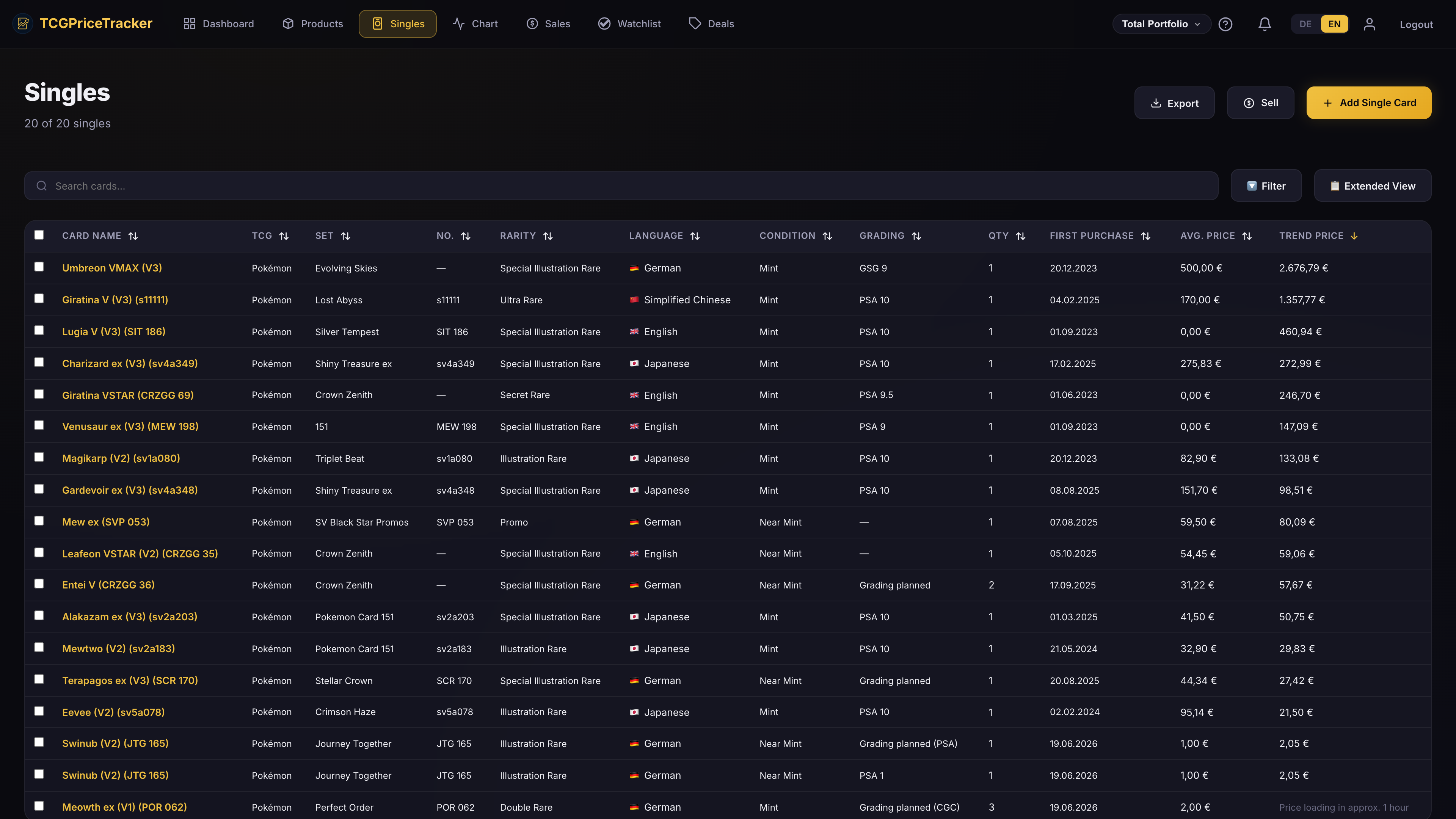
Prices and market
| Term | Meaning |
|---|---|
| Trend price | Weighted average of recently sold copies — the most usable yardstick for current value |
| Lowest price | The cheapest current listing; often in poor condition and therefore not a yardstick |
| 30-day average | Mean of the past month's sales, useful for judging whether the trend is off |
| Spread | The gap between what buyers pay and what sellers ask |
| Market value | What is actually paid on the market — not to be confused with the asking price |
| ROI | Return on investment: the ratio of profit to capital employed |
| Selling commission | The share of the sale price the platform keeps |
| Bulk | Cards of very low individual value, traded only in quantity |
| Bulk price | Price per card in a quantity sale, usually fractions of a cent up to a few cents |
| Sealed | Unopened original packaging; traded in its own right and valued separately |
| Singles | Individual cards, as opposed to packaged product |
A common misunderstanding: the price shown for a card is a market value, not a guaranteed payout. What actually arrives also depends on commission, payment fees and shipping — worked through in Cardmarket Fees.
Grading
In grading, a service assesses a card's condition against fixed criteria, assigns a grade and seals the card in a protective case.
| Term | Meaning |
|---|---|
| PSA | Professional Sports Authenticator, the most widely used grading service worldwide |
| BGS | Beckett Grading Services, known for subgrades and the Black Label |
| CGC | Certified Guaranty Company, the third major provider |
| Slab | The sealed case a graded card sits in |
| Gem Mint | The grade 10 at PSA: near perfect across all criteria |
| Pristine 10 | At BGS and CGC, a step above the regular 10 with stricter requirements |
| Black Label | A BGS distinction awarded when all four subgrades are 10 — extremely rare |
| Subgrades | Individual grades for centering, corners, edges and surface |
| Population report | An overview of how many copies of a card exist at each grade |
| Crossover | Regrading an already graded card with a different provider |
| Regrade | Resubmitting in the hope of a better grade |
| Turnaround | Processing time from arrival to return shipment |
| Declared value | The stated card value that determines the price tier of a submission |
Whether the effort pays depends on the card's value and the expected grade — worked through in Is Grading Worth It. On waiting times see The PSA Backlog, and on submitting from Europe PSA in Germany.
Products and packaging
| Term | Meaning |
|---|---|
| Booster | A single pack of cards with random contents |
| Display / box | A carton with typically 18, 24 or 36 boosters |
| Case | A shipping carton holding several displays |
| Elite Trainer Box (ETB) | A Pokémon product with boosters, sleeves, dice and accessories |
| Blister | A small retail unit with one to three boosters, often with a promo card |
| Bundle | Several boosters combined in one package |
| Theme deck / starter | A ready-made deck for beginners, playable without further cards |
| Collection box | A set of boosters plus one or more special cards |
| Pull rate | The probability of pulling a particular card from a booster |
| God pack | A booster containing nothing but rare cards |
| Weighing / mapping | Attempts to identify boosters with rare cards in advance — treated as fraud in the trade |
| Resealed | Packaging that was opened and closed again; a scam in sealed-product sales |
With sealed product, look closely at the shrink wrap: a resealed pack is the most common route to fraud in this area. How to spot tampered product is covered in Buying Cards Safely.
Protection and storage
| Term | Meaning |
|---|---|
| Penny sleeve | A thin, cheap sleeve for basic protection |
| Perfect fit | A close-fitting inner sleeve, usually worn under a second sleeve |
| Double sleeve | Two sleeves layered: perfect fit inside, a sturdy sleeve outside |
| Toploader | A rigid plastic holder against bending, standard for shipping valuable cards |
| Magnetic holder | A premium holder with a magnetic closure, often with UV protection |
| Team bag | A resealable bag protecting sleeve and toploader together |
| Binder | An album with card pockets |
| Side loader | A binder pocket loaded from the side so cards cannot slip out |
| Deck box | A box for sleeved cards, usually 60 to 100 of them |
| Storage box | A larger box for several hundred to several thousand cards |
As a rule of thumb: a plain sleeve is enough up to a few euros, a toploader joins it from double-digit values, and genuinely expensive cards sit double-sleeved in a magnetic holder. Details are in Storing Trading Cards, the shipping options in Shipping Trading Cards.
Community slang
| Term | Meaning |
|---|---|
| Chase card | The most sought-after card in a set, usually the reason boxes get bought |
| Hit | A valuable card pulled from a booster |
| Pull | Getting a particular card out of a booster |
| PC | Personal collection: cards that are not for sale |
| Grail | The one card someone has been hunting for a long time |
| WTB / WTS / WTT | Want to buy / sell / trade — shorthand in listings and forums |
| LGS | Local game store: the card shop around the corner |
| Rip | Opening boosters |
| Flipping | Reselling quickly for profit |
| Scalping | Buying up scarce product to resell it above retail |
| Cardboard crack | A self-deprecating name for the hobby's addictive pull |
| Vintage | Older sets; in Pokémon usually the Wizards era up to around 2003 |
| Modern | Current sets from the running product generation |
| Meta | The decks and cards currently dominating tournament play |
| Staple | A card played in many decks and therefore in lasting demand |
| Rotation | Older sets leaving the tournament format; often pushes down prices of affected cards |
Nowhere does the price impact of such rule changes show more clearly than in Yu-Gi-Oh! — covered in Yu-Gi-Oh! Card Value: Why the Banlist Matters.
Terms understood — now your own collection
Trend prices per card, updated daily, with total value and history. Free, no credit card.
Start for free →Frequently asked questions
What does NM mean on trading cards?
NM stands for Near Mint: almost flawless, at most minimal marks that you find on close inspection. It is the second-highest step on the common condition scale, directly below Mint, and by far the most frequent grade in the trade.
What is the difference between Holo and Reverse Holo?
On a holo card the artwork area shines; on a reverse holo the rest of the card around the artwork does. They are two separate variants of the same card, traded separately and often worth different amounts.
What does bulk mean?
Bulk means cards of very low individual value that are traded only in quantity — usually for fractions of a cent up to a few cents each. Selling them individually does not pay, because the time spent exceeds the proceeds.
What is a slab?
The sealed plastic case a graded card sits in. It holds the card and the label with grade and serial number, and cannot be opened without visible destruction. Opening it voids the grade.
What does whitening mean?
White spots along the edges where the coloured back has rubbed away and the light core shows through. It is the most common reason for a downgrade and especially conspicuous on dark card backs.
What is a chase card?
The most sought-after card in a set — usually the actual reason displays get bought and opened. It often determines the price of the whole set, because demand concentrates on that single card.
Is a term missing?
The glossary is extended over time. If something you looked for is not here, write to us via the contact page — terms that come up repeatedly get added.
What is your collection worth?
Trend prices per card, updated daily, with total value and history. Start free, no credit card.
Start for free →