Buying Trading Cards Safely: the Checklist
Most bad purchases fail on inattention rather than fraud: the wrong variant, condition overestimated, too much paid. All three take minutes to avoid. And for actual fraud there is one signal that is almost always right — a price well below market is not a bargain, it is a warning.
The checklist in short
| Check | What to look for |
|---|---|
| Platform | Buyer protection in place, reviews visible, total cost shown before purchase |
| Seller | Sales history, the text of reviews rather than stars, how criticism is handled |
| Variant | Set, card number, language, foil — is all of it in the listing? |
| Condition | Description and photos must agree |
| Photos | Front and back, sharp, unfiltered; close-ups of corners on expensive cards |
| Price | Check against completed sales, not against other listings |
| Shipping | Sleeve and toploader promised, tracking above a certain value |
| Payment | Only routes with buyer protection — never a friends-and-family transfer |
The platform
Your choice of platform determines your risk more than any single check afterwards, because it sets what you actually hold in a dispute.
Three things should be in place. Buyer protection, meaning a procedure that applies when goods do not arrive or arrive differently. Visible reviews with history, not just a star rating. And transparency about total cost before purchase: item price, shipping and any fees must be visible together.
Specialist trading card marketplaces have an advantage over general classifieds: condition and variant are captured in a structured way. That cuts misunderstandings considerably — the most common cause of trouble is not fraud but an unclear description.
Assessing the seller
The star rating alone says little, because nearly every seller sits close to top marks. Three other things are more informative.
The number of completed sales. An account with twenty or more transactions has a history you can judge. A new account is not automatically bad — but on expensive cards it is a reason for extra caution.
The text of the reviews, not the stars. That is where you find whether shipping was quick, how it was packed and whether the condition matched. Exactly the points that affect you.
How criticism is handled. The way a seller responds to a negative review says more than ninety-nine positive ones. Factual replies are a good sign; justifications and counter-attacks are not.
Reading the listing
This is where most avoidable bad purchases happen, and usually without any ill intent from the seller.
The variant must be unambiguous. Set, card number, language and whether it is a foil. If any of these is missing, ask — the same card can differ by a multiple between variants. Why that is so is covered in What makes a card valuable.
Description and photos must agree. If it says "Near Mint" but you can see whitening on the corners in the image, the image wins. Where they conflict, ask rather than hope.
Photos of the actual copy, not a catalogue image. Front and back, sharp and unfiltered. On cards in the hundreds, close-ups of all four corners are reasonable — a seller who will not supply them either has something to hide or works carelessly.
💡 Good to know: A polite question is also a test. Someone who answers quickly and specifically has the card in front of them. Evasive answers, or none, are a reason to walk away.
Judging the price
A fair price comes from completed sales, not from what other sellers are asking. Asking prices can sit arbitrarily far above market value, and regularly do.
The Cardmarket trend price is built for exactly this: a weighted average of items recently sold, filtering out individual outliers. That is your reference point.
And then the rule that really summarises this article: an offer well below market price is suspicious, not cheap. There is usually a reason for an unusually low price — a counterfeit, an undisclosed flaw, the wrong variant, or no goods at all. How to check for fakes yourself is covered in Spotting fake cards.
When comparing, do not forget total cost. An offer at €15 plus €5 shipping is dearer than one at €18 with cheap shipping. What you compare is what you end up paying.
Payment and protection
The most important sentence first: never pay by a route that carries no buyer protection. Payments declared as money to friends or family are deliberately excluded from protection — which is precisely why dubious sellers propose them. A discount for doing so is not a saving, it is the price of your protection.
Equally sensible: communicate inside the platform. Anyone steering you onto another channel early is removing the deal from the protection system. It may be meant harmlessly, but in a dispute it becomes your problem.
And when the card arrives: check it immediately. Compare condition against the description and, on expensive cards, run the authenticity checks. Buyer protection procedures have deadlines, and they run from delivery.
After the purchase: record it
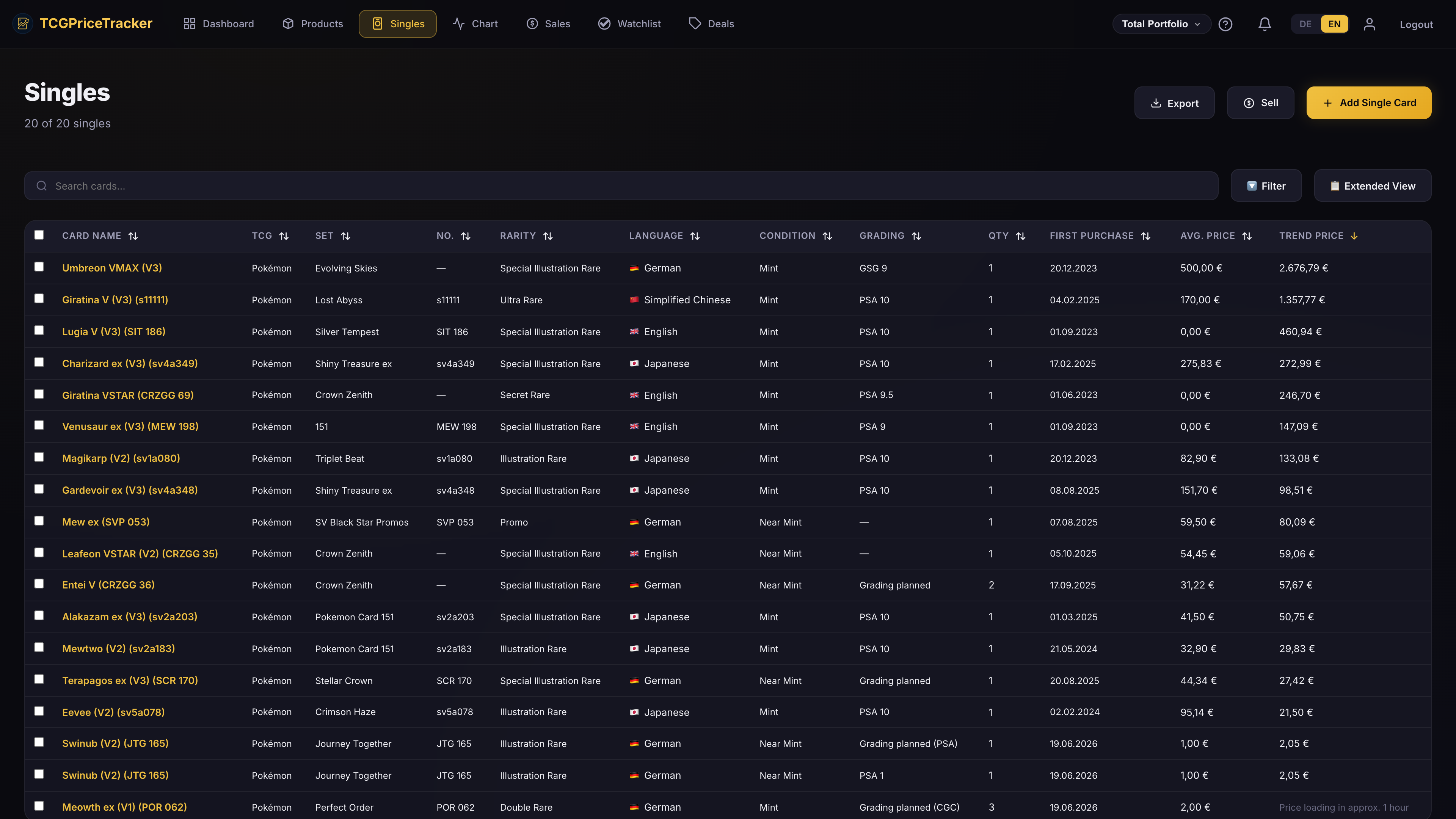
The least glamorous advice in this article is the one people most often regret ignoring: record the purchase straight away. Purchase date, purchase price, variant.
Two reasons. First, your return only works out with a real cost basis — which includes shipping and, on imports, the customs charges. Second, the purchase date cannot be reconstructed later but is needed as soon as you sell; why, is covered in Selling trading cards: tax records.
In TCGPriceTracker you add the card via its exact Cardmarket link, enter price and date, and both are done — valuation continues automatically from there.
Purchase date, purchase price and value per card in one place. Start free with 20 products, 30 single cards and 10 watchlist entries.
Related reading: Spotting fake cards · What makes a card valuable · Cardmarket price tracker
Frequently asked questions
How do I recognise a reputable seller?
By a traceable sales history, by the text of the reviews rather than the star count, and by how they respond to criticism. A new account is not automatically bad, but on expensive cards it is a reason for extra caution.
Is a cheap offer always suspicious?
Slightly below market is normal — sellers want to sell quickly. It becomes suspicious at clear deviations downwards. Behind those usually sits a counterfeit, an undisclosed flaw, a different variant than stated, or no goods at all.
How do I check whether the price is fair?
Through completed sales, not other listings. The Cardmarket trend price captures exactly that. What matters is comparing the same variant — set, number, language and foil must match. And compare total cost including shipping.
Which payment method should I choose?
One with buyer protection. Payments declared as money to friends are deliberately excluded — which is why dubious sellers propose them. A discount for doing so is not an advantage, it is the price of your protection.
What should I do as soon as it arrives?
Compare the condition against the description and, on valuable cards, check authenticity. Buyer protection procedures have deadlines running from delivery, so waiting weeks is not wise. And record the purchase with date and price straight away.
Is all this worth it on cheap cards?
Not every point. Below around ten euros, a platform with buyer protection and a quick look at the variant is enough. The full list pays off in the range where a bad purchase genuinely hurts.
Record purchases while you still remember them
Purchase date, purchase price and value development per card — in euros, based on Cardmarket trend prices. Start free, no credit card.
Start for free now →