Spotting Fake Trading Cards: eight checks
A counterfeit costs a few cents to produce; the original costs a hundred euros or more — that ratio explains why there are so many. The good news: you do not need expertise, you need eight checks that together take under three minutes. The most reliable of them is the light test, and it takes ten seconds.
The short version
| Check | Time | Reliability |
|---|---|---|
| Light test | 10 sec. | very high |
| Measure dimensions (63 × 88 mm) | 20 sec. | very high |
| Compare the back with a real card | 30 sec. | high |
| Print under magnification | 30 sec. | very high |
| Feel the surface texture | 10 sec. | high |
| Check typeface and spelling | 30 sec. | high |
| Look at the holo pattern | 20 sec. | medium |
| Test the bend | 10 sec. | medium |
Why there are so many fakes
The economics are simple and therefore effective: a counterfeit card costs a fraction of a euro to produce. It sells at the price of the original. On cards in the hundreds, the margin beats most other counterfeit goods — and the risk to the counterfeiter is low, because many buyers never check.
Four groups are hit hardest. High-value vintage cards, where prices are highest. Modern chase cards such as alt arts and special rarities, where demand is high and supply short. Sealed product, because the contents cannot be checked before opening. And now graded cards too, where it is not the card that is faked but the sealed holder around it.
The converse holds: below about five euros, faking does not pay. If you buy cheap bulk you have little to worry about — attention belongs on the expensive pieces.
The eight checks
1. The light test. Hold the card against a strong light source. Real cards are built from several paper layers with a dark core in the middle, so almost no light passes through. Counterfeits usually use simpler stock without that barrier layer and glow visibly. It is the fastest check and among the most reliable.
2. The dimensions. Standard cards measure 63 × 88 millimetres. Fakes often deviate by half a millimetre or more because they are trimmed after printing. A ruler is enough; if you check often, use callipers. A second signal is thickness: cards that are too thin or noticeably stiff are suspect.
3. The back. This is the best comparison point, because it is identical across every card in a game. Put a known-genuine card beside it and look at the colour tone — fakes are often lighter or shifted towards purple — as well as the sharpness of the outlines and the exact position of the elements.
4. The print under magnification. With a loupe or a phone camera in macro mode, genuine cards show a fine, regular rosette dot pattern from professional printing. Digitally printed fakes instead show irregular clouds of dots or washed-out transitions. Look especially at small type and colour gradients.
5. The surface texture. Modern special cards have a texture you can feel that follows the artwork — pronounced in places, smooth in others. Fakes either feel entirely flat or carry an evenly applied texture that does not match the image. Running a finger over it with your eyes closed helps more than it sounds.
6. Typeface and spelling. The fonts used are standardised. Counterfeiters take similar but not identical typefaces — noticeably often in numerals and special characters. Also check the card name, set number and copyright line for typos. Spelling mistakes have become rarer but still occur, and when they do they are conclusive.
7. The holo pattern. Shine effects are set-specific and follow a particular pattern. On fakes the effect is missing, looks flat, or has been applied as a sticker rather than built in — in which case you can sometimes see an edge.
8. The bend. Carefully. A genuine card flexes slightly and springs back. Fakes tend to crease or stay bent. This is the least certain check and the only one that can cause damage — do it last, and gently.
💡 Good to know: A single odd observation proves nothing. Print runs vary and genuine cards have tolerances too. It becomes suspicious when several checks flag at once.
The order to check in
Start with the checks that are quickest and most conclusive — in most cases you are done in thirty seconds.
First light and dimensions: together they take half a minute and rule out most poor fakes. Then the back in comparison, because it needs no tools. Only then is it worth reaching for the loupe.
Texture, typeface and holo follow if you are still unsure. The bend stays last and can be skipped once you are confident.
What matters is comparison: always keep a known-genuine card alongside, ideally from the same set. Without a reference you are judging in a vacuum, and that is exactly what good fakes rely on.
Sealed product and fake slabs
Two special cases where the eight checks do not apply.
With sealed product you cannot see the cards. All that helps is scrutinising the packaging itself: print quality, colour fidelity, how the wrap sits, weight against a known example. And the simplest rule of all — a display well below market price is not a bargain, it is a warning.
With graded cards, what gets faked these days is not the card but the sealed holder and its label. The protection is simple and free: check the certificate number online with the grading service. If card, grade and image do not match the entry, the case is clear. More on which service stands for what in Is grading worth it?.
What to do if you received a fake
Document it first. Photograph both sides and capture each suspicious feature separately, ideally next to a genuine copy. Those images are the basis for everything that follows.
Then contact the seller, factually and with the evidence. Some sellers genuinely do not know the card is fake — they bought it themselves. A calm message leads to a refund more often than an accusation.
If nobody responds, use buyer protection from the platform or payment provider. Deadlines matter here: wait too long and the claim lapses.
And report the case. An honest review and a report to the platform protect the next buyer. Systematic counterfeiters only surface when cases are reported.
What this does to your collection
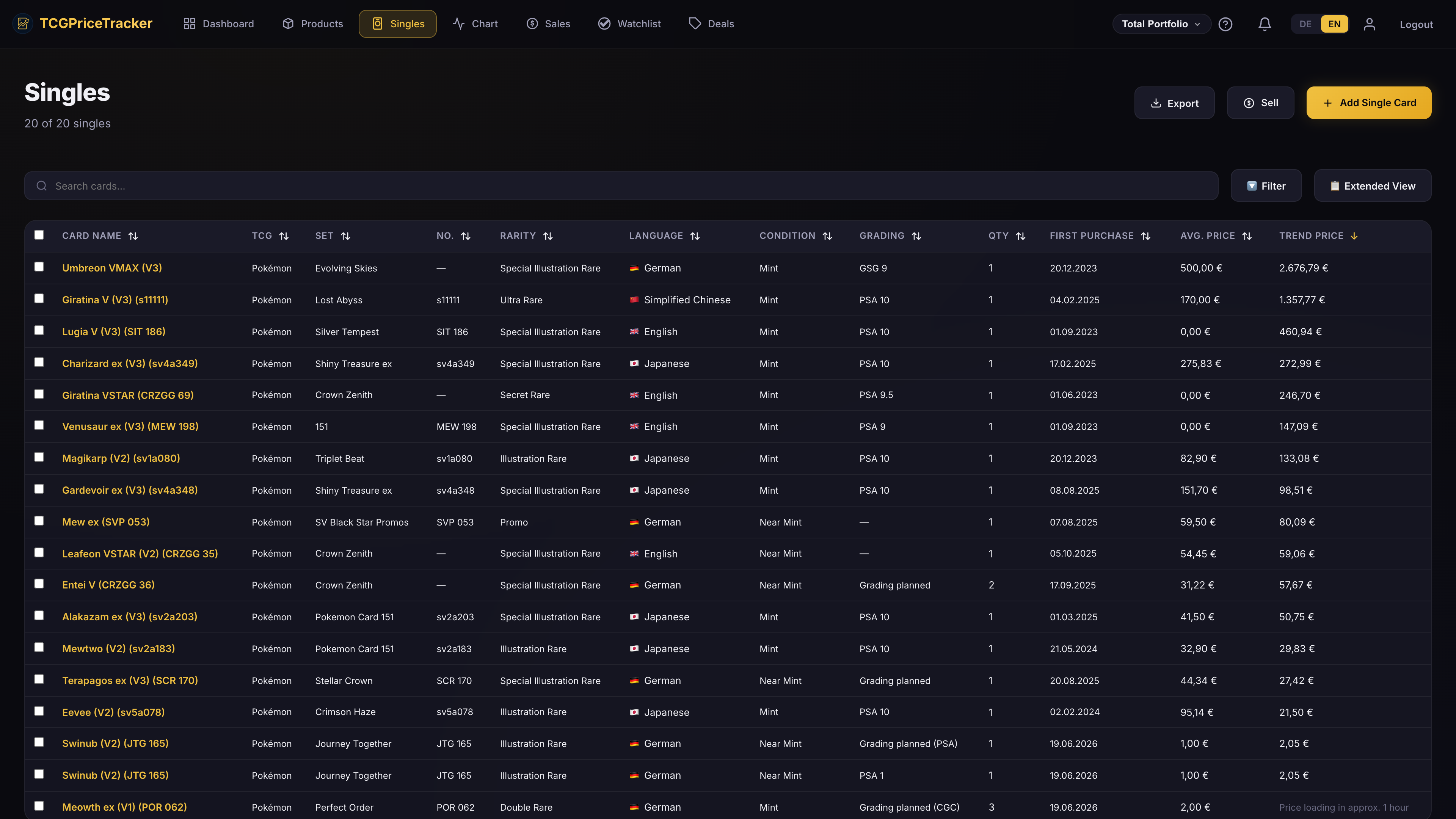
A fake in your holdings distorts two figures at once: your collection's total value and your return. The trend price a tracker shows applies to the genuine market item — it has no way of knowing what is actually in your sleeve.
In practice that means: if a purchase turns out to be fake, the position belongs out of your holdings, not merely annotated. Otherwise you keep calculating with a value you can never realise.
What helps is that TCGPriceTracker keeps purchase date and purchase price per position. That lets you place a bad purchase in time — and if the same seller appears more than once, it shows.
Holdings, purchase price and value per card in one place. Start free with 20 products, 30 single cards and 10 watchlist entries.
Related reading: Is grading worth it? · Pokémon card value · Document your card collection · Buying cards safely
Frequently asked questions
How reliable is the light test?
It is among the most reliable quick checks, because genuine cards have a dark core between the paper layers that blocks almost all light. It does not replace a second check, though: very good fakes now reproduce the barrier layer. Combine it with the dimensions.
How large is a genuine card?
The standard format is 63 × 88 millimetres. Deviations of half a millimetre or more are a clear warning, because fakes are often trimmed after printing. Unusual thickness or stiffness is worth checking too.
Can a fake pass grading?
Authentication is the first step at every grading service, and counterfeit cards are caught there. Fake holders with imitation labels do exist, however. So with graded cards, always check the certificate number on the provider's site and compare card, grade and image.
Which cards get faked most?
Anything expensive and in demand: high-value vintage cards, modern special rarities and alt arts, plus sealed product and, for some time now, graded cards via imitation holders. Below about five euros, faking does not pay.
I bought a fake — what now?
Document it first, then contact the seller factually; many do not know themselves. If they do not respond, buyer protection from the platform or payment provider applies — mind the deadlines. Then leave a review and report the case.
Do I have to check every card?
No. The effort pays off in the range where faking pays off for the seller — roughly from 30 to 50 euros. With cheap bulk the risk is low. What is always suspicious is an offer well below market price.
Know what is actually in your collection
Purchase price, purchase date and value per position — in euros, based on Cardmarket trend prices. Start free, no credit card.
Start for free now →