What Makes a Trading Card Valuable?
The most common misconception is that rare equals expensive. It does not. There are countless extremely rare cards nobody wants — and they are priced accordingly. Rarity is necessary but not sufficient. Five factors set the value, and only their interplay explains why one card costs five euros and the next five hundred.
The five factors
| Factor | Effect | How strong |
|---|---|---|
| Rarity | Limits supply | necessary, but useless on its own |
| Demand | Determines whether anyone will pay | without it, nothing else matters |
| Condition | Multiplies or halves the price | the strongest single lever |
| Variant | Separates apparently identical cards | a factor of 2 to 20 is possible |
| Time | New sets fall, vintage tends to rise | slow, but dependable |
Rarity: the overrated factor
Rarity limits supply — nothing more. It says nothing about whether anyone wants the card.
You can see this in any set: within the same rarity tier, prices differ by a factor of twenty. The print run is identical, the demand is not. A special rarity with a popular character costs a multiple of the same tier featuring an obscure one.
What still makes rarity important: it is the precondition. A card with a large print run can never stay expensive, however popular the artwork — there are simply enough of them. So rarity belongs in every list, just not at the top.
💡 Good to know: Older sets had smaller print runs than today's mass production. That is a major reason vintage cards are fundamentally scarcer — and a reason that can no longer change.
Demand: the underrated factor
Demand is the hardest factor to measure and the easiest to overlook. It comes from several sources that act independently.
Recognition of the character. A handful of characters carries a disproportionate share of every game's market. Anyone known outside the core scene has more potential buyers.
Competitive relevance. In games with an active tournament scene, cards appearing in successful decks rise — and fall when they rotate out or are banned. That effect is fast and can reverse just as fast.
Nostalgia. People who collected as children buy again twenty years later with different purchasing power. It is the slowest but most stable driver, because it tracks life stages rather than trends.
Outside attention. A viral video, an anniversary, a new adaptation: impulses like these move prices within days. They are usually short-lived, though — buying into them means buying at the top.
Condition: the strongest lever
For one and the same card, condition is the single largest price factor. The gap between a played and a flawless copy runs from double to a multiple, depending on the card.
The reason is distribution: very few old cards survive in top condition, because they were played with, bent and kept in binders. The older the card, the larger the premium for immaculate copies — and the rarer those copies become.
In practice buyers look at four things: centring of the artwork, corners without whitening, edges without wear, and a surface free of scratches. People grading their own cards are consistently too generous — when in doubt, go one step lower.
Where the premium is large enough, professional grading pays. Whether that applies to your card is worked out in Is grading worth it?.
Variant: same name, different price
Two cards can carry the same name and trade completely differently. This is where newcomers go wrong most often, because the name does not reveal it.
| Difference | What it means |
|---|---|
| Foil or not | The same card, often a separate market item with its own price |
| Alternate artwork | Different image, usually considerably scarcer |
| First edition | Early print runs are scarcer than reprints |
| Language version | Japanese prints are separate products with their own market |
| Promo | Event or insert cards follow their own logic |
In practice that means: before you look up a price, you have to know which variant you are holding. The set code and card number are printed on the card and are the most reliable route there — the name alone is not enough.
Time: why new sets nearly always fall
New sets follow a recurring pattern. In the first days few cards are in circulation and prices are high. Then thousands of packs are opened, supply jumps, and prices give way. Only weeks later does an equilibrium appear.
Buying at release therefore nearly always means buying expensive. For sellers it is the reverse — the first days are the best window.
Long term, the direction reverses for a small share of cards: once a set goes out of print and copies disappear through use, supply falls again. That affects far from every card, though — the large majority stays cheap permanently.
How to establish the value yourself
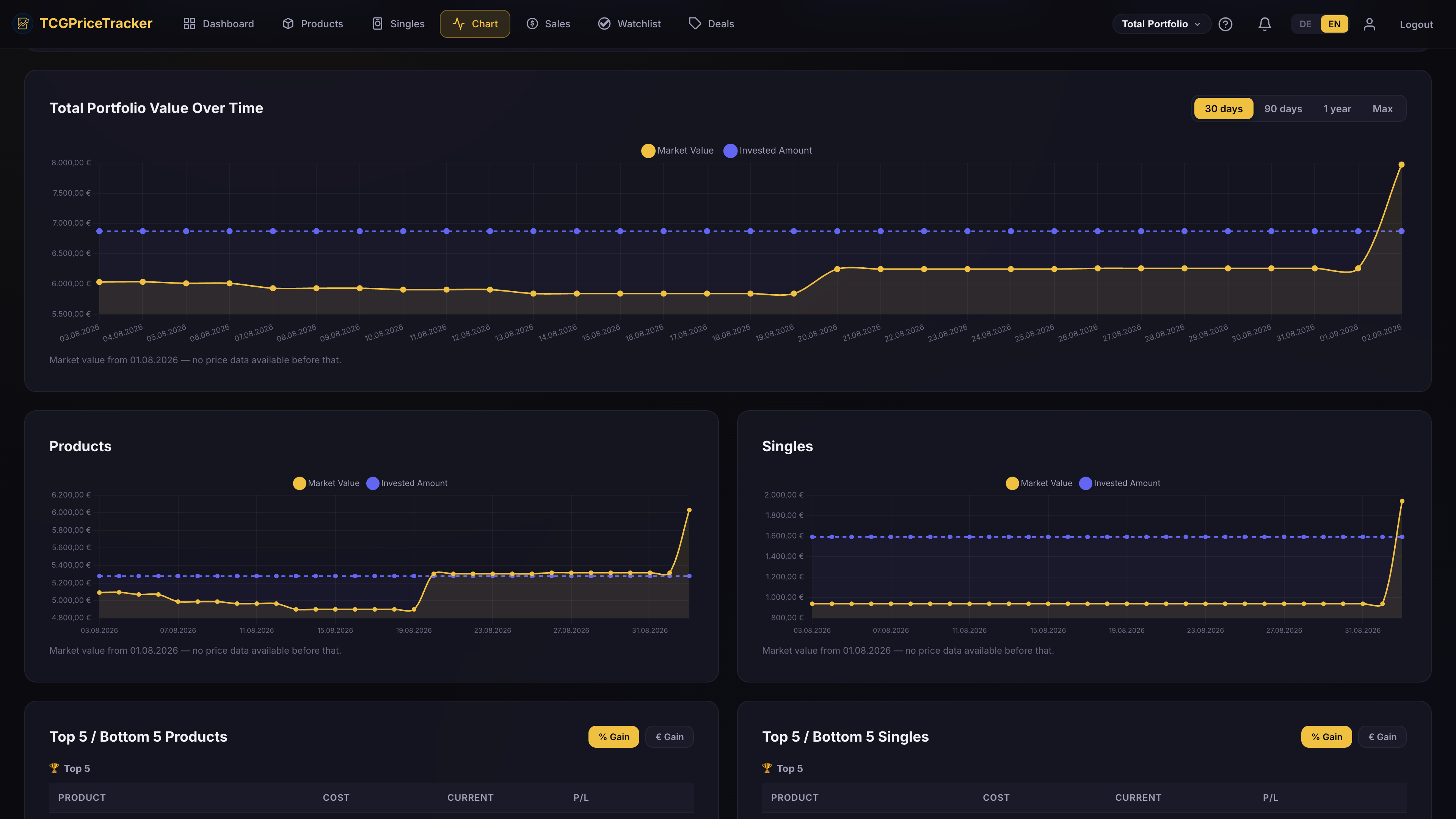
The practical route has three steps, and the first is the most important.
Identify the variant. Set, card number, language, foil or not. Skip this and you are comparing apples with pears, and everything after it is worthless.
Look at completed sales, not listings. What someone asks says little; what was actually paid is the reference. The Cardmarket trend price is built for exactly this — a weighted average of recently sold items that filters out outliers.
History rather than snapshot. A single price can be an exception. Only across weeks does it become clear whether a card sits stable, is rising, or is having a short-lived spike.
In TCGPriceTracker this runs automatically: you add the card via its exact Cardmarket link, the trend price updates daily, and the history builds itself. How to turn that into a valuation of your whole collection is covered in Pokémon card value.
Value and history per card, updated daily. Start free with 20 products, 30 single cards and 10 watchlist entries.
Related reading: Pokémon card value · Is grading worth it?
Frequently asked questions
Is a rare card automatically valuable?
No. Rarity only limits supply. Without demand even a very scarce card stays cheap — within the same rarity tier prices often differ by a factor of twenty. Rarity is necessary but not sufficient.
Which factor has the strongest effect?
For one and the same card, condition: between played and flawless lies double to a multiple, depending on the card. Across different cards it is demand that decides, because it determines whether anyone will pay at all.
Why do two cards with the same name cost different amounts?
Because they are different variants. Foil or not, alternate artwork, first edition, language version or promo — each is its own market item with its own price. The set code and card number printed on the card are the most reliable way to identify the right one.
Should I buy cards from new sets straight away?
Buyers usually do better by waiting: after release, supply jumps and prices give way until an equilibrium forms after a few weeks. For sellers it is exactly the reverse.
How do I know what my card is worth right now?
Through completed sales, not asking prices. The Cardmarket trend price captures exactly that: a weighted average of recently sold items that filters out individual outliers. What matters is having identified the right variant first.
Do trading cards rise in value long term?
A small share does, the large majority does not. The preconditions are limited supply, durable demand and good condition — where all three hold, value can rise over years. It cannot be predicted reliably, and trading cards are not an investment product.
Value and history instead of guesswork
Trend price per card, updated daily, with history across months. Start free, no credit card.
Start for free now →