Magic Reserved List: What It Is and Is Not
Few topics get used as an argument in the Magic market as often as the Reserved List — and few are misunderstood as often. It is a commitment by the publisher not to reprint certain cards. It is not a guarantee of value, not a law, and not a reason to treat a card as safe without checking. This article explains the difference.
What the Reserved List is
The Reserved List is a list of Magic cards that Wizards of the Coast has committed not to reprint in functionally identical form. It covers several hundred cards from the game's early years — sets from around the turn of the millennium onwards are no longer affected.
The phrase "functionally identical" carries the weight. The commitment rules out reprinting the card as a playable card. It does not rule out the card appearing in other forms: in collector products without tournament legality, in digital versions, or as artwork on other material. Most of the arguments about the list turn on exactly this distinction.
The short version: the Reserved List says "this card will not return as a playable reprint". It says nothing about price, nothing about demand, and nothing about whether the commitment will still stand in twenty years.
Why it exists
The list came about in 1996 in response to a breach of trust. In the mid-nineties, Wizards reprinted older, expensive cards in new sets — with the predictable result that prices of the original printings collapsed. Collectors who had invested heavily saw their holdings devalued, and the anger was considerable.
The Reserved List was the answer: a public promise never to do that again with a defined group of old cards. It is therefore less a market rule than a peace offering — created to win back trust, not to secure values.
The list has been adjusted several times since, but kept in substance. An exception that had permitted foil reprints was removed in 2010. Wizards has repeatedly stated it intends to keep the list.
What it means for prices
The effect is real: for a card on the list, supply cannot grow any further. What exists, exists — and tends to shrink over the years as cards get damaged or disappear into collections.
When that fixed supply meets rising demand, the price climbs harder than it would for a reprintable card. That is why the list's best-known cards — the old dual lands and the famous early cards from the original set — are among the most expensive Magic cards there are.
The decisive clause, though, is "meets rising demand". The Reserved List constrains only one side of the equation.
What it is not
Three misunderstandings come up again and again.
"Reserved List cards always go up." No. Limited supply is no protection against falling demand. If a format loses players, if the rules change, or if interest moves to other cards, a card that will never be printed again falls too. The list prevents supply pressure, not demand erosion.
"The list is binding." It is a self-imposed commitment by the publisher, not a contract with buyers and not a law. Wizards has repeatedly reaffirmed it — but what held in the past is still no guarantee for the future. Buying a card solely because it is on the list is a bet on a corporate decision continuing to hold.
"Anything on the list cannot be reprinted." Not as a tournament-legal card. Collector products outside tournament legality are not covered — and when such products appear, their effect on the originals' prices is its own contested topic.
This is why "it's on the Reserved List" does not work as a buying argument. It is one factor among several, and one that touches only the supply side. Basing a purchase on it means half the question was never asked.
Reprint risk on everything else
The more practically important side concerns the cards that are not on the list — that is, the overwhelming majority.
For them, every expensive card is a reprint candidate. The more in demand and the more expensive, the more attractive it becomes for a future product. And a reprint usually pushes down the price of existing printings noticeably — sometimes by a little, sometimes by half or more.
The risk is unevenly distributed:
| Card type | Reprint risk |
|---|---|
| On the Reserved List | No playable reprint to be expected |
| Expensive, widely played card off the list | High — these are exactly the cards that get reprinted |
| Special treatment (borderless, showcase, extended art) | The specific treatment is usually one-off, the card itself is not |
| Purely collectible card with no play relevance | Lower, because a reprint would serve little purpose |
Note the third row: a special treatment protects the treatment, not the card. If the same card later appears in another special version, both compete for the same demand. Which treatments exist and how they move prices is covered in Tracking Magic Card Prices.
What this means in practice
For collectors: the list is a reason to keep old cards in good condition — but not a reason to neglect condition. On the list's most expensive cards, condition makes a bigger price difference than on almost anything else. The same four points apply as everywhere: dark, dry, at a steady temperature and without pressure from above — covered in full in Storing Trading Cards.
For buyers: before a larger purchase off the list, it is worth checking how often the card has already been reprinted. A card that reappears every couple of years behaves very differently from one that has not been printed in fifteen.
For sellers: reprints are announced before they appear. Following product announcements gives you a head start on the price — the market often reacts to the announcement, not to availability.
Keeping reprint risk in view
What a price tracker does here is limited and still useful: it will not predict what gets reprinted — but it reliably shows you when something changes.
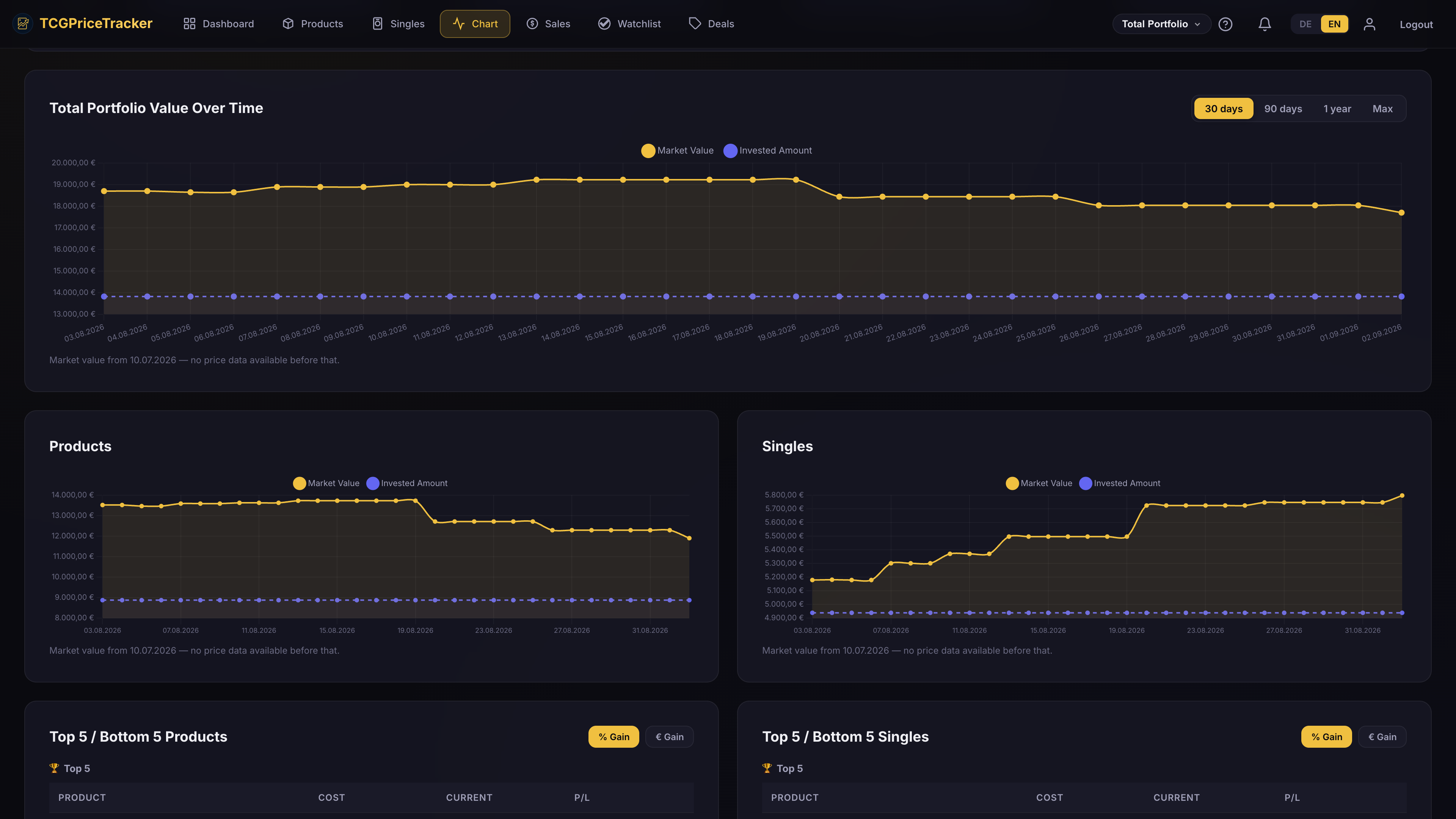
An announced reprint registers in the history as a clearly visible decline. With the history available per card, you see it the next day instead of months later. And a watchlist lets you follow cards you do not own yet, with a notification when a threshold you set is reached.
The rest stays manual: reading product announcements and judging whether a card is a plausible candidate. No tool takes that off your hands.
Keep your Magic collection in view
Entry price and trend per card, updated daily, with history and watchlist. Free, no credit card.
Start for free →Frequently asked questions
What is the Magic Reserved List?
A list of cards from the game's early years that Wizards of the Coast has committed not to reprint in functionally identical, playable form. It was created in 1996, after reprints had caused the prices of old cards to collapse.
Do Reserved List cards always increase in value?
No. The list constrains supply only. If demand falls — because a format loses players or interest moves elsewhere — a card that will never be reprinted falls too. Fixed supply is no protection against declining demand.
Can Wizards abolish the Reserved List?
It is a self-imposed commitment by the publisher, not a contract with buyers or a law. Wizards has repeatedly stated it intends to keep it. That is still not a guarantee for the future — buying solely on that basis is a bet on a corporate decision continuing to hold.
Which cards are on the list?
Several hundred cards from the early sets, including the best-known and most expensive cards in the game. Sets from around the turn of the millennium onwards are no longer affected. The authoritative version is published by Wizards of the Coast itself.
How do I tell whether a card might be reprinted?
As a rule of thumb: the more expensive and the more widely played, the more likely. Check how often the card has already been reprinted — one that returns regularly behaves differently from one that has not appeared in many years. Announcements come before availability, and the market usually reacts to them.
Does a special treatment protect against reprints?
Only partly. The specific treatment — borderless or extended art, say — is usually one-off, but the card itself is not. If it later appears in another special version, both compete for the same demand.
What is your Magic collection worth?
Entry price and trend per card, updated daily, with total value and history. Start free, no credit card.
Start for free →