Storing Trading Cards: What Preserves Value
The most common damage to trading cards happens neither in play nor in transit, but in storage — slowly, quietly, over years. Warped cards from a damp basement, faded colours from a windowsill, pressure marks from an overstuffed binder. All three are avoidable, and none of the remedies is expensive.
The short version
| Point | Recommendation |
|---|---|
| Light | Store dark; direct sun fades colours permanently |
| Humidity | Dry room, no basements and no external walls |
| Temperature | Room temperature, but above all steady |
| Pressure | Upright rather than stacked, never overfill a binder |
| Cheap cards | A penny sleeve is enough, box kept upright |
| Valuable cards | Double sleeve plus toploader or magnetic holder |
| Graded cards | Leave in the slab, upright, protected from pressure |
| Sealed product | Never stack; the wrap is the most delicate part |
The four enemies
Light. Ultraviolet light fades printing inks, and the damage is not reversible. The cards most affected are the ones put on display — which are, of course, the valuable ones. If you want to display, look for UV protection and choose a position away from the window.
Humidity. Cards are made of several paper layers. Take on moisture and the layers move differently, and the card warps. It happens slowly enough that you only notice once it is too late. Basements, lofts and external walls are the usual problem spots.
Temperature swings. The level matters less than the change: where temperature fluctuates, so does humidity, and condensation forms. A steadily cool room beats a warm one with big swings.
Pressure. The underrated factor. A stack of boxes compresses the bottom cards over months; an overstuffed binder presses pages against each other. Neither causes visible damage in the first year, but the cards no longer sit flat afterwards.
Sleeves: what is for what
| Sleeve | For what | Limits |
|---|---|---|
| Penny sleeve | Basic protection for everything | No protection against creasing |
| Perfect fit | Inner sleeve when double sleeving | Too thin on its own |
| Toploader | Individual valuable cards, shipping | Rigid, takes space |
| Magnetic holder | Long-term storage of valuable cards | Pricier, unsuited to volume |
| Binder pages | Overview of sets | Pressure when overfilled, cards can slip |
With double sleeving, the card goes first into a snug perfect-fit sleeve, and that goes upside down into a standard sleeve. The second opening then faces the other way, creating a largely closed space. For cards in the hundreds this is the usual standard.
A note on plasticisers: with very cheap sleeves of unknown origin it is not always clear what was used. For long-term storage of valuable cards it is worth sticking to established manufacturers — the price difference is negligible against the card's value.
Binder, box or slab
The box is the most space-efficient solution and right for the bulk of a collection. All that matters is that cards stand upright and the box is well filled but not compressed. Under-filled boxes are almost as bad as overfilled ones, because cards tip and bend.
The binder is good for overview and bad for pressure. If you use one, keep pages from being overfilled and store the binder lying flat rather than standing — upright binders let cards slide down inside the pages.
The slab of a graded card already protects well. Even so: store upright, do not stack, and put nothing heavy on top. Slabs are pressure-sensitive and can crack.
Where the collection should sit
The short answer: in a lived-in room. Where people are comfortable, cards are comfortable — steady temperature, moderate humidity, no direct sunlight.
Concretely that means a cupboard or shelf in a living room or study, not directly against an external wall and not above a radiator. A closed cupboard beats an open shelf because it keeps out light and dust.
What to avoid: basements (humidity), lofts (temperature swings), garages (both) and windowsills (light and heat). Those four places account for most of the damage you see on second-hand collections.
💡 Good to know: If you store a valuable collection, check once whether and to what extent your household insurance covers it. Many policies treat collections separately or cap them. Which records you need for that is covered in Document your card collection.
Sealed product
With displays and boxes it is not the cards that are delicate but the packaging — and the packaging determines a substantial part of the value.
The wrap is the critical point. It reacts to heat, contracts and becomes brittle. A display that sat above a radiator shows it. So: cool, dark, and free of temperature swings.
Do not stack. The weight of boxes above presses those below out of shape, and edges or corners deform permanently. Upright, with no load on top, is the right way.
And a point that sounds obvious yet is often ignored: do not open it to look inside. On sealed product, the state of the wrap is a large share of the value.
What storage has to do with valuation
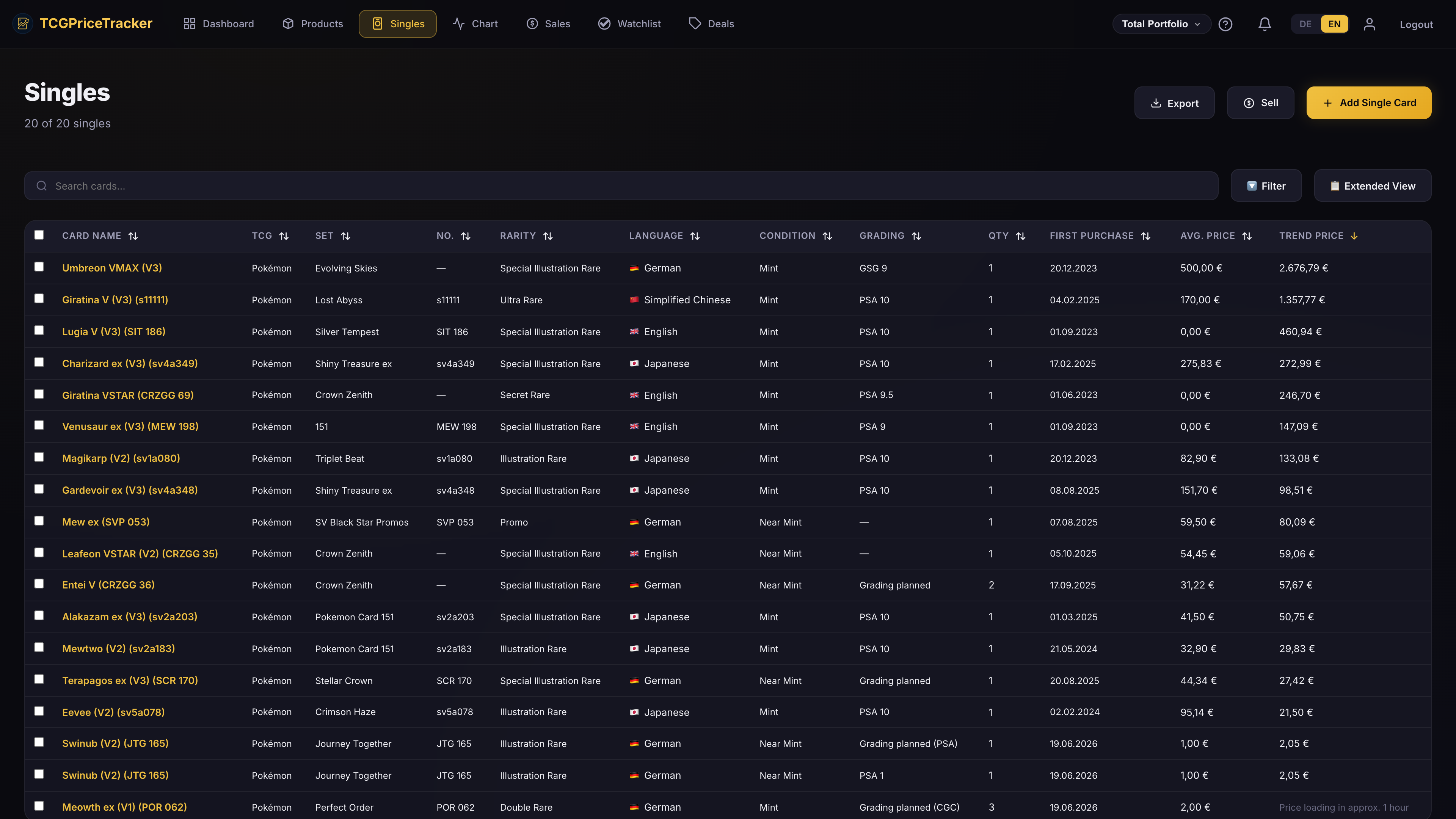
The connection is more direct than it looks. A card's displayed value is the trend price of the linked Cardmarket page, and therefore assumes a market-typical condition. If your card deteriorates on the shelf, the displayed value quietly becomes too optimistic.
That is why condition is a separate field per position in TCGPriceTracker. If a review shows a card has suffered, adjust the condition — then at least your inventory is right, even though the trend price does not reflect the deterioration.
The practical takeaway: set aside an hour once a year and go through your twenty most valuable positions. That is also the best opportunity to notice storage problems while they are still small.
Condition, purchase price and value per card in one place. Start free with 20 products, 30 single cards and 10 watchlist entries.
Related reading: Document your card collection · What makes a card valuable · Shipping trading cards safely
Frequently asked questions
Where is the best place to store trading cards?
In a lived-in room, ideally in a closed cupboard — steady temperature, moderate humidity, no direct light. Avoid basements, lofts, garages and windowsills; those four places cause most of the damage.
Binder or box?
The box is better for the bulk of a collection: space-efficient and less pressure — cards upright, box well filled but not compressed. Binders give more overview but should lie flat and must never be overfilled.
What is double sleeving?
The card goes first into a snug perfect-fit sleeve, and that goes upside down into a standard sleeve. The openings then face opposite directions, creating a largely closed space. For cards in the hundreds this is the usual standard.
Do graded cards need extra protection?
The slab already protects well. Even so: store upright, do not stack and keep heavy objects off. Slabs are pressure-sensitive and can crack.
How do I store sealed displays?
Cool, dark and free of temperature swings — the wrap reacts to heat, contracts and becomes brittle. Above all do not stack: the weight of boxes above deforms those below permanently. And do not open them, because the state of the seal is a large share of the value.
Does poor storage affect the displayed value?
Not automatically. The trend price comes from the linked Cardmarket page and assumes a market-typical condition — if your card deteriorates, the display quietly becomes too optimistic. So adjust the condition on the position when a review shows something.
Keep holdings and condition in view
Condition, purchase price and value per position — in euros, based on Cardmarket trend prices. Start free, no credit card.
Start for free now →