Shipping Trading Cards Safely: the Guide
One creased corner costs you half the card's value and the rating along with it. Proper packing costs under 50 cents and, after a few parcels, takes less than two minutes. This article walks through the process step by step, lists the services with current prices – and covers the point almost every guide gets wrong: the German Päckchen gives the buyer no tracking at all.
Status of these figures: shipping prices checked on 13 August 2026 for domestic shipping within Germany. Postage changes – the provider's own price list is authoritative.
The short version
| Question | Answer |
|---|---|
| What does packaging cost? | Around 25 to 50 cents per parcel |
| How long does packing take? | Under two minutes after three or four parcels |
| Cheapest service | Standard letter €0.95, compact letter €1.10, large letter €1.80 |
| First tier with tracking | Warenpost from €2.25 |
| Watch out with Päckchen | Päckchen S €4.19 and M €5.19 – but without tracking for the recipient |
| First tier with liability | DHL Paket from €6.19, insured up to €500 |
| Most important rule | The card must not be able to move inside the parcel |
| Second most important | Never put tape directly on the toploader |
What you need
Six items cover every card shipment. Together they cost less than a stamp per parcel.
| Item | What it is for |
|---|---|
| Penny sleeve | First layer against the card, prevents scratches |
| Toploader or card saver | Protection against creasing and pressure |
| Painter's tape | Seals the toploader without leaving residue |
| Zip bag | Moisture protection – rain reaches every parcel eventually |
| Two pieces of card | Anti-crease reinforcement, slightly larger than the toploader |
| Bubble mailer | The outer shell |
A note on choosing between toploader and card saver: the card saver is flatter and more flexible. For letter-format shipping that is often the difference between "fits the format" and "surcharge on delivery". The toploader protects marginally better against pressure but adds bulk.
What not to use: a plain envelope with no reinforcement. Postal sorting machines work with rollers, and an unprotected card reliably arrives creased.
The process step by step
| Step | What you do |
|---|---|
| 1 | Put the card in the penny sleeve, opening upwards |
| 2 | Slide the sleeve into the toploader – opening downwards, so the card cannot slide out |
| 3 | Seal the top of the toploader with painter's tape, folding the end into a small tab |
| 4 | Place it in the zip bag or wrap it in film |
| 5 | Sandwich it between two pieces of card and tape it to the card, not the toploader |
| 6 | Place it in the bubble mailer – nothing may move |
| 7 | Seal, address, frank |
Two details where most mistakes happen. The sleeve opening points down into the toploader – the other way round, the card can work its way out in transit. And tape never goes directly onto the toploader, only onto the card backing: peeling tape off a toploader is how impatient unpacking turns into damage.
💡 Good to know: The little tab at the end of the tape is not a perfectionist's detail. It lets the buyer open the toploader without dragging a fingernail along the edge – which is exactly where the first scratch otherwise appears.
Services and prices
| Service | Price | Tracking | Liability |
|---|---|---|---|
| Standard letter (20 g) | €0.95 | no | no |
| Compact letter (50 g) | €1.10 | no | no |
| Large letter (500 g) | €1.80 | no | no |
| Maxi letter (1000 g) | €2.90 | no | no |
| Warenpost (up to 500 g) | from €2.25 | yes | no |
| DHL Päckchen S | €4.19 | no | no |
| DHL Päckchen M | €5.19 | no | no |
| DHL Paket (up to 2 kg, online) | €6.19 | yes | up to €500 |
The row most often misunderstood is the Päckchen. It costs more than Warenpost yet is the worse choice for sellers: the recipient gets no tracking code. In a dispute you are as exposed as with a plain letter – only you paid three times as much.
The second surprise is where liability starts. Only the DHL Paket is insured, up to €500. Nothing below that is replaced if it goes missing, Warenpost included – that only shows where the parcel has been.
Which service at which value
| Card value | Recommendation | Why |
|---|---|---|
| under €10 | Letter | The loss would be bearable; tracking would eat the margin |
| €10 to €50 | Warenpost | From here you want to know where the parcel is |
| €50 to €200 | DHL Paket | The first tier with real liability |
| over €200 | DHL Paket with added cover | The standard €500 limit is not always enough |
These boundaries are not laws of nature but a judgement call: at what amount would a total loss actually hurt you? Someone selling regularly calculates differently from someone parting with a card once a year.
One note on the maths: on small sales it is shipping, not the platform fee, that decides the margin. How much so is worked through in Cardmarket fees – there, a €5 card leaves just over €4 once postage is mis-costed.
Why this protects you, not the buyer
Tracking protects you first and the buyer second. If a parcel supposedly never arrives, the only thing that matters is whether you can evidence delivery. Without it you lose the card and the money – and on most platforms the dispute as well.
Three habits that protect you at almost no cost in time:
Photograph the card before packing, front and back. That is your condition record if someone later reports a crease that was not there before.
Share the tracking number immediately, not on request. It prevents half of all follow-up questions and reads as professional.
For valuable cards, film the packing. One continuous video from condition to sealed envelope is the strongest record you can hold – and hopefully one you never need.
Recording shipping costs properly
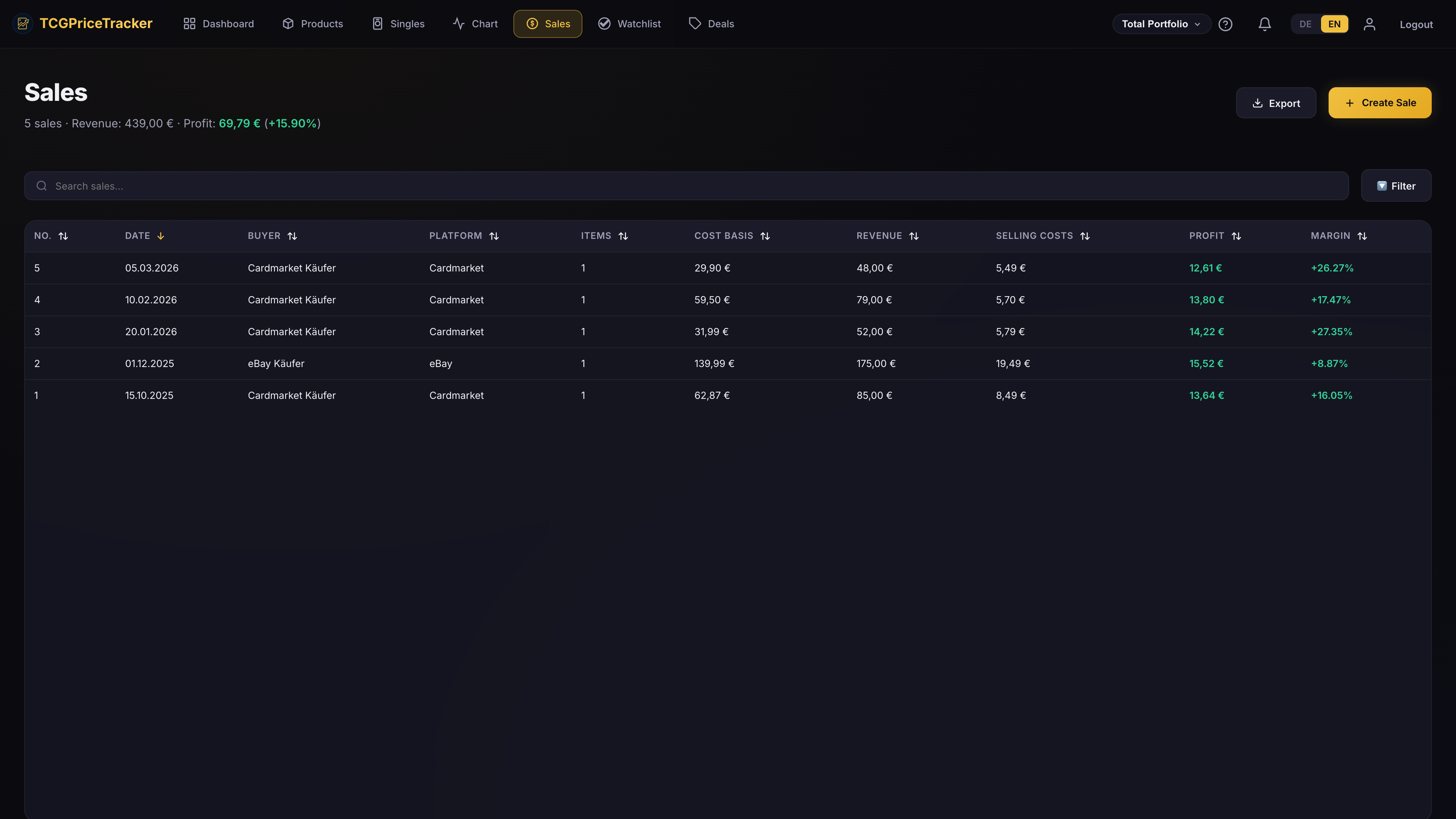
When you create a sale in TCGPriceTracker you enter fees and shipping costs alongside the sale price and the cost basis. The realised result follows from that.
What matters is entering the actual amount, not what you charged the buyer. Charge €1.50 and spend €2.20 on postage and packaging and you are 70 cents down – which only becomes visible if both figures are right.
The benefit shows across several sales: after twenty transactions you can see the card value at which single-item shipping starts to work for you. That line differs for everyone, because it depends on your postage and your packaging.
Proceeds, fees, shipping and result per sale. Start free with 20 products, 30 single cards and 10 watchlist entries.
Related reading: Cardmarket fees · How to sell Pokémon cards · Selling trading cards: tax records
Frequently asked questions
Can I send trading cards as a letter?
Yes, and for cards under €10 it makes sense. A compact letter costs €1.10, a large letter €1.80. You still need a sleeve, toploader and card reinforcement – without them the sorting machines will crease the card. Letters carry no tracking and no liability.
Does DHL Päckchen include tracking?
Not for the recipient. Päckchen S costs €4.19 and Päckchen M €5.19, neither with a tracking code for the buyer. If you need tracking, use Warenpost from €2.25 – cheaper and tracked – or the DHL Paket from €6.19, which also carries liability up to €500.
From what value should I insure the shipment?
From around €50 in card value the DHL Paket makes sense, because it is the first tier that carries liability at all – up to €500. Above that, added cover is worth it. Below, it is a judgement call: at what amount would a total loss hurt?
How do I protect cards from moisture?
A small zip bag around the toploader is enough and costs a few cents. It matters most on longer transit times and in winter, when parcels are stored outdoors along the way.
What do I do if the card arrives damaged?
Ask for photos of the damage and compare them with your own shots from before packing. For insured shipments you report the damage to the carrier. For uninsured ones there is no claim – all that remains is an agreement with the buyer.
Is single-item shipping worth it on cheap cards?
Usually not. Postage and packaging are fixed costs per parcel, not per card. Five cards in one parcel spread the same cost across five times the value. Record your sales with real figures and after a few transactions you will see where your own line sits.
See what a sale actually brings in
Proceeds, fees, shipping and realised result per sale – plus purchase price and value per position. Start free, no credit card.
Start for free now →