One Piece Card Value: The Complete Guide
In the One Piece Card Game, a card's value is rarely set by its rarity tier alone. What matters is which version you are holding: the same character exists as a regular card, as a parallel version with different artwork, and as a Japanese first printing — with price gaps that quickly reach three figures. This guide explains how to tell them apart.
What sets One Piece apart
The One Piece Card Game is young — it launched in Japanese in 2022, with the English edition following in 2023. That youth has three consequences for pricing that are worth knowing.
First, there is no vintage market. Unlike Pokémon or Magic, no card is old enough to carry collector demand built up over decades. Value comes almost entirely from print run and current popularity — both of which can shift faster than in established games.
Second, demand is strongly tied to characters. The series' well-known leads attract buyers who will never play a tournament. It is the same mechanism that makes Charizard cards dominate Pokémon rankings, and it works even more concentrated here, because the cast is smaller.
Third, cards get reprinted. Popular cards reappear in later products, sometimes in new presentation. A reprint pushes down the price of the original printing — not always, but often enough that it is worth watching on expensive cards.
The rarity tiers
The tier is printed on the card as a short code. It is the first clue to value, but not the most important one.
| Code | Tier | What it means |
|---|---|---|
| C | Common | Base tier, effectively always bulk |
| UC | Uncommon | Slightly scarcer, in value terms usually still bulk |
| R | Rare | Playable cards can hold value here, otherwise little |
| SR | Super Rare | The usual tier for in-demand cards |
| SEC | Secret Rare | Highest regular tier, usually the most expensive cards in a set |
| L | Leader | Leader card; value depends heavily on tournament strength |
| P | Promo | Card outside regular sets, value varies widely by occasion |
The tier alone says little, though. An SR in standard presentation can cost a few euros, while the same card as a parallel version fetches a hundred times that. Hence the next section.
Why the parallel version sets the price
Many One Piece cards exist in more than one version. Alongside the standard printing there are parallel versions with different artwork, a different finish, or both — commonly called alternate art or alt art. On some cards a manga-style version exists as well.
These versions are the same playing card with the same function. For the collector market they are something else entirely: they are pulled less often, they look far more striking, and that is exactly what demand aims at. The price gap between the standard and parallel version of the same card routinely runs into two or three figures on popular characters.
The most common misjudgement: looking up a card's price without checking the version puts you off by a multiple — in both directions. Always confirm that the price you are looking at belongs to the version you own. On Cardmarket the versions are separate product pages.
An observation from our data: among the 30 most expensive One Piece cards tracked in TCGPriceTracker, seven feature Monkey D. Luffy — and the top end consists almost entirely of parallel versions and promos, not standard printings. The caveat: what gets tracked are the cards users care about, and those skew expensive. That makes it useless as a market overview, but still meaningful as a pattern.
Japanese or English
One Piece appears in Japanese first, with the English edition following later. Both markets exist alongside each other, and their prices do not move in step.
Japanese cards are frequently cheaper, because more is printed in Japan and availability is better. On especially sought-after cards it can be the other way round, when a version exists only in Japanese. For you, the practical point is this: Japanese and English printings are separate products with separate prices. Confusing them means misjudging your own holdings.
If you import Japanese cards, customs and import VAT come into play — what to watch for is covered in Importing Japanese Cards. The article is framed around Pokémon, but the import rules apply regardless of the game.
Condition and centering
Condition is the same price factor in One Piece as anywhere — with one particularity that matters when buying and when grading.
The community regularly discusses centering: the artwork does not always sit evenly between the borders from the factory. For ordinary trading that barely matters — for a grading submission it does, because centering is one of the main criteria there. Anyone planning to send in an expensive card should look at it with that question in mind first.
The condition steps themselves follow the usual scale from Near Mint to Poor; the terms are listed in the TCG Glossary. Whether a submission pays off depends on the card's value and the expected grade — worked through in Is Grading Worth It.
Reading prices correctly
Cardmarket shows several figures side by side. For assessing your own holdings the trend price is the most usable: a weighted average of recently sold copies. The lowest price only shows the cheapest current listing — often in worse condition or from abroad.
Two points that matter particularly in One Piece:
Thinly traded cards swing hard. On a card that sells only a few times a month, a single sale can shift the displayed price considerably. A jump upwards only becomes reliable once it holds across several sales. Because the game is young and many versions exist, this affects more cards here than in established games.
Reprints change the picture fast. When an expensive card is printed again in a new product, the price of the existing version can drop sharply within weeks. Watch the history and you see it coming; know only today's price and you do not.
Tracking value over time
That is exactly what TCGPriceTracker is built for. You store the Cardmarket link of the version you own for each card — which rules out confusing the standard and parallel printings — and get the entry price and trend price updated daily. By default, your collection is valued by entry price, the average of the up to three cheapest matching offers in your card's language and condition.
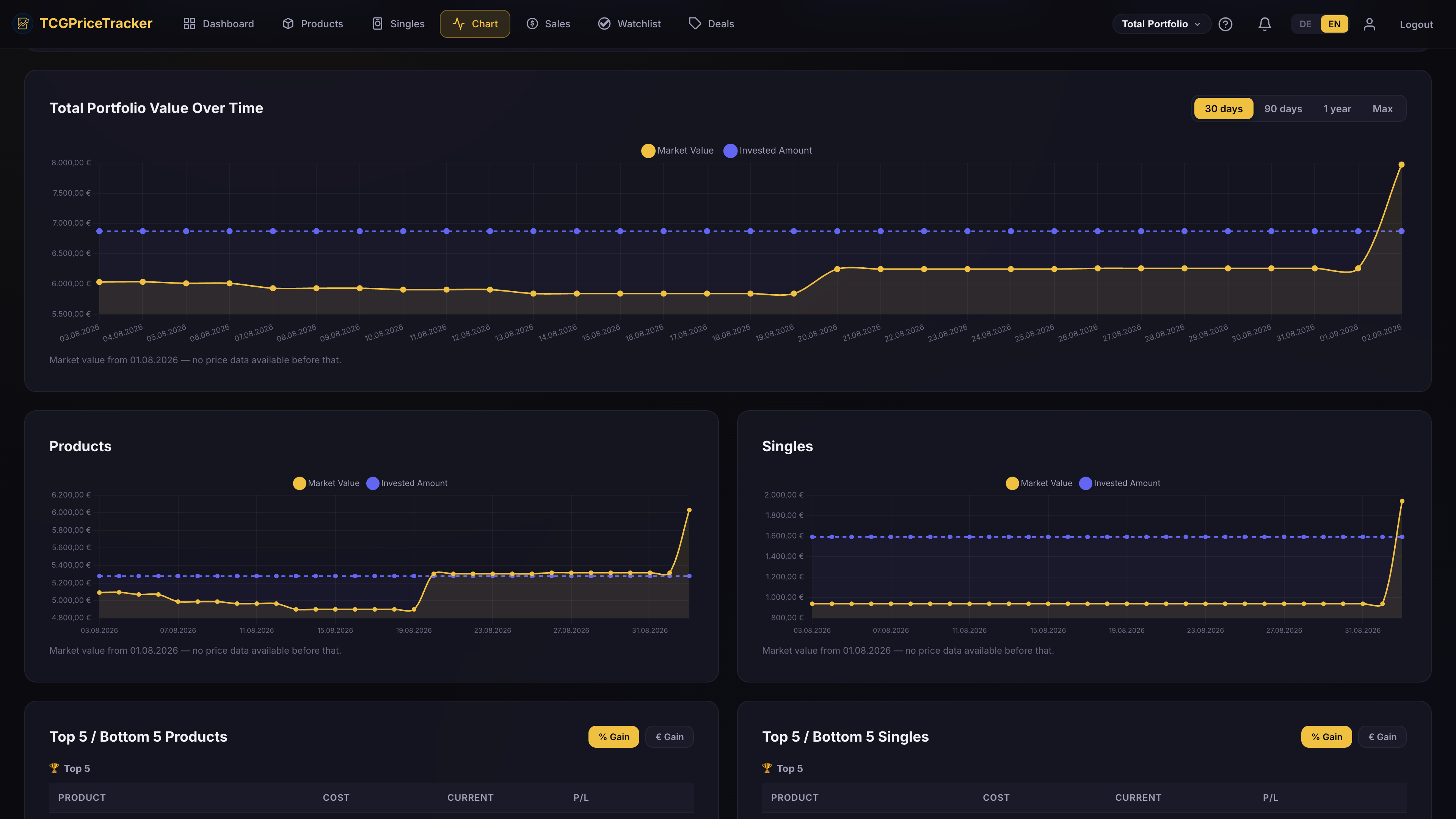
Alongside that come the collection's total value, its history over time, and a watchlist for cards you do not own yet but want to keep an eye on. One Piece is one of 21 supported games — anyone also collecting Pokémon or Magic keeps everything in the same overview.
For graded cards you enter your own value, because the trend price reflects the ungraded market product.
Keep your One Piece collection in view
Entry price and trend per card, updated daily, with total value and history. Free, no credit card.
Start for free →Frequently asked questions
How do I find out what my One Piece card is worth?
Search for the card on Cardmarket and make sure you land on the right version: standard, parallel and Japanese printings are separate product pages with separate prices. The trend price on that page is the most usable guide. For a lasting overview, store the link in TCGPriceTracker.
What is a parallel version?
A second version of the same playing card with different artwork, a different finish, or both — often called alternate art in the trade. Identical in play, considerably more sought after by collectors, with a routinely large price gap to the standard printing on popular characters.
Are Japanese One Piece cards worth more?
Not as a rule. Japanese cards are often cheaper thanks to better availability, but can be more expensive when a version exists only in Japanese. What matters most is not to confuse the two: they are separate products with separate prices.
Why do the prices swing so much?
Because the game is young, many versions exist, and individual cards therefore trade rarely. With only a few sales a month, a single sale shifts the displayed price. The history over several weeks says more than today's figure.
Is grading worth it for One Piece?
As everywhere, it depends on the card's value and the expected grade. One particularity is centering, which is not always even from the factory and counts as a main criterion in grading. Check the card on that point before sending it in.
Does TCGPriceTracker fully support One Piece?
Yes. Single cards and sealed products can be recorded via their Cardmarket link, and the entry price and trend price are updated daily. One Piece is one of 21 supported games; several collections run in the same overview.
What is your One Piece collection worth?
Entry price and trend per card, updated daily, with total value and history. Start free, no credit card.
Start for free →