Selling Trading Cards: The 9 Most Common Mistakes
Selling cards rarely costs you money through one dramatic error. It costs you in small amounts, repeatedly, at the same points — the price anchor, the fees, the condition grade. These nine are the ones that go wrong most often in practice, ordered by the damage they do.
The nine mistakes at a glance
| Mistake | Better |
|---|---|
| Clinging to the purchase price | Decide on today's market value |
| Using the lowest price as reference | Trend price as the yardstick, lowest price as a floor |
| Calculating fees afterwards | Deduct them from the proceeds beforehand |
| Grading condition generously | When in doubt, one grade lower |
| Estimating shipping roughly | Cost out postage, materials and proof |
| Listing everything individually | Weigh time per card against the proceeds |
| Reacting to daily swings | Look at the history |
| Selling without an overview | Document your holdings first |
| Ignoring the tax question | Know the holding period and the threshold |
1. Using your purchase price as the yardstick
The most common and most expensive thinking error: "I paid €80, I'm not letting it go below €80."
The market does not know what you paid and does not care. The purchase price is spent — it affects today's value of the card by exactly nothing. The only sensible question is: is the card worth more to me than the amount I can get for it today? If yes, keep it. If no, sell it. The purchase price does not appear in that question.
In practice the anchor means cards that have fallen sit unsold for years while the value keeps sliding, in the hope of "at least breaking even". In the other direction, cards that have risen get sold too early, because the gain against the purchase already looks good.
Important: for tax purposes the purchase price very much matters, because it determines the gain. For the decision whether to sell, it does not. Keeping those two apart is the whole trick.
2. The wrong price reference
Cardmarket shows several prices side by side, and they mean different things. Pick the wrong one and you either sell too cheaply or not at all.
| Figure | What it says | What it is good for |
|---|---|---|
| Lowest price | The cheapest current listing, often in poor condition or from abroad | A floor, not a yardstick |
| Trend price | Weighted average of recently sold copies | A realistic yardstick |
| 30-day average | Mean of the past month | Telling whether the trend is currently off |
The typical mistake is to take the lowest price as a guide and list your own card below it — even though it is in better condition than the cheapest offer. The trend price is the better anchor because it reflects what was actually paid. More on reading these figures in Determining Pokémon Card Value.
3. Calculating fees afterwards
A sale at €40 is not €40 in proceeds. Between the sale price and what arrives sit the selling commission, payment fees and shipping.
The mistake is not that fees exist — everyone knows that. The mistake is calculating them after the decision. If you only notice at payout that little is left of the gain you had in mind, you may have sold a card you would have kept at that net figure. On low-priced cards the ratio flips especially fast: on a €3 card, shipping can swallow the proceeds.
The full breakdown with worked examples is in Cardmarket Fees.
4. Flattering the condition
The temptation is understandable: one grade higher brings noticeably more money. It reliably backfires.
A buyer who unpacks a card sold as Near Mint and finds visible edge wear will get in touch — and then the case costs a return, a refund, time, and in the worst case the rating. On platforms with a feedback system, reputation is the real currency: damage it and everything you sell afterwards sells worse.
The rule: when in doubt, grade one step lower. For cards of meaningful value it is also worth photographing the actual card rather than using a catalogue image — that removes the basis for any argument. The most common reasons for a downgrade are whitening along the edges, corner wear and surface scratches.
5. Underestimating shipping
Shipping costs are more than postage. Add the toploader or cardboard, the sleeve, the envelope, possibly tracking or insurance — and at larger amounts, proof that the card was actually sent is not a luxury but self-protection.
Two errors show up especially often here. First, shipping uninsured because it is cheaper — on a €200 card, saving a few euros is not worth the risk. Second, packing too thinly, so the card arrives damaged and the argument about its condition lands with the buyer. Both are solved by the same measure: a toploader plus a sturdy envelope, and insured shipping from triple-digit amounts upwards. The details are covered in Shipping Trading Cards.
6. Trying to sell every card individually
Selling individually gets the best price per card — and costs the most time per card: listing, checking condition, photographing, packing, shipping, answering questions.
Work the effort out honestly once. Spending twenty minutes in total on a €2 card is an hourly rate you would rather not write down. For the bulk of a typical collection — the many cards worth a few euros — selling in bulk to a dealer or as a lot is the more sensible decision, even though it brings less per card.
The rule of thumb: sell individually where the premium justifies the effort. That is usually the case from a double-digit card value upwards. Below that, form bundles.
7. Reacting to the daily price
Prices fluctuate daily, and part of that fluctuation is simply noise — especially on cards that trade rarely. There, a single sale can shift the displayed price considerably without anything having changed in the market.
React to every swing and you sell in panic on the way down and buy in euphoria on the way up. The history over several weeks says far more than today's figure. A sudden jump upwards only becomes reliable once it holds across several sales.
8. Not knowing what you had
An underrated mistake that only hurts later: selling without recording what was sold and at what price.
It surfaces at the latest when you want to know whether a sale was worth it, or when you need to prove a gain to the tax office. Without records you have neither. Anyone selling regularly does not need bookkeeping, but does need a plain list: what, when, bought for how much, sold for how much. More on that in Documenting a Card Collection.
9. Ignoring the tax question
For occasional sales from your own collection the situation in Germany is usually straightforward — but "straightforward" is not the same as "irrelevant". What matters are the one-year holding period for private disposals and the threshold for gains. Buying and reselling within a year sits in a different frame from breaking up a ten-year-old collection.
Anyone selling regularly and at scale should also check whether that still counts as private. An overview of the governing rules is in Selling Trading Cards and Tax — it does not replace professional tax advice, but it makes clear when the question arises at all.
What a tool takes off your hands
Four of the nine points are pure information problems — and those are exactly the ones that can be automated.
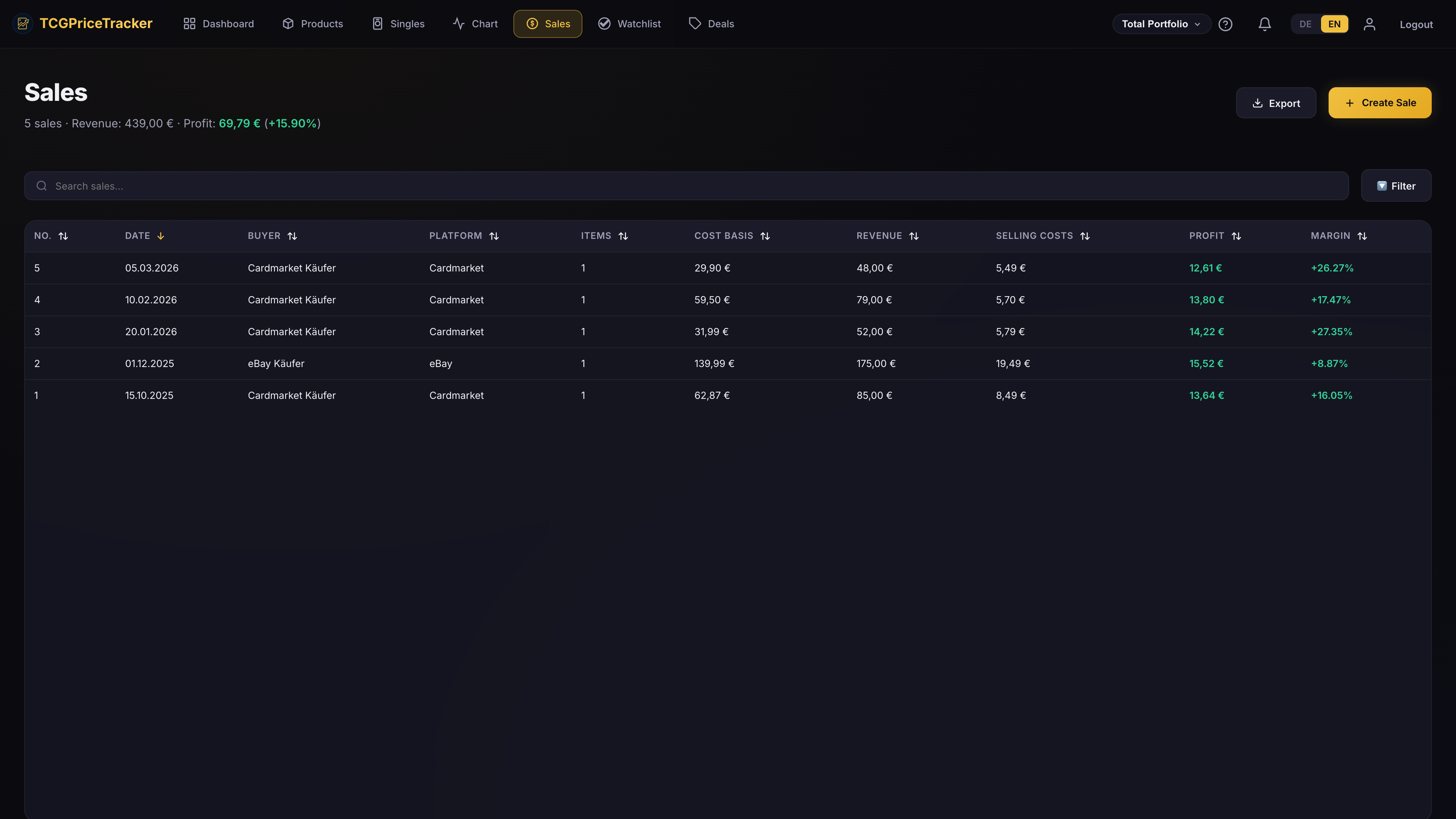
The trend price is available per card and updated daily, so the reference from point 2 does not have to be guessed. The history shows whether a swing has substance or is noise — that defuses point 7. The purchase price is carried per position but shown separately from market value: you see both and do not confuse them. And the sales overview records what went out at what price — the list from point 8, without you having to keep it yourself.
What a tool does not take off your hands: grading condition, packing, and deciding whether a card is better sold on its own or in a bundle.
Know what a card is worth before you sell it
Trend prices per card, updated daily, with history and purchase price. Free, no credit card.
Start for free →Frequently asked questions
What is the most expensive mistake when selling cards?
Using your own purchase price as a guide. What you paid does not affect today's market value. The anchor leads to holding fallen cards too long and selling risen ones too early. Decide on today's value, not on what it cost you.
Should I use the lowest price or the trend price?
The trend price. It is a weighted average of actual sales. The lowest price only shows the cheapest current listing — often in worse condition or from abroad. It is useful as a floor, not as a yardstick.
From what value is selling individually worth it?
As a rule of thumb, from a double-digit card value. Below that, the time for listing, packing and shipping is out of proportion to the extra you get over a bundle or a dealer sale. Work the effort per card out honestly once.
What happens if I overstate the condition?
At best the buyer complains and you refund. At worse it also costs you a negative rating, which makes future sales harder. When in doubt grade one step lower, and photograph valuable cards yourself rather than using a catalogue image.
Do I have to pay tax on profits from card sales?
That depends mainly on the holding period and the size of the gain, and with frequent sales also on whether the activity still counts as private. Our article on tax when selling cards sets out the governing rules. It does not replace professional tax advice.
How do I tell whether a price jump is real?
From the history and the number of listings. On rarely traded cards a single sale can shift the displayed price sharply. Only once the new level holds across several sales and a few weeks is it reliable.
Sell on numbers, not on hunches
Trend prices, history, purchase price and sales overview in one place. Start free, no credit card.
Start for free →