Best Cardmarket Tracker – finding the right collection app
MKMtool, EchoMTG, Archidekt, Deckstats or the trusty old Excel spreadsheet? We compare the common options for tracking your Cardmarket collection honestly and objectively – with strengths, weaknesses and a big comparison table so you can make the right call.
Feature status of the tools named here: checked on 27 June 2026. Competing products keep evolving – any statement about a missing feature refers explicitly to that date. If in doubt, check the current feature list with the provider.
The problem: Cardmarket is a marketplace, not a tracker
Cardmarket is the largest European marketplace for trading cards – and that is exactly what the platform is built for: buying and selling. But the moment you want to know how much your entire collection is worth or how its value has developed over the past few months, Cardmarket leaves you hanging.
Cardmarket has no portfolio view that adds up all of your cards. There is no value history graph for your collection as a whole. And there is no automatic ROI calculation that shows you whether your €200 display is worth more or less today. You can look up individual cards – and that's it.
Many collectors therefore reach for a second tool. But the path there is littered with pitfalls:
- The official Cardmarket API is no longer freely available. Anyone who once wanted to access price data via the API could do so fairly easily. Today, API access comes with conditions and is hardly practical for private collectors anymore. As a result, home-built scripts and older community tools regularly break.
- Manual tracking in Excel is laborious. A spreadsheet is quick to set up, but it doesn't update itself. Every time you want to check values, you have to look up each card on Cardmarket individually and type in the price – a full-time job once you have hundreds of cards.
- Many tools specialize in a single game. Anyone collecting Pokémon, Magic and One Piece at the same time often needs three different apps – with three logins, three interfaces and three price sources.
The good news: there are solutions. The less good news: they vary widely in how well suited they are to the European Cardmarket collector. One of them, TCGPriceTracker, is a browser-based web app – no download, no installation, it runs directly in your browser on desktop and mobile. Below we take an honest look at the common options.
💡 Good to know: Cardmarket prices are considered the European standard for valuing trading cards – in euros and based on real sales. US-oriented tools, by contrast, usually work with TCGPlayer prices in US dollars, which introduces exchange-rate and market discrepancies for European collectors.
The common options, honestly reviewed
Each of the following options has its reason to exist – but each was built for a specific purpose. What matters is whether that purpose matches your goal: tracking your Cardmarket portfolio.
MKMtool
MKMtool is an open-source community project that originally grew up around the Cardmarket API. Its strength lies in the management of seller inventories: updating prices at scale, maintaining stock levels, automating listings. For commercial or technically skilled power sellers, it can be a useful tool.
The weaknesses for the average collector, however, are clear: MKMtool requires its own Cardmarket API access – which, as described above, is no longer open to everyone. On top of that come installation, configuration and ongoing maintenance. It offers no convenient portfolio or ROI view, no price alerts and no mobile interface. Anyone who simply wants to keep an eye on the value of their collection is over-served here.
EchoMTG
EchoMTG is an established collection and portfolio app with a focus on Magic: The Gathering (and, in part, other games). It offers solid portfolio management including value history, purchase-price tracking and statistics – conceptually exactly what collectors are looking for.
The catch from a European perspective: EchoMTG is heavily geared toward the US market and TCGPlayer prices (US dollars). Cardmarket prices in euros are not the focus, and the interface is English-only. The full feature set is also tied to a paid subscription. A good choice for US Magic collectors – less obvious for European multi-TCG collectors.
Archidekt
Archidekt is first and foremost a deckbuilder for Magic: The Gathering – and a really good one at that. Building decks, sharing them, enriching them with price information: all of that works conveniently. It also offers a collection feature that can show rough values.
But Archidekt is not a portfolio or investment tool. ROI calculation based on purchase prices, sealed-product tracking, sales analysis or price alerts based on Cardmarket are not part of its core. Anyone who mainly plans decks is in good hands here; anyone who wants to track the value of their collection as an investment, less so.
Deckstats
Deckstats is likewise primarily a deckbuilding and collection tool for Magic, free of charge and with a long history. It can manage collections and display approximate values. For pure Magic players who want to organize their decks and card inventory, it is solid.
As with Archidekt, though, the focus is on playing, not investing. A daily Cardmarket portfolio valuation with ROI, profit tracking across sales and price alerts is not the tool's ambition – and accordingly, it isn't built out for that.
A plain Excel spreadsheet
The Excel or Google Sheets spreadsheet is the classic. Its big advantage: maximum flexibility and full ownership of your data. You can add any column you like, and nothing costs you anything except time.
But time is exactly the problem. A spreadsheet does not update prices. Every value has to be looked up on Cardmarket and entered manually. There are no price alerts, no automatic history graph, no built-in separation of singles and sealed. As your collection grows, the upkeep quickly becomes a burden – and errors creep in.
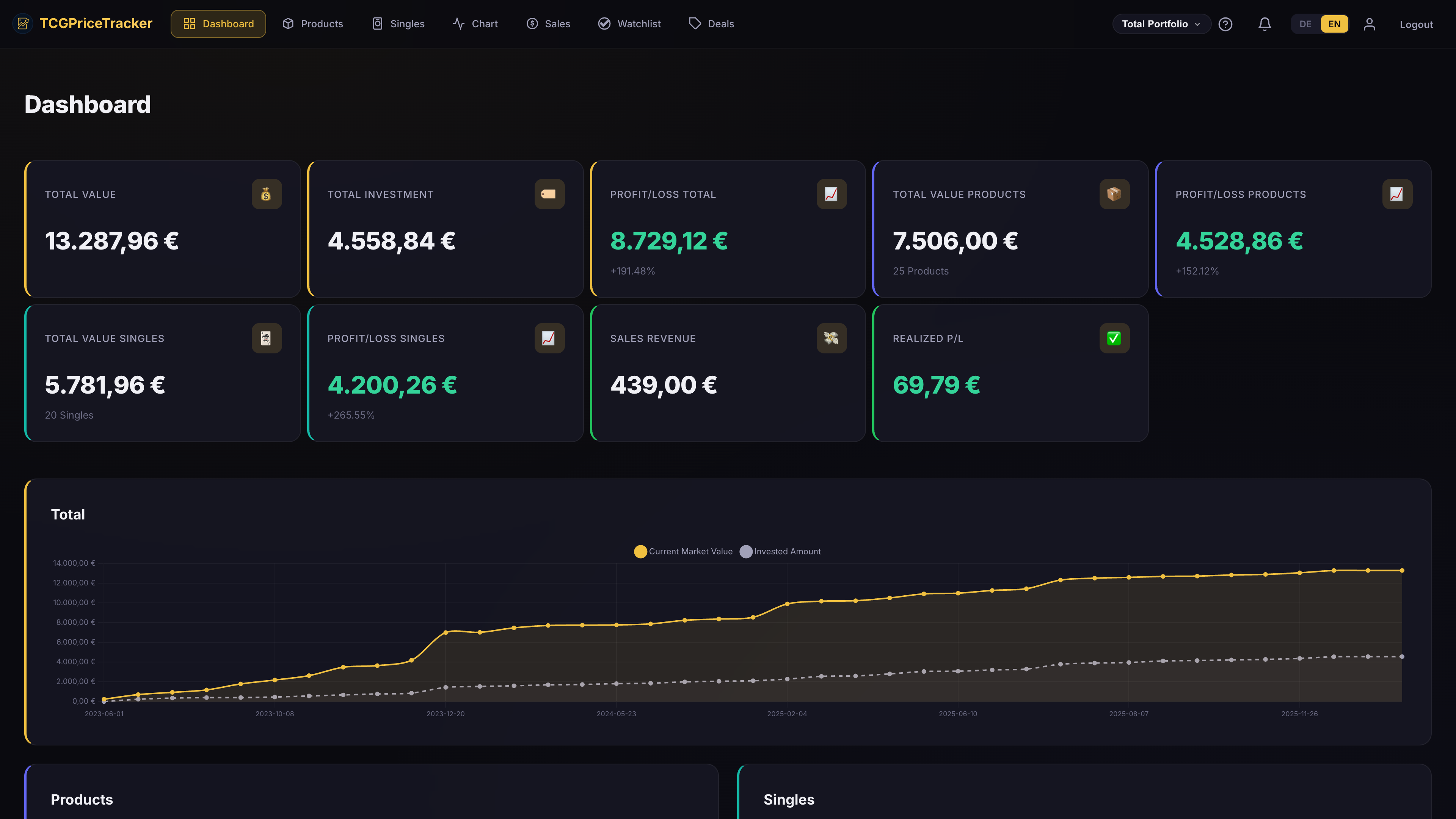
Would rather not look up every card individually? With TCGPriceTracker, the Cardmarket trend price of your entire collection is updated automatically every day.
Cardmarket tracker comparison: the big table
The table below compares the most important options against the criteria that really matter for tracking a Cardmarket collection. We've tried to stay fair and objective – every tool is strong within its own area of focus.
| Criterion | MKMtool | EchoMTG | Archidekt | Deckstats | Excel | TCGPriceTracker |
|---|---|---|---|---|---|---|
| Cardmarket prices (EUR) | ✗ API needed | ✗ TCGPlayer focus | partial | partial | ✗ manual | ✓ daily |
| Automatic price updates | ✗ setup | ✓ | ✓ | ✓ | ✗ manual | ✓ daily |
| Price history | ✗ | ✓ | limited | limited | ✗ maintain yourself | ✓ Trend price |
| Portfolio value & ROI | ✗ | ✓ | limited | limited | ✗ formulas | ✓ automatic |
| Sealed products + singles | mostly singles | mostly singles | mostly singles | mostly singles | ✓ free-form | ✓ both |
| 21 TCGs | ✗ | MTG focus | MTG focus | MTG focus | ✓ free-form | ✓ 20+ |
| Watchlist / price alerts | ✗ | limited | ✗ | ✗ | ✗ | |
| Grading status (PSA, BGS) | ✗ | limited | ✗ | ✗ | own columns | ✓ built in |
| CSV import / export | ✓ | ✓ | ✓ | ✓ | ✓ native | ✓ |
| Localized interface | ✗ | ✗ EN only | ✗ EN only | ✓ partial | ✓ yourself | ✓ EN/DE |
| Setup effort | high | low | low | low | medium | ✓ none |
| Cost | free (open source) | subscription | free + subscription | free | free | Free / €5.99 |
The picture is clear: the deckbuilders (Archidekt, Deckstats) shine at deckbuilding, not at portfolio tracking. EchoMTG is a good portfolio tool, but US- and MTG-centric. MKMtool is powerful, but designed for power sellers with API access. Excel is flexible, but labor-intensive. For the European collector who wants to manage multiple TCGs with Cardmarket prices in euros, TCGPriceTracker closes the gaps most completely.
What a good Cardmarket tracker needs to do
Before you settle on a tool, it pays to get clear on your own requirements. This checklist sums up how to recognize a genuinely useful Cardmarket price tracker:
- Real Cardmarket prices in euros: the price source should be Cardmarket, not a converted US market. The Cardmarket trend price belongs here too.
- Automatic, regular updates: prices should refresh on their own – ideally daily, without you doing anything.
- Total portfolio value with ROI: a good tracker shows not just individual values but sums up the whole collection and, based on your purchase prices, calculates your profit or loss.
- Singles and sealed products: displays, ETBs and bundles behave differently from individual cards – both categories should be supported.
- Watchlist with price alerts: you should be notified when a wishlist card hits a target price.
- Sales and profit tracking: anyone who sells wants to see the margin actually realized, not just the theoretical market value.
- CSV import and export: so switching from Excel is fast and you can take your data with you at any time.
- Grading and variant support: foil, reverse-holo and grading status (e.g. PSA, BGS) significantly affect value.
- Multiple TCGs and a localized interface: one tool for all games – ideally in the language you speak.
The more of these points a tool covers, the fewer workarounds you need. You'll find a comprehensive guide to building it out in our article Trading Card Portfolio Tracker. If you are coming from an app like Collectr, the short version is at Collectr Alternative.
All the checklist points in one tool? TCGPriceTracker covers Cardmarket prices, ROI, watchlist, sealed and 21 TCGs – in English and German.
TCGPriceTracker: closing the gaps in the comparison
TCGPriceTracker is deliberately neither a marketplace nor a deckbuilder – it is a pure tracker for your Cardmarket collection. As a collection app it runs entirely as a web app in your browser, so there is nothing to install, and the same tool works on desktop and mobile. That is precisely how it closes the gaps the other options leave open. Here are the key points from the comparison in detail:
Cardmarket prices in euros, updated daily
All prices come straight from Cardmarket and are updated automatically every day – based on the Cardmarket trend price. You don't have to set up any API or look up another card by hand. That is the decisive difference compared to Excel and to API-dependent tools like MKMtool.
21 TCGs instead of a single-game focus
While EchoMTG, Archidekt and Deckstats are geared toward Magic, TCGPriceTracker covers 21 trading card games – including Pokémon, Magic: The Gathering, Yu-Gi-Oh!, One Piece TCG, Disney Lorcana, Digimon and Dragon Ball. One login, one dashboard, all games.
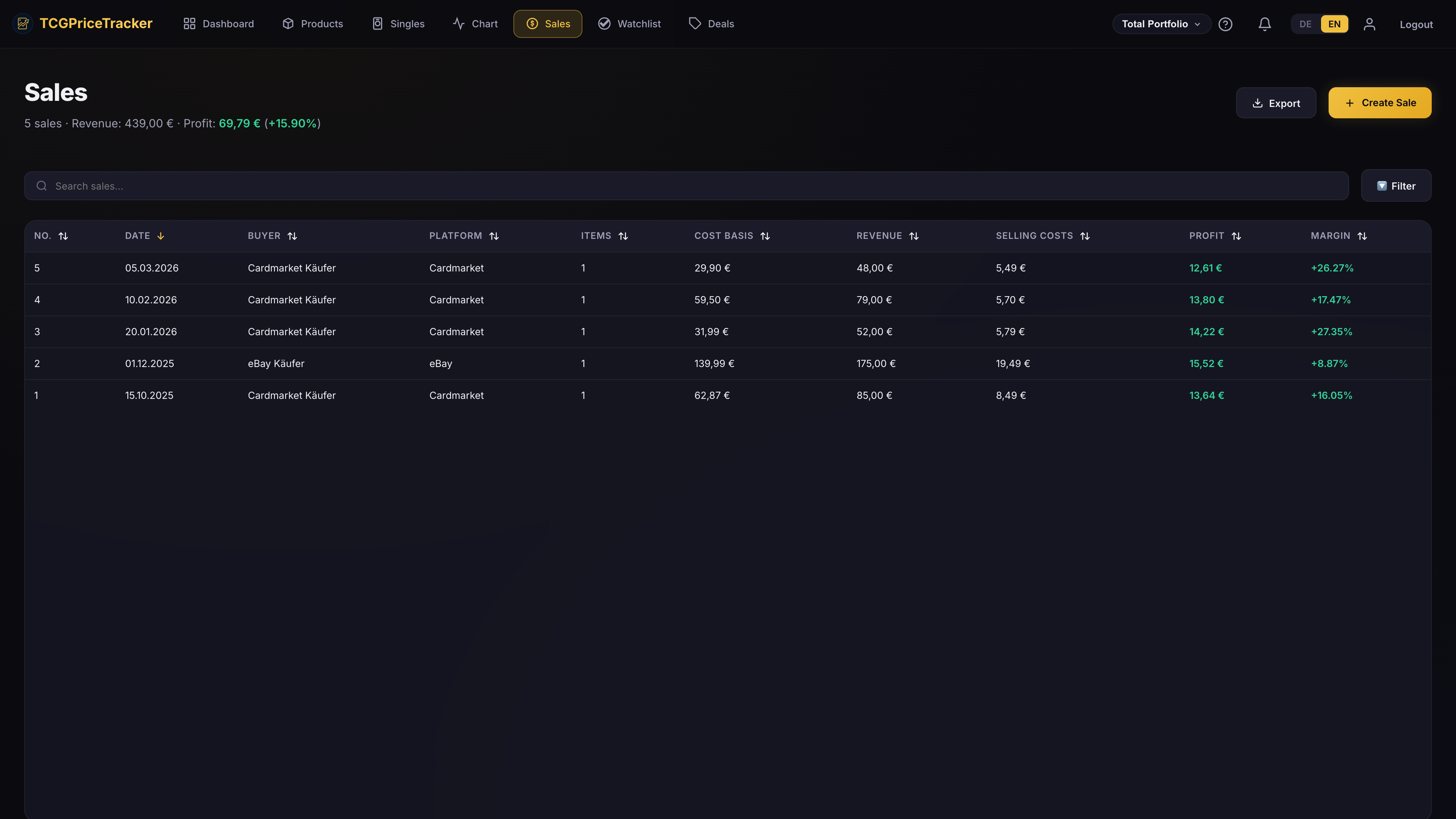
Total portfolio value, ROI and sales analysis
TCGPriceTracker sums up your entire collection, calculates the ROI for every product and every single based on your purchase prices, and records sales including profit tracking. That gives you the investment view deckbuilders don't offer – in euros and without exchange-rate conversion.
Sealed, singles, foil and grading
Whether an unopened display or a single card, whether foil, reverse-holo or a graded copy with a PSA/BGS status: TCGPriceTracker distinguishes these variants because they have a major impact on value. In Excel you'd have to maintain your own columns and formulas for that.
Watchlist with email price alerts
Add cards to your watchlist and define a target price. As soon as the trend price reaches your goal, you get an email. None of the pure deckbuilding options offer this in this form.
CSV import in minutes – a fair switch
Coming from Excel or another tool? Export your list as a CSV and upload it – your collection is transferred in just a few minutes. A CSV export is available as well, so you always stay in control of your data.
Free plan and fair pricing
You can start for free right away: the free plan includes up to 20 products, 30 singles and 10 watchlist entries. If that's not enough, the Pro plan costs €5.99 per month or €49.99 per year and removes the limits. No forced subscription just to see the value of your collection.
If you want to dig deeper into the fundamentals, also read our overview Cardmarket Price Tracker, which explains the Cardmarket trend price in detail.
Ready to switch? Start for free with up to 20 products, 30 singles and 10 watchlist entries. No risk, no credit card required.
Which tracker is right for whom?
No tool is right for everyone. So you don't pick the wrong one, here's an honest breakdown by use case:
You mainly build Magic decks
Then Archidekt or Deckstats are your first choice. They are excellent deckbuilders, free to use and geared toward playing. For purely tracking the value of your collection, however, you'll also need a portfolio tool on top.
You're a US collector with a Magic focus
Then EchoMTG can be a good fit, because it is tailored to TCGPlayer prices and the US market. For European Cardmarket prices in euros it is less suitable.
You're a technical power seller
Then MKMtool is worth a look – provided you have Cardmarket API access and are willing to take on setup and maintenance. For simply tracking a private collection, it is over-engineered.
You want maximum control and have plenty of time
Then the Excel spreadsheet remains an option. You get full flexibility and ownership of your data – but you pay with continuous manual upkeep and no automatic updates.
You collect multiple TCGs and want to track your Cardmarket portfolio effortlessly
Then TCGPriceTracker is the most obvious choice: a browser-based collection app – really a web app and tool in one – with Cardmarket prices in euros, 21 TCGs, ROI and sales analysis, sealed and singles, a watchlist with price alerts, CSV import – in English and German, with no installation and a free way to get started.
🎯 Bottom line: deckbuilders build decks, marketplace tools manage inventories, Excel demands manual work. If your goal is tracking your Cardmarket collection across multiple games, a dedicated tracker like TCGPriceTracker is the most efficient solution – and you can try it for free.
Frequently asked questions about the Cardmarket tracker comparison
What is the best Cardmarket tracker?
There is no single best Cardmarket tracker – it depends on your use case. If you want portfolio and ROI management across multiple TCGs with Cardmarket prices in euros and an English interface, TCGPriceTracker is an excellent choice. For pure deckbuilding, Archidekt or Deckstats are well suited, and for US collectors focused on TCGPlayer prices, EchoMTG is the better fit.
Is there a free alternative to EchoMTG?
Yes. TCGPriceTracker offers a permanently free plan with up to 20 products, 30 singles and 10 watchlist entries. Unlike EchoMTG, prices are based on Cardmarket (euros) instead of TCGPlayer (US dollars), and the interface is available in both English and German.
Why can't I just connect to Cardmarket via API?
The official Cardmarket API has not been freely available to everyone for some time now – API access comes with conditions and is hardly practical for private collectors. That is why home-built scripts and older community tools like MKMtool regularly break the moment interfaces or access rules change. A maintained tracker like TCGPriceTracker takes that hassle off your hands.
Is MKMtool still a good solution for Cardmarket?
MKMtool is an open-source community project that was primarily designed around the Cardmarket API and the management of seller inventories. For technically skilled power sellers it can be useful, but it requires setup, API access and ongoing maintenance. For regular collectors who simply want to see their portfolio and its value over time, a ready-made web app with no setup is usually the better choice.
Which collection app supports the most TCGs?
Many tools specialize in a single game – Archidekt and Deckstats focus on Magic, for example, and EchoMTG is also primarily geared toward Magic. TCGPriceTracker supports 21 trading card games in one tool, including Pokémon, Magic, Yu-Gi-Oh!, One Piece TCG, Disney Lorcana and Digimon, each for both singles and sealed products.
Can I switch from Excel to a tracker without retyping everything?
Yes. TCGPriceTracker offers a CSV import. You can export your existing Excel spreadsheet as a CSV and upload it in just a few minutes. A CSV export is available as well, so you always stay in control of your data.
What should a good Cardmarket tracker be able to do?
A good Cardmarket tracker should pull prices from Cardmarket automatically and regularly, calculate a total portfolio value with ROI, support singles and sealed products, offer price alerts or a watchlist, allow CSV import/export, and ideally cover multiple TCGs as well as a localized interface.
How much does TCGPriceTracker cost?
TCGPriceTracker has a free plan (20 products, 30 singles, 10 watchlist entries). The Pro plan costs €5.99 per month or €49.99 per year and removes these limits.
Found the right Cardmarket tracker?
Try TCGPriceTracker for free and manage your Cardmarket portfolio across 21 TCGs – with daily price updates, ROI analysis and price alerts.
Start for free now →