Collectr Alternative: Value Your Collection in Euros
Looking for a Collectr alternative and collecting in Europe? Then the question that matters is not which app has the most buttons, but which market price your collection is valued against. TCGPriceTracker works with Cardmarket prices in euros: the default is the entry price, the average of the up to three cheapest matching offers in your card's language and condition; next to it is the trend price of the Cardmarket product page you link. You record grading per card on top. This page lays out what the tool does, so you can decide in two minutes whether it fits.
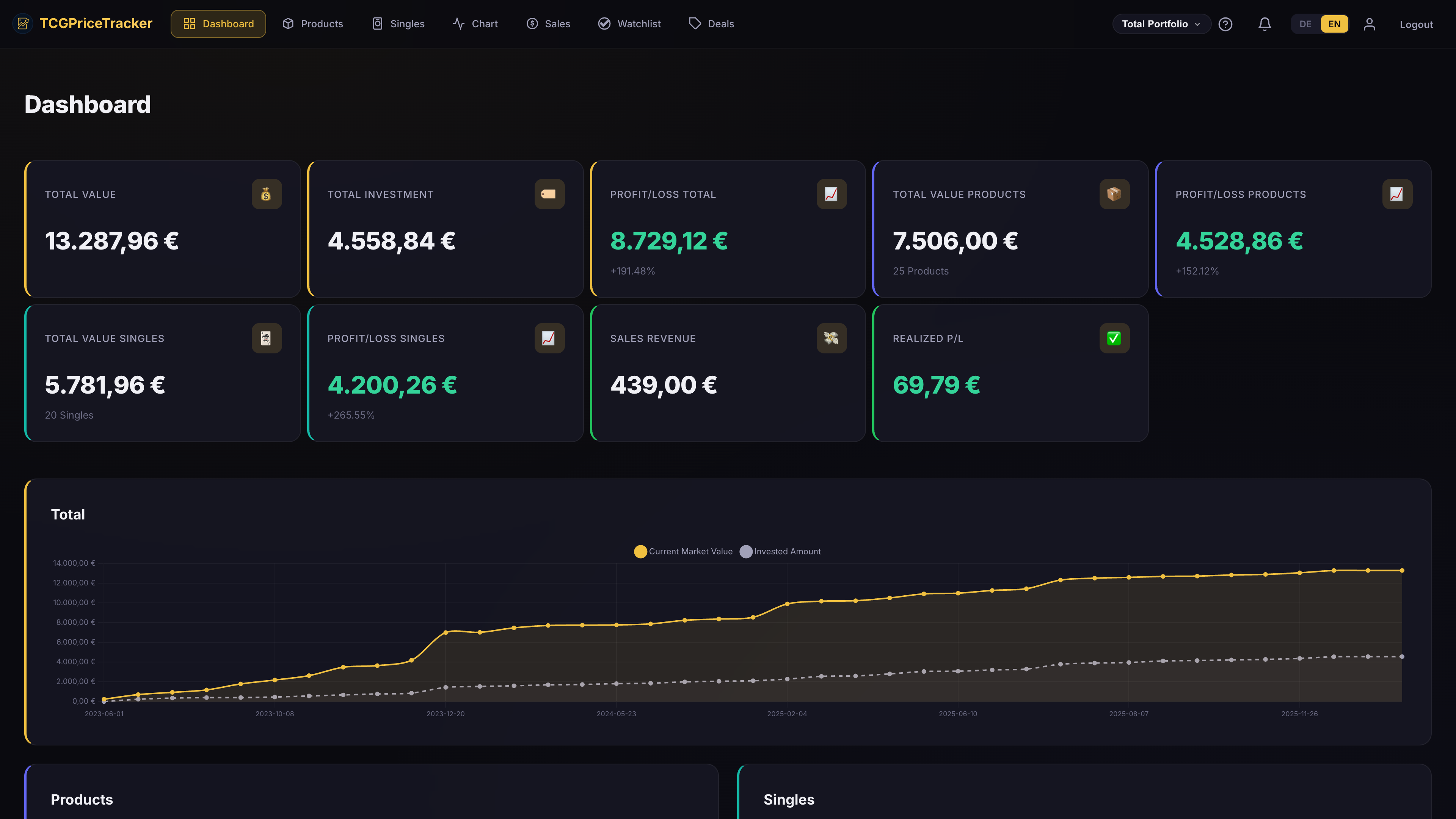
The essentials in ten lines
| Feature | TCGPriceTracker |
|---|---|
| Price source | Cardmarket: entry price as the default and trend price alongside, retrieved automatically and updated daily |
| Currency | Euro |
| Supported games | 21 trading card games in one account |
| Price basis | entry price in your card's language, condition or better and variant; trend price of the Cardmarket product page you link, reverse holo and foil with their own trend where Cardmarket reports one |
| Recorded per card | language, condition, grading with grader and grade, rarity, card number, foil, reverse holo, 1st edition, signed, altered, stamped |
| Sealed products | displays, elite trainer boxes, booster bundles, tins and blisters as their own category |
| Analysis | total value, ROI, value development over time, profit per sale |
| Price alerts | watchlist with notifications in the web app and by email |
| Separation | multiple portfolios in one account, with a combined view |
| Free | permanently, with 20 products, 30 single cards and 10 watchlist entries |
| Pro | from €5.99 per month or €49.99 per year |
Why the price source decides everything in Europe
The same card does not carry the same price in Europe and in the United States. Supply, demand and print runs differ, and on top of that sit the exchange rate, shipping and import duties. If you buy and sell in Germany, Austria or Switzerland, you need the figure that applies on the market you actually trade on.
That is why every price in TCGPriceTracker comes from Cardmarket: the entry price, the average of the up to three cheapest matching offers excluding shipping, and the Cardmarket trend price, a weighted average of recently sold items that filters out individual outliers. Every figure is in euros, with no conversion. Price data is retrieved automatically and updated daily; you never look up a card by hand or set up an access key.
What gets recorded, and where the price comes from
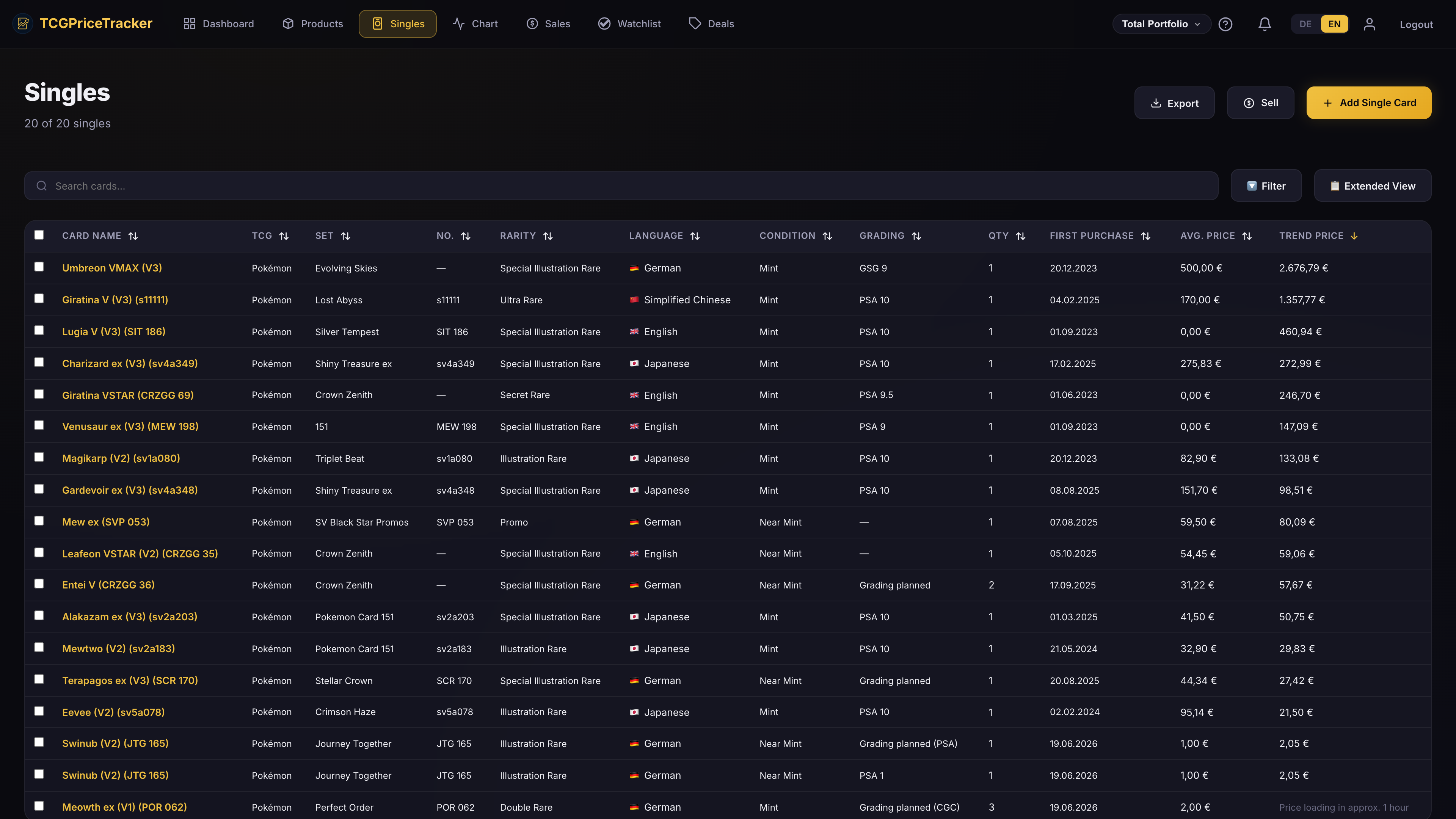
When you add a position, you paste the exact Cardmarket link. Language, condition and variant are taken from it, and grading can be recorded on top, with grader and grade. Rarity and card number are available as their own columns, as are attributes such as foil, reverse holo, 1st edition, signed, altered and stamped – all filterable and sortable.
One thing to understand about the figures: both prices are based on the Cardmarket product page you linked. Wherever Cardmarket maintains a separate product page, you therefore get a separate price – a Japanese print, a special rarity or a different set printing are each their own market item. For the trend, reverse holo and foil use that variant's own trend where Cardmarket reports one; the entry price only counts offers in your variant anyway.
Language and condition move the entry price: a German card in Excellent is valued by the cheapest German offers in Excellent or better, the English copy of the same product page by the English ones. They do not move the trend, which applies to the product page as a whole. If there is no current entry price, the tool keeps using the trend. Beyond that, language and condition make your inventory complete, they are filterable, and they appear in the valuation report. For graded cards you enter the value yourself: every position has a manual value field for exactly that, and it takes precedence over entry price and trend. A market price for ungraded copies cannot represent a PSA 10 anyway. You use the same field whenever you want to value a position differently for any other reason.
Documents you can actually hand over
Sooner or later you will want to do more than look at your holdings – you will want to prove them, to an insurer, an accountant or a buyer.
The valuation report as a PDF lists every position with set, language, number, condition and quantity, plus purchase price, value per unit and total value, subtotalled separately for products and single cards – with a visible price date and a named price source. It is part of the annual plan and can be limited to a single portfolio. The sales record documents one transaction with proceeds, cost, fees, shipping, tax and realised result; it is available in every paid account. A CSV export of your holdings is included in every account, the free one included.
Work in euros, record your holdings in full. Free account with 20 products, 30 single cards and 10 watchlist entries – no credit card.
Getting started
Create an account, paste your first Cardmarket link, done – valuation runs from there. If you are moving a larger collection, use the CSV import: the import format is exactly what the export produces, so you can edit a file and read it back in. For a start it is usually enough to enter your thirty most valuable positions; they account for most of the total value anyway.
Related reading: Tracking a trading card portfolio · Document your card collection · Cardmarket trackers compared
Frequently asked questions
Which prices is the valuation based on?
By default the entry price: the average of the up to three cheapest matching Cardmarket offers in your card's language, condition or better and variant, excluding shipping. Next to it you see the trend price of the product page you linked, and you can switch to it under Valuation in your account. Every figure is in euros, and the data is retrieved automatically and updated daily. For graded cards – and any other case where you want it more precise or simply different – you enter your own value per position, and that value takes precedence.
How do I get my collection in?
Two ways. Individually via the exact Cardmarket link, which supplies language, condition and variant. Or by CSV import in our import format, which is identical to the export. In the free account the limits of 20 products and 30 single cards apply.
Which games are supported?
21 trading card games in one account, among them Pokémon, Magic: The Gathering, Yu-Gi-Oh!, One Piece TCG, Disney Lorcana, Digimon, Flesh and Blood, Star Wars: Unlimited and Riftbound. So you do not need a second tool for a second game.
What does it cost?
The free account is permanent and covers 20 products, 30 single cards and 10 watchlist entries. Pro starts at €5.99 per month or €49.99 per year and removes the limits. The PDF valuation report belongs to the annual plan, the PDF sales record to every paid account.
Can I separate my personal collection from trading stock?
Yes, using multiple portfolios in one account. Entries can be moved between them, and there is a combined view across all of them. The valuation report can be limited to a single portfolio.
Value your collection in euros
Cardmarket prices in euros, valued in each card's language and condition, grading recorded, 21 games in one account. Start free, no credit card.
Start for free now →