The Most Valuable Pokémon Cards in 2026
Most lists of this kind name record auctions: individual sales in the millions that guide nobody. This one works differently — it shows trend prices that actually apply on the market, measured across 10,383 Pokémon cards in our database. And more interesting than the top itself are the patterns: Charizard appears four times in the first ten, and half of them are promos.
Data basis and its limits: the prices are Cardmarket trend prices as at 12 August 2026, drawn from 10,383 Pokémon cards tracked in TCGPriceTracker. That is not a complete market survey but a sample — the cards our users actually hold. Prices change daily.
Where the figures come from
A word on method, because it is what separates this list from others.
The common rankings quote record sales — one-off auctions of individual, usually graded copies. Such figures are spectacular and practically useless: they say nothing about what a card costs if you want to buy or sell it tomorrow.
This list shows trend prices instead. A trend price is a weighted average of recently sold items with individual outliers filtered out. It describes what the market is actually doing, not its exceptions.
One further caveat belongs with it: what was analysed are the cards in our catalogue, which are there because users track them. Cards nobody tracks are missing. For the top end this matters less than for the rest — expensive cards are nearly always tracked.
The ten most expensive cards
| # | Card | Set | Rarity | Trend price |
|---|---|---|---|---|
| 1 | Charizard | Skyridge | Secret Rare | €4,526.87 |
| 2 | Mario Pikachu | XY Promos | Promo | €4,229.18 |
| 3 | Luigi Pikachu | XY Promos | Promo | €3,893.52 |
| 4 | Charizard | Base Set | Holo Rare | €3,567.07 |
| 5 | Latias & Latios GX | Team Up | Special Illustration Rare | €3,150.47 |
| 6 | Charizard Gold Star Delta Species | Offense and Defense of the Furthest Ends | Secret Rare | €2,586.87 |
| 7 | Umbreon VMAX | Evolving Skies | Special Illustration Rare | €2,358.91 |
| 8 | Charizard | Unnumbered Promos | Promo | €2,346.17 |
| 9 | Psyduck [Scream] | Sun & Moon Promos | Promo | €1,892.63 |
| 10 | Eevee [Scream] | Sun & Moon Promos | Promo | €1,868.65 |
Pattern 1: Charizard beats everything
Four of the ten places go to the same character. That is neither coincidence nor the effect of one card — these are four different cards from four different sets spanning roughly two decades.
What it shows: demand attaches to the character, not to the set and not to the rarity tier. A Charizard in any set finds buyers who would otherwise not be there. Demand is thus the most underrated price factor of all — considerably more powerful than the rarity tier printed on the card, as What Makes a Card Valuable sets out in detail.
For judging your own cards this means: before you look at the rarity tier, look at the character. A special rarity featuring an obscure character almost always trails a more ordinary card with a sought-after one.
Pattern 2: promos dominate the top
Five of the ten are promos — cards that were never in regular packs but distributed through campaigns, events or collaborations.
The reason is the print run. A regular set is printed in millions; a campaign card available only through one event or partnership exists in a fraction of that. Add a sought-after character and you get exactly the combination of scarce supply and broad demand that carries high prices.
Two of the cards on the list — Mario Pikachu and Luigi Pikachu — are collaboration cards recognised far beyond the Pokémon scene. That is the demand factor "recognition outside the core scene" in its purest form.
💡 Good to know: Promos are also interesting because they are not reprinted. A card from a regular set can return in a later set; a campaign card is tied to its occasion.
Pattern 3: modern cards are in there too
The common assumption is that high prices only exist on old cards. The list contradicts that: two of the ten come from modern sets — Latias & Latios GX from Team Up and Umbreon VMAX from Evolving Skies, both as Special Illustration Rares.
What these modern cards share with the old ones is scarcity within their set. Special Illustration Rares are printed at very low ratios, and where a sought-after character sits on one, the same effect appears as with a promo from the 2000s.
The difference lies in the risk. Old cards are scarce because many copies were lost over the years — that is irreversible. On modern cards, scarcity depends on the pull rate of a set still in print. Such prices therefore move more after release than those of closed sets — as long as printing continues, supply can follow.
What these prices assume
One qualification, without which the list misleads: the figures apply to market-typical copies of each card, not to every specimen in every state.
On old cards especially, condition is the largest price factor. A heavily played Base Set Charizard sits far below the trend price; a flawless, professionally graded copy considerably above. Between the two, a factor of ten is quickly reached.
If you own such a card, the first question is therefore not "what is it worth" but "what condition is it in". And the second: is it genuine? At these price levels the check is always worth it — the procedure is in Spotting fake cards.
What your own cards are worth
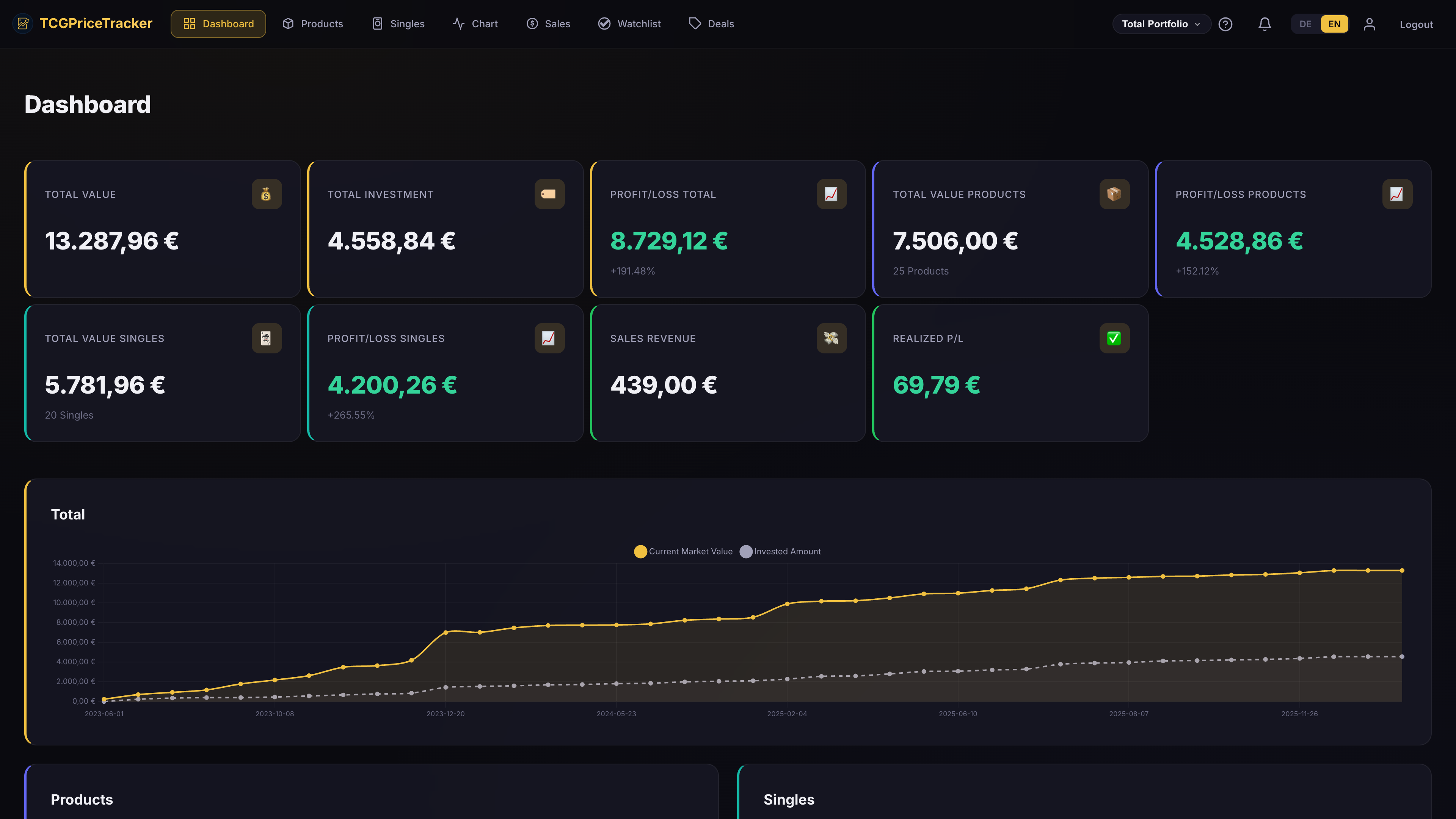
Rankings are entertaining but never answer the question you actually care about: what is my collection worth?
For that you do not need a list but the same mechanism this list came from. In TCGPriceTracker you add your cards via their exact Cardmarket link; the trend price is retrieved daily, and the individual values build your collection's total and its history.
Two notes on that. The displayed value comes from the linked product page and therefore represents the regular market item — for graded cards you enter your own value. And the purchase price belongs in the record, otherwise ROI shows a return that does not exist.
Trend prices for 21 games, updated daily. Start free with 20 products, 30 single cards and 10 watchlist entries.
Related reading: Pokémon card value · Pokémon sets in order · 30th Celebration: is waiting worth it?
Frequently asked questions
Why are there no million-euro figures here?
Because those come from individual record auctions and are useless for judging your own cards. This list shows trend prices — weighted averages of actual sales that reflect the ongoing market rather than its exceptions.
Why does Charizard appear four times?
Because demand attaches to the character, not the set. These are four different cards from four sets spanning roughly two decades. A sought-after character reaches buyers that a scarcer card with an unknown one does not.
Why are so many promos on the list?
Because of print runs. Regular sets are printed in millions, campaign and collaboration cards in a fraction of that. Add a sought-after character and you get scarce supply meeting broad demand. Promos are also, as a rule, never reprinted.
Does the price apply to every copy?
No. The figures apply to market-typical copies. On old cards especially, condition is the largest price factor — between heavily played and flawless, a factor of ten is quickly reached. So check the condition first, and at these price levels the authenticity too.
Is the list complete?
It covers the 10,383 Pokémon cards tracked in TCGPriceTracker — a sample, not a complete market survey. For the top end that matters less, because expensive cards are nearly always tracked. Prices also change daily.
How do I find out what my cards are worth?
By the same route this list came from: record the card via its exact Cardmarket link and let the trend price update daily. For graded copies you enter your own value, because the trend price represents the ungraded market item.
What is your collection worth?
Trend prices per card, updated daily, with total value and history. Start free, no credit card.
Start for free now →