Pokémon cards and products: Which language is worth more?
English is seen as the “valuable” language. Is that true? We compared what the same Pokémon card and the same sealed product cost at minimum on Cardmarket in English, German, French, Italian and Spanish. In short: for booster boxes and expensive cards, English comes out on top. For cheap cards, things look different.
The result at a glance
Each time, we compared the cheapest offer in a language with the cheapest English one — for singles in Near Mint. The values are medians.
| Language | Sealed products | Cards from €100 | Cards up to €5 |
|---|---|---|---|
| English | reference | reference | reference |
| French | −7% | +7% | +50% |
| Spanish | −11% | −8% | +51% |
| German | −12% | −21% | ±0% |
| Italian | −28% | −20% | −34% |
In short: for sealed products, English is the most expensive language, followed by French, Spanish and German, with Italian by far the cheapest. Expensive cards look similar — only French sits slightly above English there. For cheap cards, the picture flips: French and Spanish copies cost around half as much again as English ones.
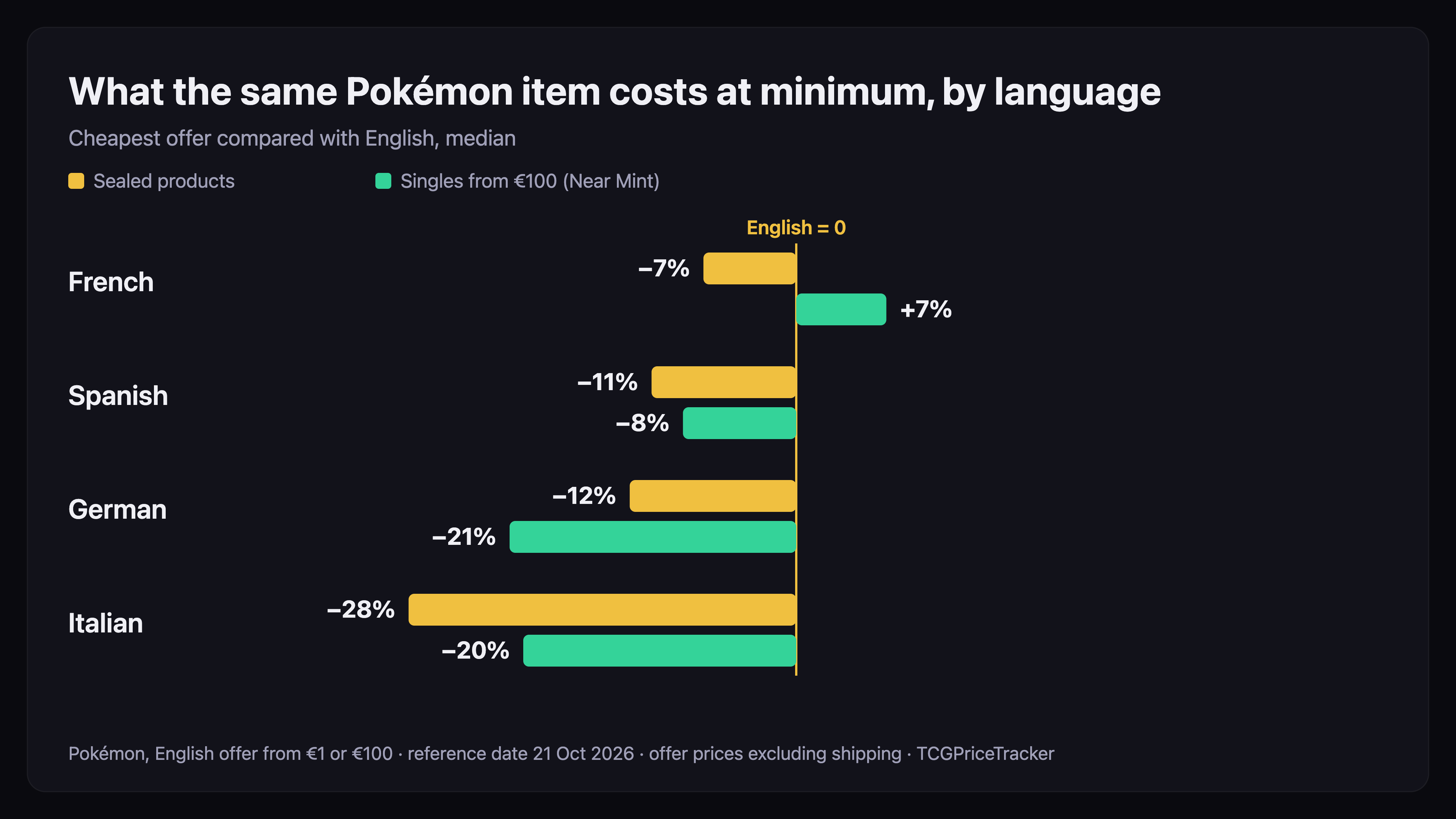
Sealed products: English is the most expensive
For booster boxes, Elite Trainer Boxes and other sealed products, the cheapest English offer was, at the median, more expensive than that of every other language compared:
| Language | Median vs. English | Cheaper than English |
|---|---|---|
| French | −7% | for 58% of products |
| Spanish | −11% | for 64% of products |
| German | −12% | for 77% of products |
| Italian | −28% | for 79% of products |
For expensive products from 100 euros, the gaps are almost the same. If you want to open a booster box and do not mind the language, Italian saves the most, while German or Spanish still save a good tenth.
Singles: it depends on the price
For singles, the result depends heavily on how expensive the card is. The table shows the median per price range, measured against the cheapest English Near Mint offer:
| English price | German | Italian | Spanish | French |
|---|---|---|---|---|
| €1 to €5 | ±0% | −34% | +51% | +50% |
| €5 to €20 | −6% | −36% | +16% | +21% |
| €20 to €100 | −11% | −32% | +2% | +24% |
| from €100 | −21% | −20% | −8% | +7% |
Italian is clearly cheaper than English in every price range, by a fifth to a third.
German gets cheaper as the price rises. For cards under 5 euros there is no difference to English; from 100 euros, German sits around a fifth below.
Spanish and French are much more expensive than English for cheap cards, by around half. The more expensive the card, the smaller the gap. From 100 euros, Spanish is below English and French only just above.
A single figure across all cards would therefore be misleading: it would be driven by the many cheap cards. And even within a price range, the patterns hold only on average. For a specific card, only a look at its offers helps.
How we compared
- Same card, same product: Every comparison was made within the same Cardmarket product page — same set and same number, or the same product.
- Same condition: For singles, Near Mint offers only, so condition does not skew the comparison. Sealed products have no condition.
- Lowest price per language: the cheapest offer, with offers from sellers in the EU preferred, excluding shipping.
- Which cards and products: Pokémon singles and sealed Pokémon products that users track in TCGPriceTracker and that had offers in several languages. Only items costing at least 1 euro in English were included.
- Median rather than average: Individual cards with extreme gaps barely move the median.
- Reference date: October 21, 2026.
Important: We compared offers, that is what sellers ask — not completed sales. For the question “What do I have to pay at least?” that is exactly the right value. What actually sells in a given language can differ.
Possible reasons
The price data shows the result, not the cause. A few obvious explanations — as context, not as proof:
- Who buys: English cards and products are bought all over Europe, including by collectors whose language is not printed at all. Other languages mainly have buyers in their own language area. That points to higher prices for English, especially for booster boxes and sought-after cards.
- Few offers for cheap cards: There are probably far fewer offers for cheap French and Spanish cards than for English ones. Then the cheapest offer sits higher without the card being worth more.
- Collecting by language: Anyone who deliberately collects in their own language often pays a premium for it — especially if that language is rarely offered.
Which forces dominate for which language cannot be read from offer prices alone.
What about Japanese?
Japanese and Korean cards do not appear in this comparison. Japanese cards come out in their own sets with their own numbering and have separate product pages on Cardmarket; Korean cards are usually listed as a language on those Japanese pages. A comparison with the same English or German card is therefore generally not possible. What a Japanese card is worth is best judged by its own offers.
What it means for you
When buying: If you do not mind the language, it pays to look at Italian and German offers for booster boxes and expensive cards. For a card that costs 150 euros in English, a fifth less can quickly be 30 euros. For cheap cards, on the other hand, English is often the cheaper choice compared with French or Spanish. Still check what you are getting before you buy — see Buying trading cards safely.
When selling: Never go by the unfiltered From price of the product page. Without a language filter it mixes all languages — and for a German card it may well be an Italian offer. How to find the lowest price for exactly your language is explained in Cardmarket lowest price. More pitfalls: The 9 most common mistakes when selling cards.
When valuing your collection: Price trend and average prices on Cardmarket know no language. If your collection consists mostly of German or Italian booster boxes and expensive cards, the trend may show you more value than your copies would actually fetch. The same applies to condition — how much it shifts the price is shown in Card condition and price.
What else determines a card's value — condition, variant, rarity, demand — is explained in What makes a card valuable.
Valuing your collection by language
TCGPriceTracker values your collection by entry price by default; you can switch to the trend under Valuation in your account. With the entry price, each card is valued by the up to three cheapest matching offers in its entered language — and also in its condition or better and in its variant. The same applies to sealed products, where only the language counts. The language difference from this comparison is thus automatically reflected in the value of your collection.
The setting applies to the dashboard, lists, detail view and the history of your collection. How to record cards with their language is explained in Pokémon card value.
Your cards and products, valued in their language
Entry price per language and condition with the trend alongside, updated daily, with history and total value. Free, no credit card.
Start for free →Frequently asked questions
Are English Pokémon cards worth more than German ones?
For expensive cards, yes: from 100 euros, the cheapest German Near Mint offer was a median of around 21 percent below the English one. For cards under 5 euros, however, there was no difference.
Are English Pokémon booster boxes more expensive than German ones?
Yes. For sealed products, the cheapest German offer was a median of around 12 percent below the English one. English was the most expensive of the languages compared for products.
Which language is cheapest for Pokémon?
Italian, for cards and sealed products alike. The cheapest Italian offer was a median of around 28 percent below the English one for products, and 20 to 36 percent for cards depending on the price range.
Why are cheap French Pokémon cards more expensive than English ones?
For cards under 5 euros, the cheapest French offer was a median of around 50 percent above the English one, but only just under 7 percent from 100 euros. The obvious explanation is that there are fewer offers for cheap French cards. For sealed products, French is cheaper than English.
Does the Cardmarket trend show the price per language?
No. Price trend and average prices apply to the product page as a whole and mix all languages. The From price only does so without a filter: once you set the language filter in the offer list, it shows the cheapest offer in that language.
Can my collection be valued by the price in its language?
Yes. TCGPriceTracker values your collection by entry price by default. Each card and product is valued by the cheapest matching offers in the language you entered, for cards also matching condition and variant.
What is your collection worth in its language?
Entry price per language and condition, updated daily, with history and total value. Start free, no credit card.
Start for free →