Cardmarket lowest price: From price, trend and entry price explained
Every Cardmarket page shows a “From” price at the top — and it is almost never the price at which you can buy or sell your card. Without a filter, it mixes every language, every condition and every country. This guide explains what the numbers on Cardmarket really mean, how to find the lowest price for exactly your card — in its language and its condition — and how to track it without checking every day.
The short version
| Value | What it is | By language and condition? |
|---|---|---|
| From price | the cheapest current offer | not without a filter; with a language filter, language only |
| Price trend | smoothed value from past sales | no |
| 1, 7 and 30-day average | mean of the sales in that period | no |
| Entry price | average of the up to three cheapest matching offers | yes, both |
Cardmarket shows the first three rows itself. TCGPriceTracker calculates the entry price from the offers — because the question collectors ask most often is exactly the one the Cardmarket figures do not answer reliably — the trend knows neither language nor condition, and even with a filter the From price shows only a single offer: What is the cheapest price right now for my German card in Excellent?
The prices on a Cardmarket page
Open a single card on Cardmarket and the info box shows several numbers one below the other. They measure different things.
“From” — the From price. Often simply called the lowest price: the cheapest offer listed for the product at this moment. A single offer, not an average and not a sale. It changes as soon as someone lists a cheaper offer or the cheapest one sells. If you filter the offer list by language, it shows the cheapest offer in that language.
Price trend. A smoothed value that Cardmarket calculates from past sales. Cardmarket does not publish the exact formula. It reacts slowly — good for placing the market, poor for seeing short-term moves.
Average price over 1, 7 and 30 days. The mean of actual sales in that period. If the 7-day value is clearly above the 30-day value, recent sales were more expensive. Whether that is due to higher demand or because more good copies were sold, the value does not show.
Available items. How many copies are offered in total — again across all languages and conditions.
The key point: Price trend, average prices and available items apply to the product page as a whole. Cardmarket does not break them down by language or condition. A German card in Good and an English one in Mint sit in the same number. Only the From price follows the language filter — without a filter it mixes every language, and even with one it remains a single offer.
Why the From price is almost never your price
If you want to sell your card and go by the From price, you will almost always price too low. If you want to buy and use it as your target, you will often wait in vain. Four reasons.
Without a filter, it mixes all languages. The cheapest offer may be an Italian card while yours is English. Differences between languages are often considerable — how large, our comparison of what the same Pokémon card costs in each language shows.
It mixes all conditions. The cheapest offer is often a played card. For a copy in Near Mint, that price is no guide. How far apart the conditions are is shown in our analysis Card condition and price.
It is a single offer. One seller who made a typo or wants a quick sale sets the From price alone. Once that copy sells, the value jumps.
It excludes shipping. A cheap offer from another country can cost more with shipping than a slightly higher one from your own.
The price trend only partly helps with the first two points: it is more stable, but also not split by language and condition.
Finding the lowest price for your card by hand
Cardmarket has all the tools for this — you just have to use them. Here is how:
- Right product page. Set, number and variant must match. A reverse holo, a first edition or a Japanese print is a different offer from the standard card.
- Filter the language. Choose your card's language in the filter. The From price at the top then also shows the cheapest offer in that language.
- Set the minimum condition. The condition filter on Cardmarket means “this condition or better”. For a card in Excellent, it shows Excellent, Near Mint and Mint. That is correct: a better copy at the same price is direct competition for buyers.
- Fix the variant. Reverse holo, foil, signed, altered, first edition — set each to match your card.
- Look at the three cheapest, not just the first. If the cheapest is far below the next ones, it is an outlier — or bait.
- Think about shipping. When buying, compare the total price; when selling, know that buyers do the same.
That takes a minute or two per card. For a handful of cards, that is fine. For a collection with a hundred items — and prices that keep moving — it is not.
The entry price: the lowest price for your cards and products
The entry price in TCGPriceTracker runs exactly this search for every card and every sealed product in your collection. It is the average of the up to three cheapest matching offers on Cardmarket.
Matching means for singles:
- in your card's language,
- at least in your card's condition — just like the Cardmarket filter,
- in the same variant: a normal card is not compared with reverse holo, foil, signed, altered or first edition offers, and vice versa.
For sealed products such as booster boxes, only the language counts; there is no condition.
Why three offers instead of a single lowest price? Because a single offer distorts too easily. The average of three shows where the market for your copy actually starts — hence the name. An offer far below the rest does not count, provided there are enough other offers to compare: if it costs less than a fifth of what the next offers typically cost, it is skipped as an outlier.
Excluding shipping. It uses the offer price as Cardmarket shows it in the list. Shipping depends on the seller and the basket and does not belong to any single card.
Current or not at all. The entry price is updated daily. If a value is older than two days or there are currently no matching offers, the tool keeps using the trend for that card — and says so. You never see an outdated entry price without knowing it.
Honest about gaps. If Cardmarket does not currently list your card's variant, the tool takes the value from the closest comparable offer and points this out. If Cardmarket does not list the card in the language you entered at all, you get a note to check your entry.
Trend and entry price compared
In the tool, your collection is valued by entry price by default; you can switch to the trend in your account. The two answer different questions:
| Trend | Entry price | |
|---|---|---|
| Based on | past sales | the up to three cheapest matching offers |
| Language | no | yes |
| Condition | no | your condition or better |
| Variant | reverse holo and foil have their own trend where Cardmarket lists one | exactly yours |
| Reacts | slowly | quickly, without outliers |
| Answers | Where is the market overall? | What does a copy like mine cost right now? |
Values you enter yourself, for example for graded cards, take priority in both valuations. A trend cannot reflect a PSA 10 — that is what the field for your own value is for.
Which price for what
If you want to sell: The entry price shows which offers your card competes with. If you are clearly above it, buyers will buy elsewhere first. What else costs money is covered in The 9 most common mistakes when selling cards and Cardmarket fees.
If you want to buy: The entry price is a realistic floor for a copy like the one you are looking for. An offer well below it deserves a second look — see Buying trading cards safely.
If you want to value your collection: The trend is the calmer value and works well for the history over months. The entry price comes closer to what your specific copies would cost today — especially for cards whose language or condition differs from the average.
Switching in the tool
The entry price is the default for every account, including the free plan. You change the valuation in your account under Valuation: entry price or trend. The setting applies to the dashboard, lists, detail view and the history of your collection.
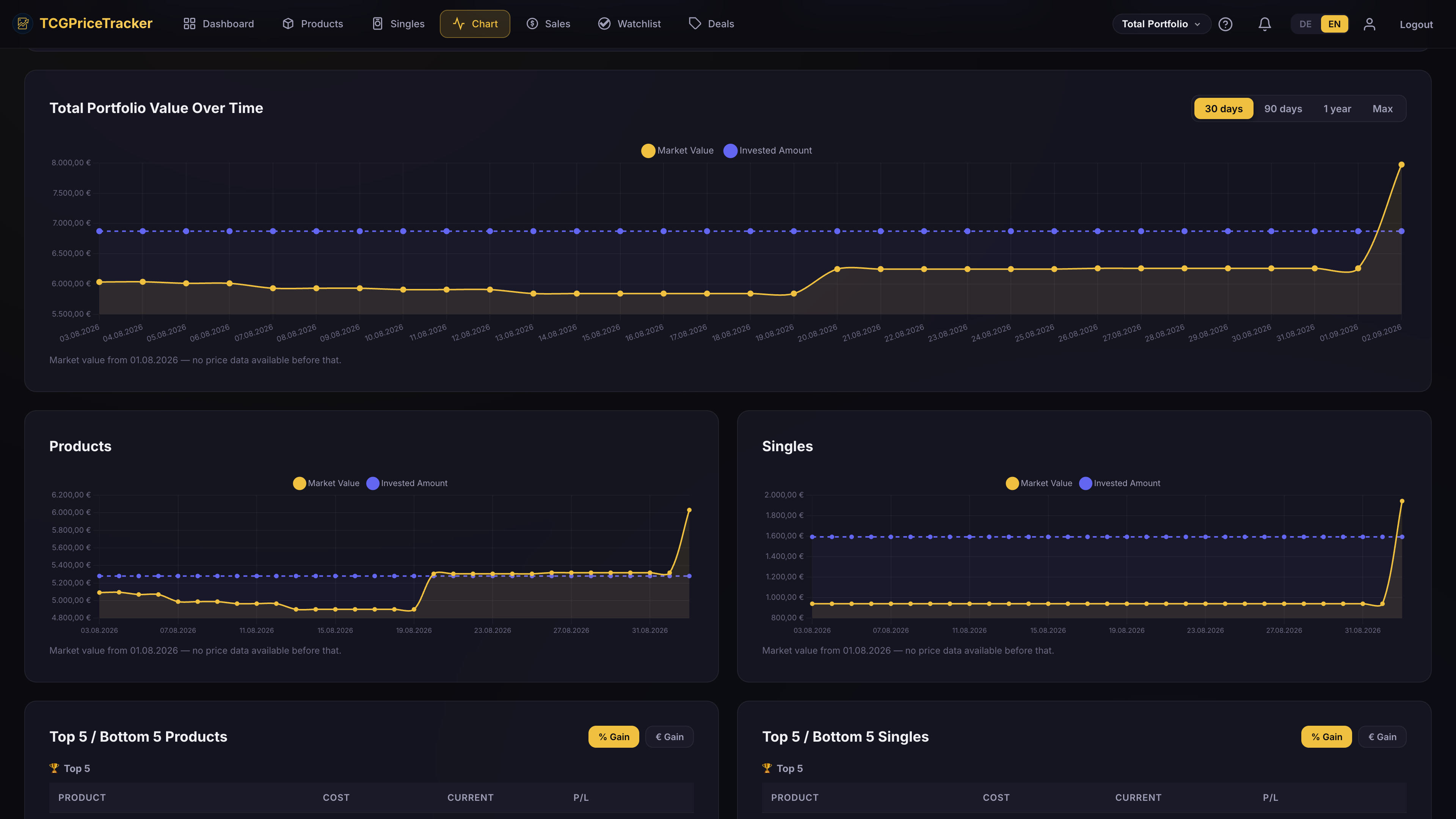
For each card and product you can see what it is currently valued by. If there is no current entry price, it says “by trend” explicitly, so nothing gets mixed up unnoticed. In the detail view you also see the offer prices the entry price was calculated from and when it was last updated.
How to record your cards with language and condition is explained in Pokémon card value. What the terms around conditions and variants mean is covered in the TCG glossary.
Keep the lowest price for your cards in view
Trend and entry price per card and product, with history and total value. Free, no credit card.
Start for free →Frequently asked questions
What is the From price on Cardmarket?
The From price is the cheapest offer currently listed for a card — without a filter, across all languages, conditions and countries. It is a single offer, not a market value, and it almost never applies to one specific copy.
What is the lowest price on Cardmarket?
The lowest price usually means the cheapest offer for a card — on Cardmarket, the From price. Without a filter it covers all languages and conditions. You see the lowest price in your language when you filter the offer list by language. Because a single offer distorts easily, the entry price uses the up to three cheapest matching offers.
What is the difference between the From price and the price trend?
The From price is the cheapest current offer. The price trend is a smoothed value based on past sales. The From price reacts instantly and jumps around, the trend reacts slowly. The price trend applies to the product page as a whole and does not distinguish by language. The From price only does so when you filter the offer list by language.
How do I find the lowest price for my card in my language?
On the product page, set your card's language and its condition as the minimum condition, choose the same variant and then look at the three cheapest offers rather than only the first one. A single strikingly cheap offer is often an outlier.
What is the entry price in TCGPriceTracker?
The entry price is the average of the up to three cheapest matching offers on Cardmarket — for singles in their language, at least in their condition and in the same variant, for sealed products in their language, in each case excluding shipping. Where there is no current value, the tool keeps using the trend.
Does the entry price include shipping?
No. It uses the offer price without shipping, as Cardmarket shows it in the offer list. Shipping depends on the seller and the basket and cannot be assigned to a single card.
Is there a price alert on the lowest price?
Yes, through the entry price: watchlist price alerts follow it, meaning the average of the up to three cheapest matching offers in the language and, for singles, the condition of your link. It is updated daily. If there is none, the trend applies.
What does your card really cost?
Entry price for your cards and products, in their language and condition, updated daily, with history. Start free, no credit card.
Start for free →