Card condition and price: What do Near Mint, Excellent and Played cost?
Everyone knows a played card is worth less than a flawless one. But how much less? And is the step up from Excellent to Near Mint worth paying for at all? For Pokémon singles, we analysed what a card costs at minimum on Cardmarket in each condition — and compared it with the Cardmarket trend of the same card. Two results are surprising.
The result at a glance
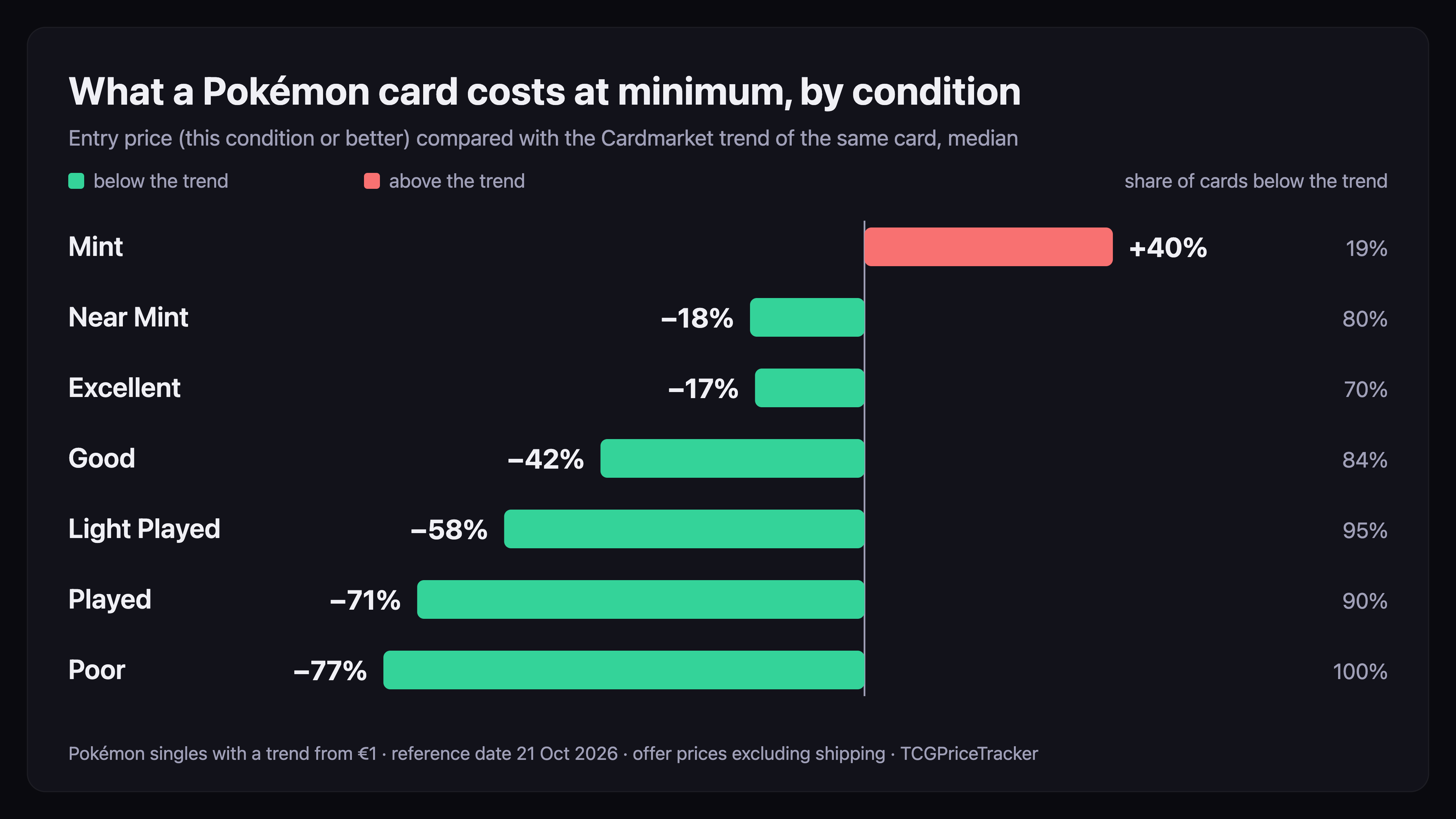
The table shows where the market for a card starts in each condition — measured against the Cardmarket trend of the same card.
| Condition | Entry price vs. trend (median) | Below the trend |
|---|---|---|
| Mint | +40% | for 19% of cards |
| Near Mint | −18% | for 80% of cards |
| Excellent | −17% | for 70% of cards |
| Good | −42% | for 84% of cards |
| Light Played | −58% | for 95% of cards |
| Played | −71% | for 90% of cards |
| Poor | −77% | for all cards |
The two surprises: even Near Mint is available well below the trend on average — and Excellent costs barely less than Near Mint. Only from Good does it get noticeably cheaper, and from Light Played very clearly so.
The condition scale on Cardmarket
Cardmarket distinguishes seven conditions. Sellers choose the condition themselves; buyers can raise a complaint after the purchase.
| Code | Condition | Meaning |
|---|---|---|
| MT | Mint | Flawless, as if fresh from the booster |
| NM | Near Mint | Almost flawless, at most minimal marks visible on close inspection |
| EX | Excellent | Visibly imperfect at first glance, like after a few games without sleeves; only minor flaws such as white spots on corners and edges |
| GD | Good | Heavy wear all round, often scratches, but no bends or water damage |
| LP | Light Played | Played unsleeved for a long time, can look quite beaten up, but clearly tournament legal in a sleeve |
| PL | Played | Heavily played, several clear defects |
| PO | Poor | Severe damage: creases, tears, water marks, writing |
Excellent and Good are a feature of the European scale; other marketplaces partly work with fewer levels. Careful with US terms: what US shops call “Lightly Played” usually matches Cardmarket's Excellent, not Light Played. How to assess your card's condition is explained in Pokémon card value. You will find all the terms in the TCG glossary.
How we compared
- Entry price per condition: instead of a single lowest price, the average of the up to three cheapest offers on Cardmarket in the card's language, in the same variant and excluding shipping.
- “This condition or better”: That is how Cardmarket filters, and that is how we calculated. For Good, all offers in Good, Excellent, Near Mint and Mint count. This reflects a seller's position: a Good copy competes with every better offer at the same price.
- Reference value: the Cardmarket trend of the same card. It is not split by condition and therefore works as a common yardstick.
- Which cards: Pokémon singles that users have recorded in TCGPriceTracker in the respective condition, with a trend from 1 euro.
- Median rather than average, so that individual extreme cards do not shift the result.
- Reference date: October 21, 2026.
Important: We compared offers, that is what sellers ask — not completed sales. The value shows what you have to pay at least for a copy in that condition and which prices you compete with when selling.
The conditions one by one
Mint: well above the trend. If you explicitly ask for Mint, you pay a median of 40 percent above the trend. The obvious explanation: many sellers list even flawless cards as Near Mint to be safe, and those who explicitly offer Mint ask correspondingly more. For truly flawless cards, a look at grading may be more worthwhile.
Near Mint: already below the trend. The three cheapest Near Mint offers were a median of 18 percent below the trend, and below it for four out of five cards. So the trend is not a floor. Obvious reasons: it is based on sales, and buyers do not always take the cheapest offer, for example because of shipping, ratings or the seller's country. It also mixes all languages.
Excellent: almost like Near Mint. A median of 17 percent below the trend, and thus hardly different from Near Mint. The next section shows why.
Good: the first big step. A median of 42 percent below the trend. This is where discounts start that really matter when buying.
Light Played and Played: more than half off. Light Played was a median of 58 percent below the trend, Played 71 percent. For nine out of ten cards or more, the entry in these conditions was below the trend.
Poor: residual value. Around three quarters below the trend. There were only a few values for Poor, so the figure is only a rough indication.
These values are medians. Discounts vary considerably from card to card: for some cards Excellent is level with Near Mint, for others well below. For a specific card, only a look at its offers helps.
Excellent vs. Near Mint: barely a difference
The comparison is most precise when you look at the same card in the same language and only change the condition. That is possible wherever users have recorded a card in several conditions:
| Condition (or better) | vs. Near Mint (median) |
|---|---|
| Mint | +60% |
| Excellent | −3% |
If you accept Excellent instead of Near Mint, you save a median of only about 3 percent. For more than a third of these cards, the entry price was exactly the same: the three cheapest offers in “Excellent or better” were Near Mint copies anyway. For many other cards, however, an Excellent copy came out ahead: for just under a third, Excellent saved more than 10 percent. So it pays to look at the specific card.
For sellers this means: a card in Excellent competes directly with Near Mint offers at the same price. If you list it above the cheapest Near Mint offer, you will usually wait in vain.
What about Magic?
For Magic cards, the discounts for played conditions were considerably smaller in our data than for Pokémon. An obvious explanation: many Magic cards are bought to play, and in a sleeve on the table condition matters less. The basis for played Magic cards is small, however, so we do not give figures here. More on Magic prices in Track Magic card prices.
What it means for you
When selling: Do not use the trend as the price for a played card. Listing a Light Played card at the trend means asking more than twice the entry. State the condition honestly: a card whose condition is overstated costs ratings and returns — more in The 9 most common mistakes when selling cards.
When buying: Excellent instead of Near Mint saves little on average. If you are looking for binder or playing cards, you save noticeably from Good and a lot from Light Played onwards. With played cards, check the photos and ask if in doubt — see Buying trading cards safely.
When valuing your collection: The trend knows no condition. For a collection with many played cards, it shows considerably more value than the copies would fetch. What else the trend does not distinguish, and how to find the lowest price for exactly your card, is explained in Cardmarket lowest price. How much the language shifts the price is shown in Which language is worth more?.
Valuing your collection by condition
TCGPriceTracker values your collection by entry price by default; you can switch to the trend under Valuation in your account. With the entry price, each card is valued by the average of the up to three cheapest matching offers — in its language, in its condition or better and in its variant. Exactly the values this analysis is based on. If there is no current entry price for a card, the tool keeps using the trend and says so.
For graded cards there is a separate field for your own value, which takes priority in every valuation.
Your cards, valued in their condition
Entry price per language and condition, updated daily, with history and total value. Free, no credit card.
Start for free →Frequently asked questions
How much less is a card in Excellent worth than in Near Mint?
Usually little. For the same card in the same language, the entry price for Excellent or better was a median of only about 3 percent below that for Near Mint or better. Often the cheapest offers were Near Mint copies anyway.
What does Light Played mean on Cardmarket?
Light Played is the fifth of seven levels on the Cardmarket scale, below Good: the card has been played without sleeves for a long time and can look quite beaten up, but it is clearly tournament legal in a sleeve. In our analysis, the entry price for Light Played or better was a median of just under 60 percent below the trend.
Does the Cardmarket trend apply to every condition?
The trend is not split by condition. It applies to the product page as a whole. For a played card it is therefore usually well above what copies in that condition cost.
Is it worth buying cards in Good or Light Played?
For a binder or for playing, often yes: the entry was around 40 percent below the trend for Good and just under 60 percent for Light Played. If you plan to sell later, keep in mind that played cards also only sell at a discount.
Can my collection be valued by the condition of its cards?
Yes. TCGPriceTracker values your collection by entry price by default. It takes each card's language, condition and variant into account. Where there is no current value, the tool keeps using the trend.
What is your collection worth in its condition?
Entry price in each card's language and condition, updated daily, with history. Start free, no credit card.
Start for free →