Pokémon Market Report October 2026
How did the Pokémon market develop in October? We measured 3,652 singles and 727 sealed products over the whole month. The picture: the market eased slightly, sealed products stood still — and 30th Celebration fell clearly, as the previous anniversaries also did in the months after release.
The result in three sentences
The median Pokémon card lost 3.3 percent in October 2026, and 57 percent of all cards got cheaper. Sealed products were practically unchanged at the median.
The newer the set, the steeper the drop: Sword & Shield stood still, Scarlet & Violet eased by just under 4 percent, Mega Evolution by just under 7 percent — and cards from 30th Celebration lost 27 percent at the median.
Expensive cards again fell more than cheap ones: from 100 euros, the median decline was 11.5 percent.
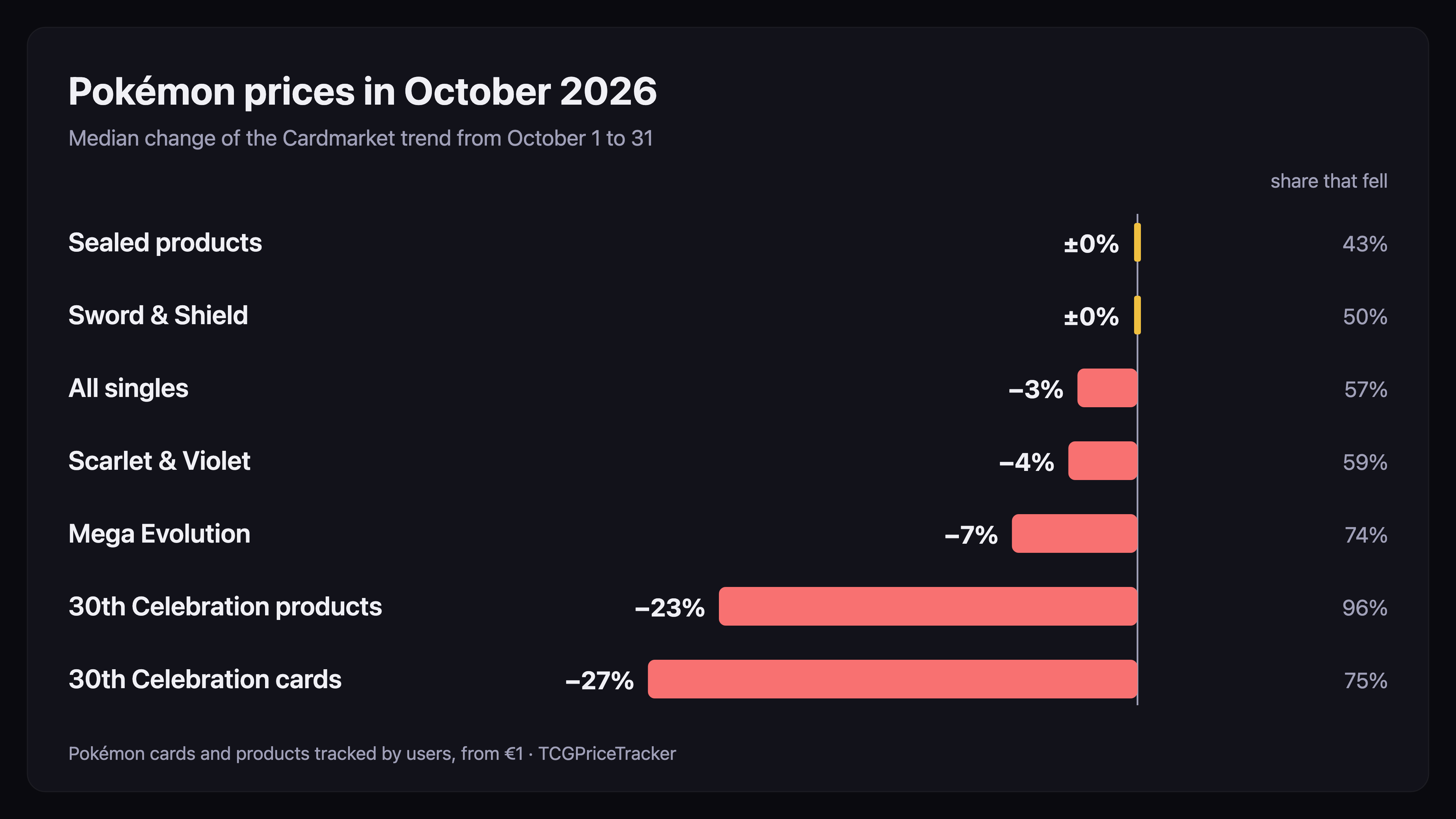
Data basis and its limits: We analysed Cardmarket trend prices of 3,652 Pokémon singles and 727 sealed Pokémon products that cost at least €1 on October 1 and still had a price on October 31. If the same card is in the tool with different links, it counts only once. It is a slice of the market — namely what TCGPriceTracker users hold in their collection or on their watchlist — not a complete market overview.
What exactly was measured
The structure follows the August market report, so the figures stay comparable.
- Period: the whole of October, from October 1 to 31, 2026.
- Selection: Pokémon singles and sealed Pokémon products that users track in TCGPriceTracker — cards and products someone actually owns or watches, not an arbitrary database dump.
- Minimum price: only items costing at least €1 on October 1. With cent amounts, a change of a few cents already produces three-digit percentages.
- Measure: the Cardmarket price trend, a smoothed value from past sales. It applies to the product page as a whole, across all languages and conditions. We keep using it here because it has the longest history and keeps the reports comparable.
- Median rather than average: the median describes the middle card and is not bent by individual outliers.
Three small changes compared with August: if a value was missing on a reference date, the last value from the three days before counts. And besides collections, watchlist entries now count too. Instead of a window starting mid-month, we now measure the calendar month.
Singles: slightly down
| Development | Cards | Share |
|---|---|---|
| Up | 1,566 | 43% |
| Down | 2,067 | 57% |
| Unchanged | 19 | under 1% |
| Total | 3,652 | 100% |
More cards fell than rose, and the median change was minus 3.3 percent. For a collection that means a slightly lower total value, but no crash.
Most moves were small: 1,428 of the 3,652 cards — 39 percent — changed by less than ten percent. 383 cards, just over ten percent, moved by more than half their value, almost always rarely traded cards (more on that below under the extremes).
Expensive cards fall the most
| Price range on October 1 | Cards | Median change |
|---|---|---|
| €1 to €5 | 1,709 | −2.3% |
| €5 to €20 | 1,105 | −3.2% |
| €20 to €100 | 611 | −5.2% |
| from €100 | 227 | −11.5% |
The August pattern has been confirmed and strengthened: the more expensive the card, the weaker the month. In August the segment from €100 was at minus 6.4 percent, in October at minus 11.5 percent. Cheap cards, by contrast, eased only slightly.
One limitation: the most expensive segment is the smallest at 227 cards, so individual cards weigh more there.
The newer the set, the steeper the drop
Splitting the cards by the era of their set shows the clearest pattern of the month:
| Era | Cards | Median change | Fell |
|---|---|---|---|
| Sword & Shield | 604 | ±0.0% | 50% |
| Scarlet & Violet | 948 | −3.8% | 59% |
| Mega Evolution (excluding 30th Celebration) | 371 | −6.9% | 74% |
| 30th Celebration | 79 | −26.9% | 75% |
| Older sets, Asian editions and other | 1,650 | −2.3% | 53% |
Cards from Sword & Shield, the oldest of the three eras, stood still. The younger the era, the clearer the decline — down to 30th Celebration, which only came out in mid-September. Why new sets almost always ease after release is explained in What makes a card valuable.
30th Celebration: the decline after release
30th Celebration came out on September 16. The English product line arrives in waves: more followed on October 2 and 30, and the next are announced for November 6 and December 4. In October the set eased clearly — singles and products alike.
Singles: in October, 30th Celebration cards lost 27 percent at the median. Since September 18, the first day with prices for almost all cards in the set, 89 of 92 tracked cards got cheaper, by a median of 61 percent.
Sealed products in the Cardmarket trend, across all languages:
| Product | in stores from | Sep 16 | Oct 1 | Oct 31 | in October |
|---|---|---|---|---|---|
| Elite Trainer Box | Sep 16 | €165.65 | €135.27 | €124.73 | −8% |
| Booster Bundle | Oct 2 | €94.98 | €86.85 | €63.35 | −27% |
| Mini Tin (Pikachu & Vivillon) | Oct 2 | €29.49 | €31.09 | €19.95 | −36% |
| Mini Tin Display | Oct 2 | €322.30 | €317.09 | €251.46 | −21% |
| Espeon ex Ultra-Premium Collection | Nov 6 | €518.01 | €470.77 | €466.45 | −1% |
| Umbreon ex Ultra-Premium Collection | Nov 6 | €528.61 | €550.90 | €514.75 | −7% |
Of the 24 tracked 30th Celebration products, 23 got cheaper in October, by a median of 23 percent. The Elite Trainer Box has lost a quarter since release day. The Booster Bundle and Mini Tins only reached stores on October 2, so their value on September 16 was still a pre-order price. The last two rows stand out: the Ultra-Premium Collections only come out on November 6 and barely eased in October.
This is no surprise. At the previous anniversaries, prices also fell markedly in the months after release, as Pokémon 30th Celebration: Is Waiting Worth It? shows. Whether it continues the same way this time, these figures do not say.
Sealed products: standstill
| Development | Products | Share |
|---|---|---|
| Up | 371 | 51% |
| Down | 315 | 43% |
| Unchanged | 41 | 6% |
| Total | 727 | 100% |
While singles eased, sealed products stood still: the median change was plus 0.2 percent, and 526 of the 727 products — 72 percent — moved by less than ten percent. That holds across all price ranges: products under €50 were at plus 0.6 percent, between €50 and €200 at plus 0.8 percent, from €200 at zero.
The only big exception is the 30th Celebration products. Without them, the sealed picture would be calmer still.
August, September, October compared
| Period | Cards | Median change | Up |
|---|---|---|---|
| Jul 13 to Aug 12 | 2,926 | −0.7% | 42% |
| Sep 1 to Oct 1 | 3,491 | −3.7% | 41% |
| Oct 1 to Oct 31 | 3,652 | −3.3% | 43% |
After an almost unchanged summer, singles eased slightly in both September and October. In September all three eras fell — Sword & Shield by 4.3 percent, Scarlet & Violet by 2.1 percent, Mega Evolution by 6.3 percent. In October Sword & Shield steadied, while the younger eras kept easing. Sealed products were practically at zero at the median in both months.
What about the other games?
For two more games, the data basis is now large enough for a first look:
- Magic: 922 cards, median change plus 0.4 percent — practically a standstill, with almost as many winners as losers. More on Magic in Track Magic card prices.
- One Piece: 217 cards, median change minus 10 percent; 152 cards fell, 65 rose. How to value One Piece cards is explained in One Piece card value.
For Lorcana, Yu-Gi-Oh! and Riftbound, the number of tracked cards is still too small for reliable statements.
The extremes — and why they mislead
October again had cards that multiplied in price and others that lost over 90 percent. The biggest winners are mostly older cards from sets such as Neo Genesis, EX Delta Species or Triumphant — cards that rarely change hands.
For such cards the trend reflects only a few sales. A single especially well-preserved copy can multiply the value, a worn one can halve it. That has little to do with what the card is actually worth.
How much that distorts a statistic is shown by the average: in October it was plus 6.4 percent — even though 57 percent of all cards got cheaper. The median of minus 3.3 percent therefore describes the market much better.
What it means in practice
For collectors: a month of slightly falling prices is no cause for concern. If you mainly hold older cards or sealed products, you will hardly see any change; if you own many cards from new sets, more likely a decline.
For buyers: if you want 30th Celebration, October brought clearly lower prices than at release. The waves in November and December will bring more product to market. No forecast can be derived from that — but the look at the previous anniversaries in Is Waiting Worth It? helps put it in context. If you are waiting for a specific price, you do not have to check daily: a price alert for Cardmarket prices notifies you once it is reached.
For sellers: with expensive cards it pays to look at the history rather than the daily price, and at the current offers in your card's language and condition — how that works is explained in Cardmarket lowest price. What else matters when selling is covered in Sell Pokémon cards.
What the report does not say: nothing about individual cards, nothing about the coming months and nothing about whether trading cards are a sensible investment. It describes what measurably happened in October.
The same view of your own collection
This report comes from the same data basis available to every account: prices per card and product, updated daily, with history over time.
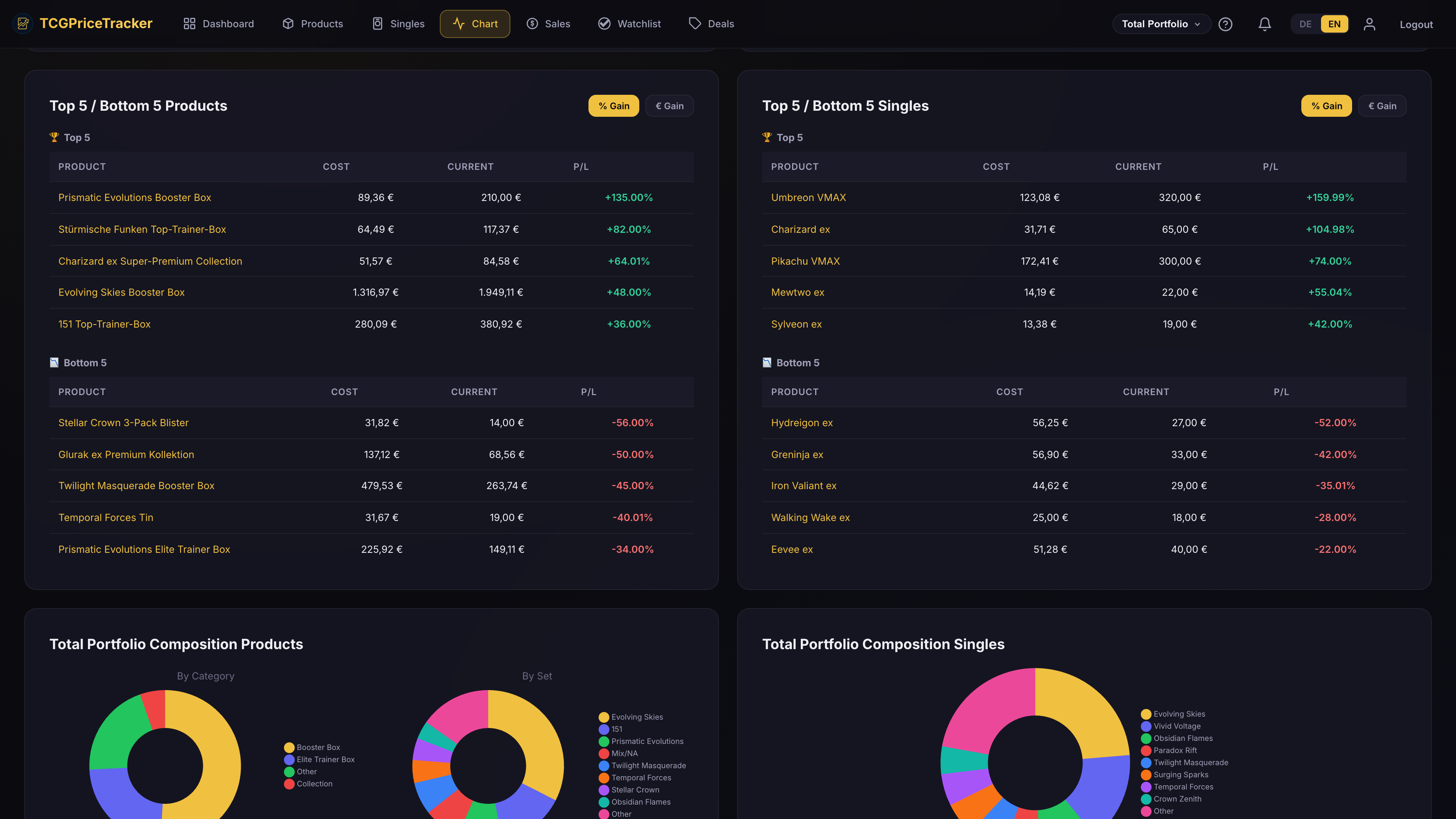
The difference to the report is the scope: here you see the market as a whole, in the tool your own cards and products — with total value, history and the development per item, valued by entry price in your cards' language and condition. How to record your collection is explained in Pokémon card value; how that turns into a lasting picture, in Trading card portfolio tracker.
Keep your collection in view
Entry price and trend per card and product, updated daily, with total value and history. Free, no credit card.
Start for free →Frequently asked questions
Are Pokémon cards going up or down right now?
In October 2026 they eased slightly: the median card lost 3.3 percent, and 57 percent of all cards got cheaper. Sealed products were practically unchanged at the median. Cards from 100 euros and cards from new sets fell the most.
How much has 30th Celebration fallen since release?
Of the tracked 30th Celebration singles, 89 of 92 got cheaper since September 18, by a median of 61 percent. The Elite Trainer Box fell in the Cardmarket trend from 165.65 euros on release day to 124.73 euros at the end of October.
Why do new sets fall after release?
The price data shows the decline, not the cause. The obvious explanation is that every wave and every restock brings more product to market, and opened packs put singles into circulation. At the previous anniversaries, prices also fell markedly in the months after release.
Are sealed products more stable than singles?
In October, yes: the median sealed product was practically unchanged, and 72 percent of products moved by less than ten percent. Singles lost 3.3 percent at the median. The big exception was the 30th Celebration products.
Why median rather than average?
Because individual rarely traded cards multiplied in price. The average in October was plus 6.4 percent, even though 57 percent of all cards got cheaper. The median describes the middle card and is not affected by such outliers.
Does this tell us what happens next?
No. A month is a snapshot, and this report deliberately contains no forecast. Trading cards are not regulated financial products; their value can fluctuate and can fall.
How is your collection doing?
Entry price and trend per card and product, updated daily, with total value and history. Start free, no credit card.
Start for free →